
President Trump’s first year back in office featured a fast-moving series of executive orders on agency cuts, immigration and a 10% tariff, triggering more than 310 federal lawsuits. In June 2025 the Supreme Court limited lower courts’ ability to issue nationwide injunctions in Trump v. CASA, pushing many plaintiffs to refile. The Court is also weighing challenges to the administration’s use of IEEPA for tariffs and a bid to narrow protections under Humphrey’s Executor, while a pivotal birthright-citizenship case is set for argument in early 2026. These decisions could significantly reshape executive, agency and judicial authority.
Courtroom Showdown: How Trump’s First-Year Executive Blitz Is Redrawing Presidential Power

Inside Trump’s first-year power plays and the court fights testing them
President Donald Trump spent the first year of his second presidential term signing a rapid succession of executive orders aimed at key campaign priorities: deep cuts to federal agency budgets and staffing, a hard-line immigration crackdown and the use of emergency authority to impose a 10% tariff on most imports.
Fast Pace, Broad Legal Pushback
The administration’s tempo on unilateral actions outpaced recent predecessors, enabling swift policy changes. That speed has also generated a wave of litigation seeking to block or pause many orders, setting up a consequential legal fight over the outer limits of presidential power under Article II and the circumstances in which federal courts should intervene.
Key Legal Battles
Litigation has targeted several of the administration’s most expansive and controversial directives: an order restricting birthright citizenship, a ban on transgender military service, sweeping agency staffing and budget reductions, and assertions of authority to federalize and deploy thousands of National Guard troops.
One early lower-court decision blocked the birthright-citizenship order for all infants, prompting fresh questions about the power of district courts to issue nationwide injunctions. Many cases remain unresolved; only a handful of second-term disputes have reached final resolution, a threshold legal experts say is critical to settling the administration’s broader agenda.
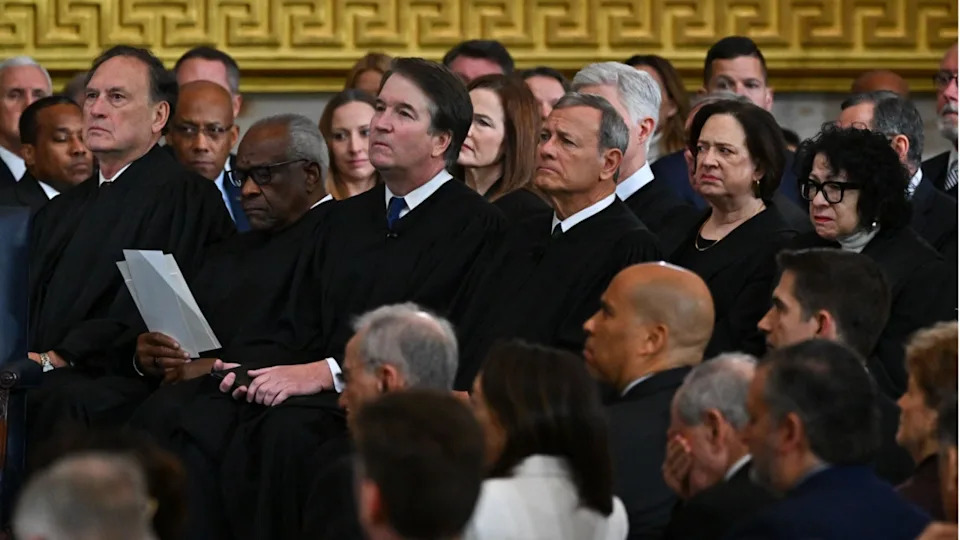
Supreme Court Justices attend the 60th inaugural ceremony Jan. 20, 2025, at the Capitol in Washington, D.C.
Supreme Court Limits Nationwide Injunctions
In June 2025, the Supreme Court issued a 6-3 decision in Trump v. CASA, focusing on the authority of district courts to issue so-called universal or nationwide injunctions blocking executive actions. Although the litigation arose from the birthright-citizenship order, the Court’s ruling largely narrowed the question to lower courts’ equitable powers rather than resolving the constitutional merits of the order itself.
U.S. Solicitor General John Sauer argued that nationwide injunctions "transgress the traditional bounds of equitable authority" and create substantial practical problems.
The ruling instructed that plaintiffs seeking relief that would apply nationwide generally should proceed through class-action procedures. That decision affected more than 310 federal lawsuits then pending that challenged early second-term orders and prompted plaintiffs to amend and refile claims in response.
Agency Removal Powers And Humphrey’s Executor
The Court also signaled receptiveness to expanding presidential control over independent agencies. In 2025 the justices paused lower-court orders reinstating two Democratic appointees — NLRB member Gwynne Wilcox and MSPB member Cathy Harris — after the administration removed them. The justices’ posture suggested they may be willing to pare back longstanding protections established in Humphrey’s Executor (1935), which limits at-will firing of certain officials serving on multi-member, congressionally created agencies.
Related litigation — including Trump v. Slaughter, about the administration’s attempt to remove an FTC commissioner without cause — and an expected dispute over the administration’s effort to remove Federal Reserve Board Governor Lisa Cook could further define or narrow those protections.
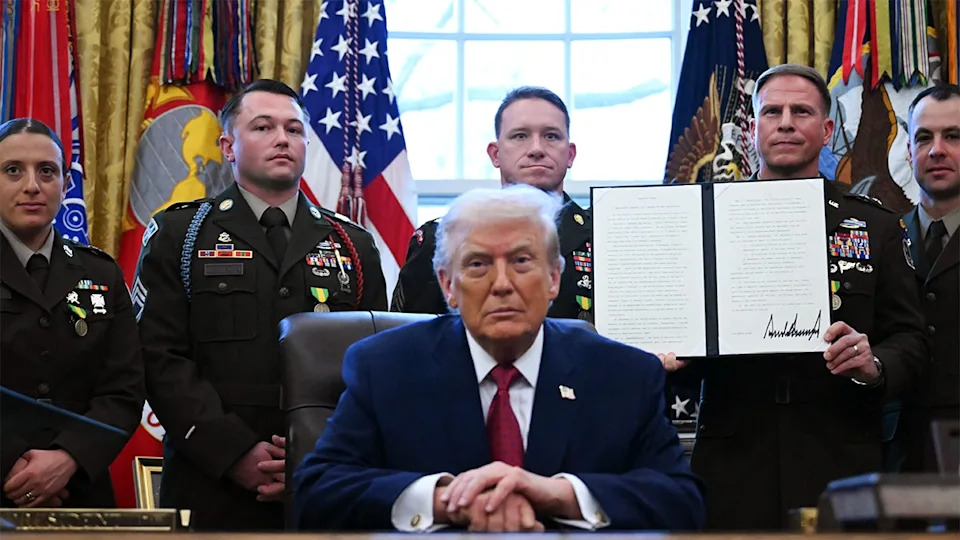
President Donald Trump signs an executive order at the White House Dec. 15, 2025, in Washington, D.C. Trump has signed more executive orders in 2025 than he did in all four years of his first presidency combined. (Getty Images)
Tariff Power Under IEEPA
The Court heard arguments in Learning Resources v. Trump, testing the administration’s use of the International Emergency Economic Powers Act (IEEPA) to justify a 10% tariff on most imports. IEEPA grants broad economic authorities during foreign-related national emergencies, but the statute does not explicitly mention tariffs or taxes — a central point of skepticism from justices across the ideological spectrum.
Court observers warned that a ruling against the administration would be a major setback for its signature trade policy, while also noting the possibility of a fractured decision that could produce a partial or practical victory for the administration.
The Birthright-Citizenship Case
The Supreme Court agreed to review the administration’s executive order seeking to restrict automatic citizenship for most children born to noncitizen parents — a move critics say would overturn roughly 150 years of precedent under the 14th Amendment. The order prompted lawsuits from dozens of states and immigrants’ rights groups and could affect an estimated 150,000 births annually to noncitizen parents and millions of American-born children living with an undocumented parent, according to Pew Research Center data.
Multiple district courts have already blocked the order from taking effect. The Supreme Court scheduled oral arguments for early 2026 (between February and April), with a decision expected by the end of June, raising the possibility of a landmark ruling on citizenship and executive authority.
Why It Matters
The legal outcomes in these cases will do more than decide specific policies: they could reshape the balance of power among the presidency, independent agencies and the federal judiciary. As the administration continues to act quickly, courts remain the primary forum for testing and (potentially) constraining those actions.
Bottom line: The Trump administration’s first-year executive blitz accelerated policy changes but also produced extensive, high-stakes litigation that may permanently redefine limits on presidential power.


