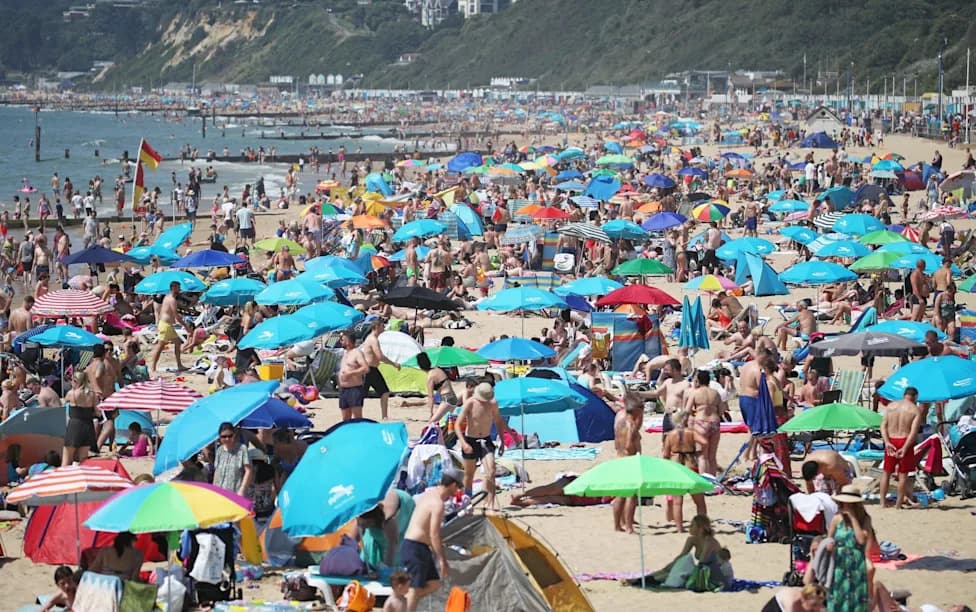
The Met Office has confirmed 2025 as the UK's hottest and sunniest year on record, with a mean temperature of 10.09°C and 1,648.5 hours of sunshine. Exceptional spring sunshine and prolonged clear summer conditions contributed to droughts, reservoir shortages, hosepipe bans and a surge in spring wildfires (over 12,400 incidents). Experts say the pattern aligns with human-induced climate change, even as renewables supplied a record ~47% of UK electricity.
2025 Confirmed As UK’s Hottest and Sunniest Year on Record

Four of Britain's last five years have been the warmest since 1884 (Paul ELLIS)(Paul ELLIS/AFP/AFP)
The Met Office has confirmed that 2025 was Britain’s hottest and sunniest year on record, calling the findings a “clear demonstration” of the impact of climate change on UK weather. The UK’s mean temperature for 2025 was 10.09°C, surpassing the previous annual record of 10.03°C set in 2022.
Records and Statistics
According to the Met Office, 2025 now ranks alongside 2022 and 2023 as the three warmest years since national records began in 1884. It is only the second year in the series where the UK’s annual mean temperature has exceeded 10.0°C. Four of the last five years now appear among the five warmest years on record, and all of the top 10 warmest years have occurred in the past two decades.
The country also recorded a record 1,648.5 hours of sunshine — 61.4 hours more than the previous sunshine record from 2003 — making 2025 the sunniest year since national sunshine records began in 1910. Spring produced an "exceptional" amount of sunshine, followed by prolonged clear skies in summer.
Weather Impacts
Persistent dry conditions and prolonged heat contributed to major impacts across the UK. Every month except January and September was warmer than average. Spring and summer were the warmest on record, while spring was the driest in more than a century.
Several regions declared droughts, some reservoir sites fell below 50% of typical capacity, and a handful of water suppliers imposed hosepipe bans. Fire services in England recorded at least 12,454 grassland, woodland or crop fires between March and May 2025 — more than four times the 2,621 incidents recorded in the same period in 2024 — the highest spring wildfire total since comparable records began in 2011.
Expert Comments
Mark McCarthy, Head of Climate Attribution at the Met Office, said the very warm year is consistent with the expected consequences of human-induced climate change and noted that while not every year will set a new record, observations and climate models show anthropogenic warming is changing the UK climate.
Bob Ward of the Grantham Research Institute at LSE described the record as "undoubtedly due to climate change" and urged deep cuts in greenhouse gas emissions to avoid escalating harm.
Emily Carlisle, Met Office scientist, explained that persistent high-pressure systems, prolonged dry sunny conditions and above-average sea temperatures combined to keep air temperatures consistently higher than normal for much of the year.
Energy and Policy Context
On the energy front, Britain produced a record share of electricity from renewables in 2025: wind, solar and biomass supplied about 47% of the country’s electricity, according to Carbon Brief. The UK has a legally binding target to reduce greenhouse gas emissions by at least 81% by 2035 (compared with 1990 levels) and aims to be carbon neutral by mid-century.
This combination of record warmth, sunlight and extreme impacts underscores the urgency policymakers and the public face as the country adapts to more frequent and intense climate-driven events.
Help us improve.