Using nearly 37 hours of continuous JWST/NIRISS observations, astronomers tracked the ultra-hot Jupiter WASP-121b (Tylos) losing atmosphere and producing two enormous helium tails that occupy almost 60% of its orbit. The helium forms both a trailing and a leading tail — a configuration current models find difficult to reproduce. The finding demands new 3D simulations to explain how radiation, stellar wind, and gravity shape atmospheric escape and how prolonged mass loss may reshape planets over time.
JWST Catches Exoplanet WASP-121b Spraying Twin Helium Tails Across 60% of Its Orbit

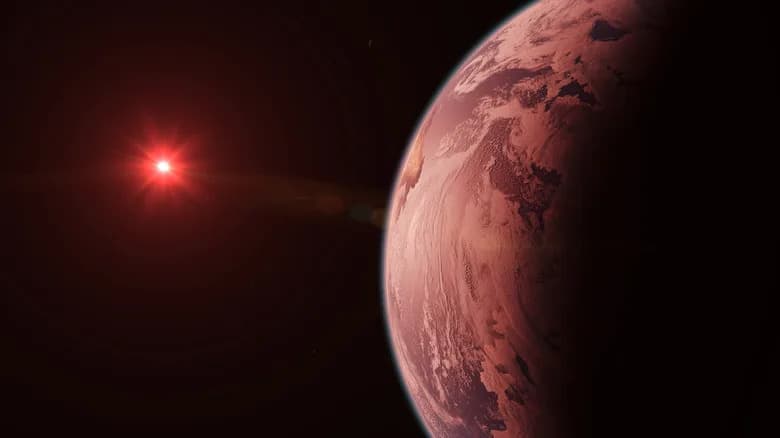
illustration of exoplanet WASP-121b, or Tylos, with its double helium tail spanning nearly 60 percent of its orbit around its parent star.
About 880 light-years from Earth, the ultra-hot Jupiter WASP-121b — nicknamed Tylos — is steadily losing its atmosphere and producing two enormous helium tails that stretch across more than half of the planet's orbit.
A Record-Breaking Continuous Observation
For nearly 37 hours straight, astronomers used the James Webb Space Telescope's Near-Infrared Imager and Slitless Spectrograph (NIRISS) to monitor WASP-121b through more than one full orbit. By tracking helium absorption at infrared wavelengths — a reliable tracer of atmospheric escape — the team captured the longest continuous record of an exoplanet shedding gas to date.
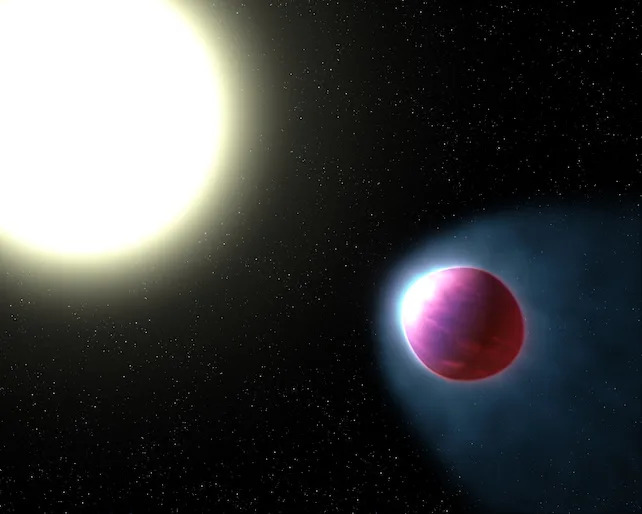
An illustration of exoplanet WASP-121b, or Tylos, and its star. (NASA, ESA, and G. Bacon/STSci)
Two Massive Helium Streams
The observations show a helium haze extending across almost 60% of the planet's orbital path. Unexpectedly, the escaping gas forms two distinct tails: one trailing behind the planet and another arcing ahead of it. Together the tails span an area more than 100 times the planet's diameter, indicating that the outflow reaches far beyond the immediate vicinity of the planet.
"We were incredibly surprised to see how long the helium outflow lasted," says lead author Romain Allart of the Trottier Institute for Research on Exoplanets and the Université de Montréal.
Why Two Tails?
Current models reproduce single tails of escaping gas but struggle to explain twin streams directed differently. The researchers suggest a mix of forces may be shaping the outflow: radiation pressure and the stellar wind could drive a trailing tail, while the star's gravity and the planet's orbital motion may draw material into a leading stream that curves ahead. More sophisticated 3D simulations and further observations will be needed to test these ideas.

Subscribe to ScienceAlert's free fact-checked newsletter
Implications for Planetary Evolution
Tylos orbits extremely close to its star (a full orbit takes roughly 30 hours) and is heated to thousands of degrees, conditions that favor escape of light gases such as hydrogen and helium. Even gradual atmospheric loss, accumulated over long timescales, can alter a planet's mass and composition — potentially transforming gas giants into smaller Neptune-like worlds or leaving behind stripped rocky cores.
"This is truly a turning point," Allart adds. "We now have to rethink how we simulate atmospheric mass loss — not as a simple flow but as a 3D geometry interacting with its star."
The study was published in Nature Communications.
Help us improve.