The immersion model suggests a supernova about three light-years away could have seeded the young solar protoplanetary disc with short-lived radionuclides (SLRs) without destroying it. Passive seeding alone cannot match SLR ratios measured in meteorites, so Ryo Sawada and collaborators propose cosmic rays from the same supernova irradiated the disc and produced additional radionuclides. This two-step process — injection plus a cosmic-ray "booster" — could explain isotopic evidence and implies Earth-like, water-poor rocky planets may be more common around sun-like stars. The model remains testable and subject to further observational and laboratory checks.
Did a Supernova Help Build Earth? A New "Immersion" Model Explains Key Isotopes

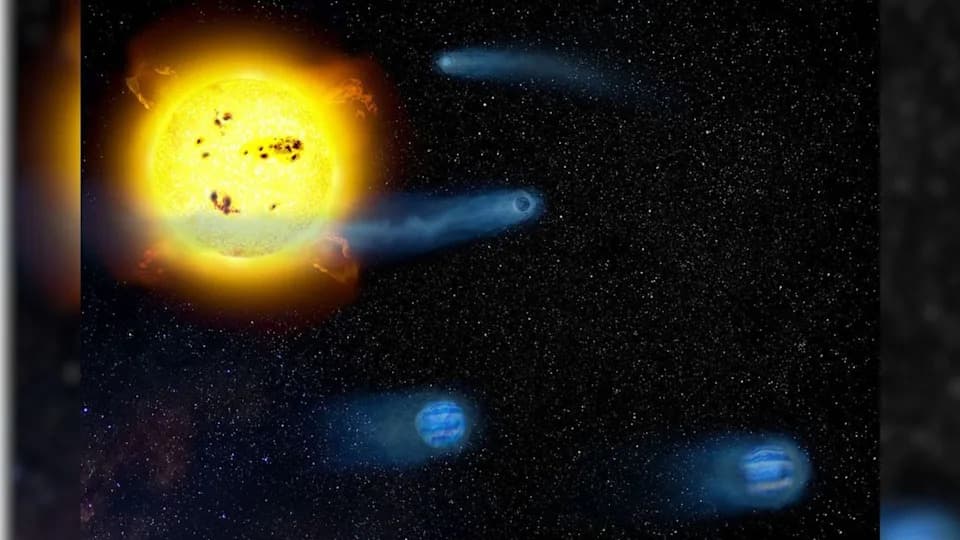
Lead image: Merikanto / Wikimedia Commons
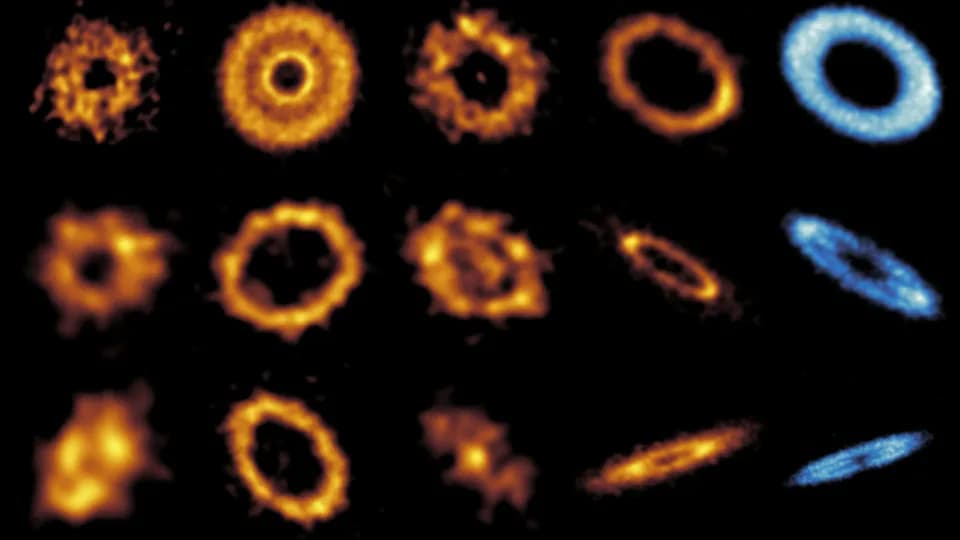
When a solar system begins, it starts as a protostar surrounded by a rotating disc of gas and dust. Over time, gravity and other forces cause the protostar to ignite and the disc material to coalesce into planets. Which kinds of planets form depends largely on distance from the young star and the chemical ingredients available in the disc.
A new study from researchers in Japan proposes that the rocky planets in our solar system — including Earth — were influenced not only by local processes inside the protoplanetary disc but also by a neighboring stellar explosion: a supernova. The team published their work in Science Advances and call their scenario the "immersion model."
Why Short-Lived Radionuclides Matter
Rocky worlds need heat during formation to drive off excess water and help their interiors differentiate. That heat can come from short-lived radionuclides (SLRs), radioactive isotopes that release energy as they decay. Meteorite studies indicate the early solar system contained specific SLR ratios, but how those isotopes arrived has been debated.
The Immersion Model And The Cosmic-Ray "Booster"
In the immersion scenario, a supernova roughly three light-years away could have gently seeded the newborn solar disc with SLRs without blasting it apart. Passive delivery of SLRs by supernova ejecta, however, does not by itself reproduce the exact isotope ratios seen in meteorites.
To fill that gap, University of Tokyo astrophysicist Ryo Sawada and colleagues propose that cosmic rays produced by the same supernova subsequently irradiated material inside the protoplanetary disc, synthesizing additional radionuclides — a kind of cosmic-ray "booster shot."
Put simply, the supernova would provide an initial injection of isotopes and high-energy particles from the explosion would then interact with gases and solids in the disc to create the remaining SLRs required by meteoritic evidence.
Implications And Caveats
The authors estimate that at least 10 percent, and possibly up to 50 percent, of sun-like stars could host protoplanetary discs with SLR abundances comparable to the protosolar disc. If correct, this raises the likelihood that Earth-like, relatively dry rocky planets form commonly across the Milky Way.
However, the immersion model is a proposed explanation, not a definitive proof. It depends on assumptions about supernova distance, cosmic-ray flux, disc structure, and isotope production efficiencies. Further tests will require improved isotopic measurements of meteorites, refined theoretical modeling, and astronomical observations of young stellar environments.
Whether or not this model becomes widely accepted, it highlights how stellar neighbors can shape planet formation and why clues preserved in meteorites remain essential for reconstructing our solar system's earliest moments.
Help us improve.