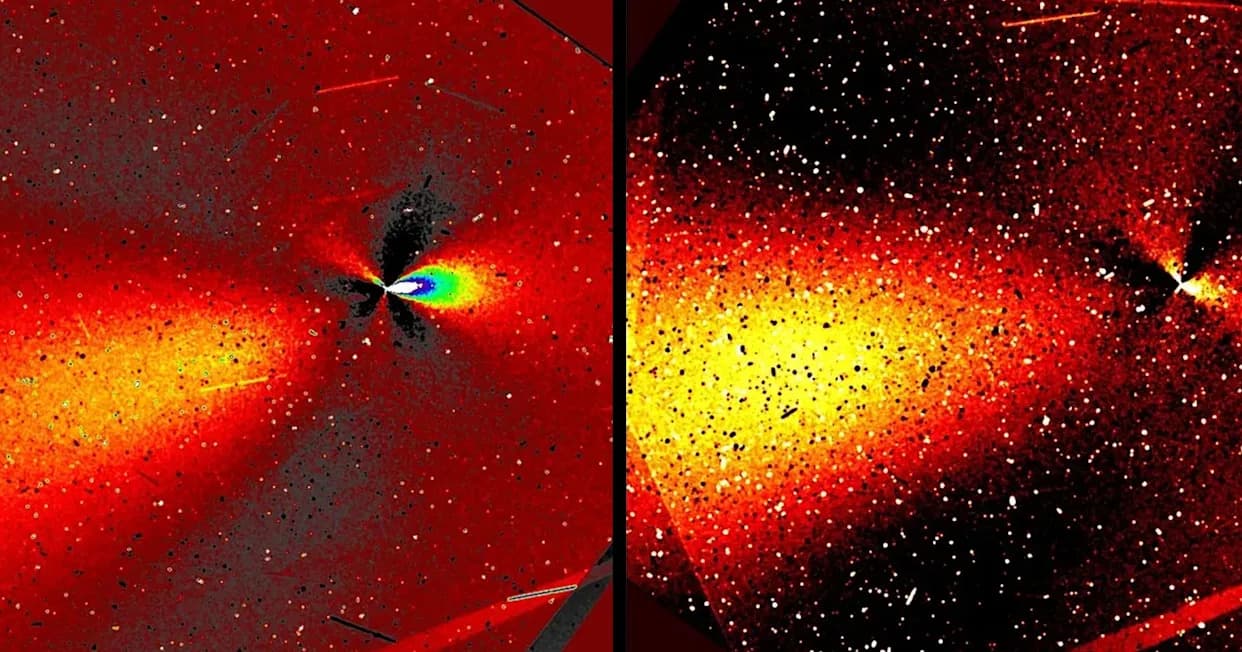
3I/ATLAS shed large jets of ice and dust at perihelion, producing a tail and an unusual anti-tail. Observations from Spain's Joan Oró Telescope reveal narrow jets and point to possible cryovolcanism on the nucleus. Researchers suggest sublimating CO2 reacting with interior metals may power these eruptions, though the object's size remains uncertain (estimates range from ~1,400 ft to 3.5 miles). The object will make its closest approach to Earth later this month, providing a rare chance to study interstellar material.
Interstellar Visitor 3I/ATLAS May Be Erupting Ice Volcanoes — Jets, Anti-Tail, and Cryovolcanism Observed

3I/ATLAS, an interstellar object that passed through perihelion earlier this year, released substantial plumes of ice and dust and produced both long jets and an unusual anti-tail. New observations suggest the nucleus may be experiencing cryovolcanic activity — eruptions of volatile ices rather than molten rock — similar to phenomena seen on trans-Neptunian objects from the outer Solar System.
What researchers observed
Using the Joan Oró Telescope at the Montsec Observatory in Spain, a team led by Josep Trigo-Rodríguez captured high-resolution images around the object's late-October perihelion, when heating from the Sun typically drives strong outgassing. The images show multiple narrow jets of gas and dust streaming from the nucleus, forming a broad tail and an apparent anti-tail that seems to point sunward.
Possible cryovolcanic mechanism
In a paper that is not yet peer reviewed, the team proposes that sublimating carbon dioxide ice inside 3I/ATLAS could react with metallic compounds such as nickel and iron sulfides in the interior. Those reactions may produce oxidation energy that helps drive cryovolcanic eruptions, ejecting gas and entrained dust into space. If confirmed, this chemistry-driven activity would make 3I/ATLAS resemble some trans-Neptunian objects, which also show evidence of cryovolcanism.
Josep Trigo-Rodríguez, lead author and researcher at the Institute of Space Sciences (Spain), said the similarity to distant Solar System bodies was surprising and notable given 3I/ATLAS' likely origin in another stellar system.
Open questions and the research opportunity
Many uncertainties remain. The object's mass and precise size are not known; current estimates place its diameter anywhere between roughly 1,400 feet and about 3.5 miles. 3I/ATLAS is expected to make its closest approach to Earth later this month and will pass near Jupiter in March 2026, offering a rare chance to study material from another planetary system.
The researchers emphasize that direct intercept and sampling missions would be invaluable for testing these hypotheses and revealing the chemical record carried by interstellar visitors. Each such object challenges and refines our models of planetary-system formation and the evolution of small bodies.
Help us improve.