A reanalysis of 15 years of NASA Fermi telescope data reveals a halo-like gamma-ray signal near the Milky Way’s center that the authors say matches predictions for annihilating WIMPs at ~20 GeV. The inferred particle mass is roughly 500 times that of a proton, implying a particle beyond the Standard Model if confirmed. Experts urge independent verification—especially searches for the same signature in dwarf galaxies—before the claim is accepted.
Astronomers Report Possible First Detection of Dark Matter from Fermi Gamma-Ray Halo

A team of astronomers is reporting a possible first detection of dark matter, based on a halo-shaped gamma-ray signal observed near the center of the Milky Way. The results, published in the Journal of Cosmology and Astroparticle Physics, come from a reanalysis of 15 years of observations by NASA’s Fermi Gamma-ray Space Telescope.
Visible, or baryonic, matter—the planets, stars and gas we can see—cannot by itself explain the formation and stability of galaxies. Cosmologists infer an additional, unseen component that outweighs ordinary matter by roughly five-to-one and influences cosmic structure through gravity: dark matter. Its elusive nature makes direct detection extremely challenging.
One leading hypothesis is that dark matter consists of weakly interacting massive particles (WIMPs). WIMPs are predicted to be heavier and slower than ordinary particles and to form extensive haloes around galaxies. Importantly, if WIMPs have corresponding antiparticles, their mutual annihilation should produce high-energy gamma rays. Detecting such gamma-ray signatures—while ruling out all other astrophysical sources—would be strong evidence for particle dark matter.
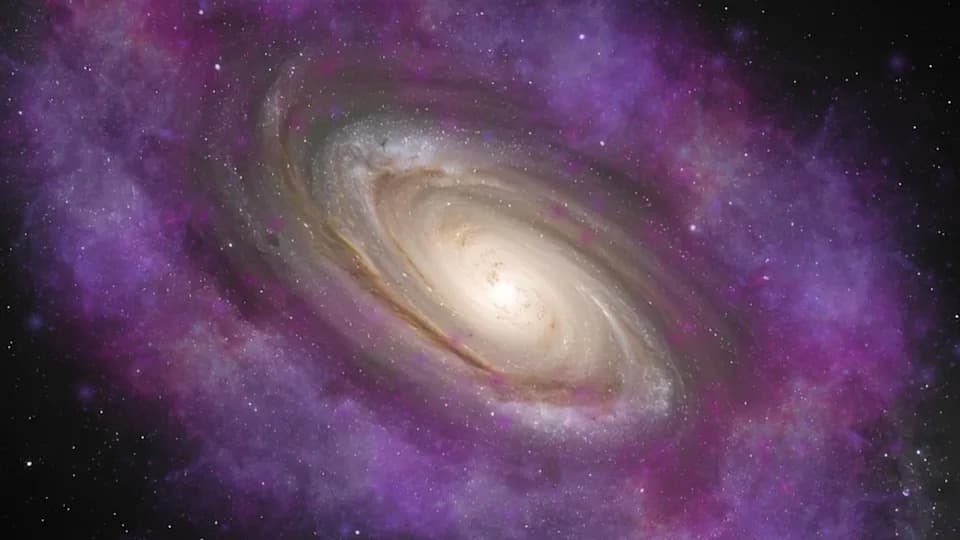
In this study the team searched an under-studied region near the Galactic center and identified a halo-like distribution of gamma rays peaking around 20 gigaelectronvolts (20 GeV). According to the authors, the spatial shape and intensity of the emission match theoretical expectations for WIMP annihilation and point to particle masses on the order of 500 times the proton mass. If true, this would imply a new particle beyond the Standard Model of particle physics.
“This could be a crucial breakthrough in unraveling the nature of dark matter,” said Tomonori Totani of the University of Tokyo, the paper’s lead author.
Other experts urge caution. Kinwah Wu, a theoretical astrophysicist at University College London, praised the careful analysis but emphasized that extraordinary claims require extraordinary evidence. The gamma-ray sky is crowded—supernova remnants, pulsars and other energetic sources can mimic similar signals—and systematic uncertainties must be thoroughly excluded.
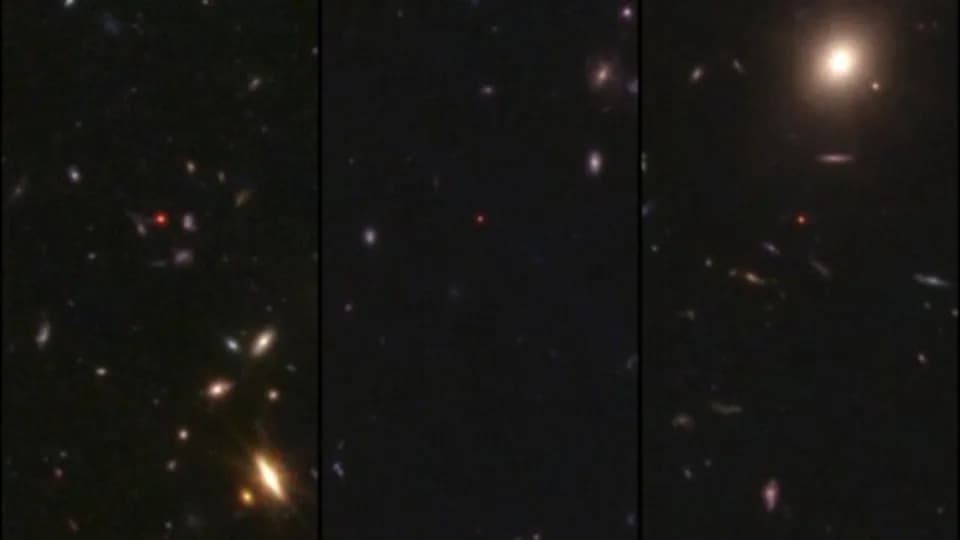
The authors propose definitive cross-checks, such as detecting the same spectral shape in dwarf spheroidal galaxies that orbit the Milky Way. Those satellites have high dark-matter fractions and little other high-energy activity, making them ideal testbeds. Independent analyses of the Fermi data and new observations will be essential before the result can be accepted as a convincing detection.
For now, the claim is a provocative data point in the long, global hunt for dark matter. It has galvanized interest and will prompt follow-up studies that could either corroborate a major discovery or identify an alternative astrophysical explanation.
Help us improve.