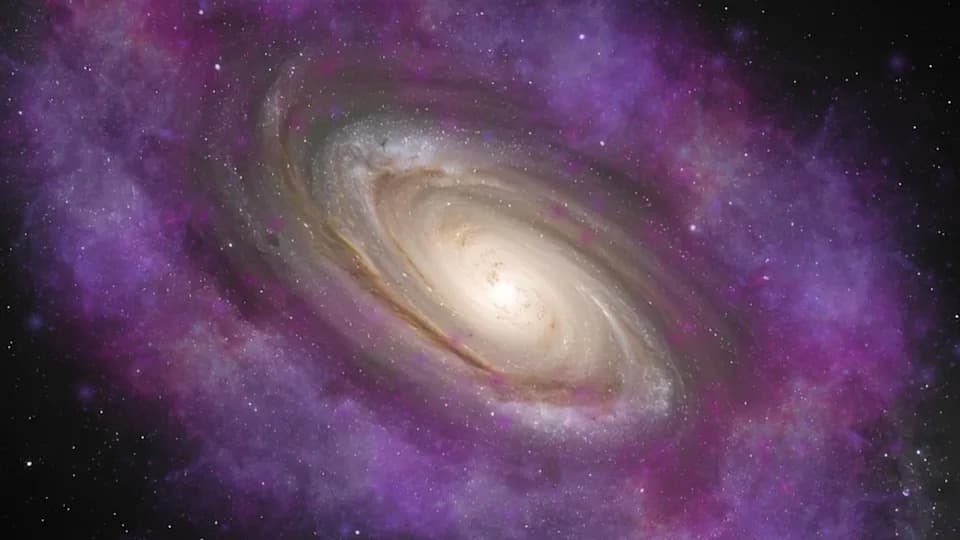
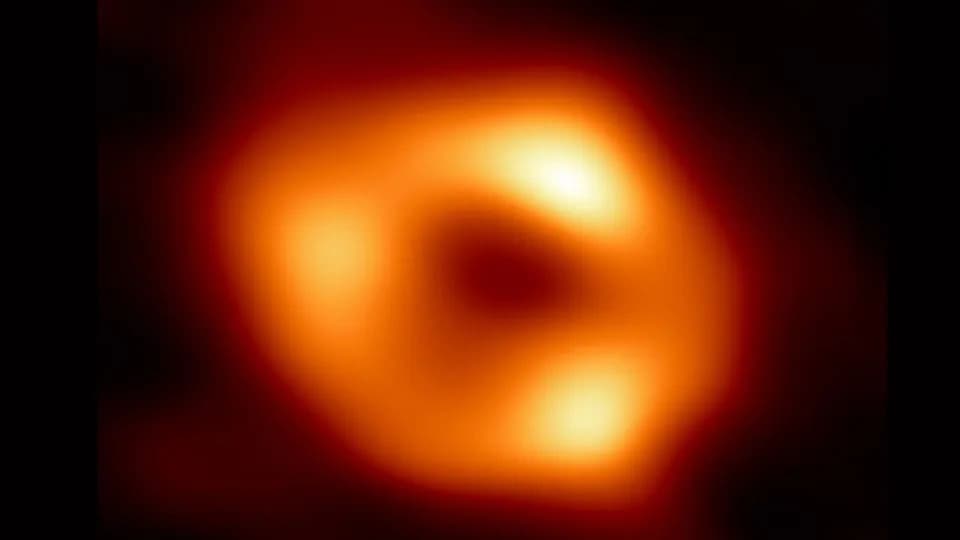
Researchers examining NASA Fermi gamma-ray data report a halo of ~20 GeV gamma rays extending toward the Milky Way’s center that matches predictions for WIMP dark-matter annihilation. WIMPs are hypothetical heavy particles that could annihilate to produce energetic gamma rays. The reported spectral and spatial features are difficult to explain with common astrophysical sources, but the authors stress independent verification is required. If confirmed, the finding would imply a new particle beyond the Standard Model and mark a major advance in dark-matter research.
Astronomers Report Possible Dark Matter Signal at the Milky Way’s Center

A team of researchers analyzing data from NASA’s Fermi Gamma-ray Space Telescope reports a gamma-ray emission feature that could be the first observational hint of dark matter inside our own galaxy.
Dark matter is an unseen substance thought to make up roughly 85% of the matter in the universe, with ordinary atoms — the stuff that forms planets, stars and people — accounting for the rest. It is inferred from its gravitational effects: without dark matter, galaxies and clusters would not hold together or rotate as observed. Because dark matter appears not to interact electromagnetically, it neither emits nor reflects light and cannot be seen directly with conventional telescopes.
The concept of dark matter dates back to Fritz Zwicky’s 1933 study of the Coma Cluster, which revealed a gravitational discrepancy that visible matter alone could not explain. In the 1970s, Vera Rubin’s measurements of galaxy rotation curves provided compelling additional evidence, moving the idea into mainstream astrophysics. Despite strong indirect evidence, the particle nature of dark matter remains unknown.
Researchers have proposed many candidates, from axions to primordial black holes. One widely studied possibility is a class of hypothetical particles called Weakly Interacting Massive Particles (WIMPs). If WIMPs exist, they would be relatively heavy and slow-moving and could annihilate when they collide, producing other particles including high-energy gamma-ray photons.
A new paper in the Journal of Cosmology and Astroparticle Physics examines Fermi data from the inner region of the Milky Way and reports a gamma-ray signal near 20 gigaelectronvolts (GeV) forming a halo-like structure toward the Galactic center. "We detected gamma rays with a photon energy of 20 gigaelectronvolts, extending in a halo-like structure toward the center of the Milky Way galaxy," said study author Tomonori Totani. "The gamma-ray emission component closely matches the shape expected from the dark matter halo."
The signal’s energy spectrum and spatial distribution are reported to be consistent with expectations for WIMP annihilation and are not easily explained by common astrophysical sources, according to the authors. If this interpretation is correct, it would imply a particle beyond the current Standard Model of particle physics and represent a major breakthrough in both astrophysics and particle physics.
However, the authors and independent experts emphasize caution. Galactic-center gamma-ray data are complex, with many overlapping sources (pulsars, supernova remnants, cosmic-ray interactions and other processes) that can mimic or obscure subtle signals. Independent analyses, additional observations, and cross-checks with other instruments and detection methods will be needed to confirm or refute the dark matter interpretation.
If validated, the result would open a new chapter in dark-matter research and deepen our understanding of the cosmos. For now, the reported 20 GeV gamma-ray halo is an intriguing and provisional clue that warrants close scrutiny by the scientific community.
Help us improve.