MRO was rolled 120° so its SHARAD radar could directly probe a 12.5-mile area beneath roughly 1 mile of south polar ice. A May overflight returned only a faint echo, undermining the 2018 interpretation that the bright radar reflection indicated a subglacial lake. The result narrows possible explanations and highlights the value of the flip maneuver for future subsurface studies.
MRO's 120° Flip Weakens Case for a Subglacial Lake at Mars' South Pole

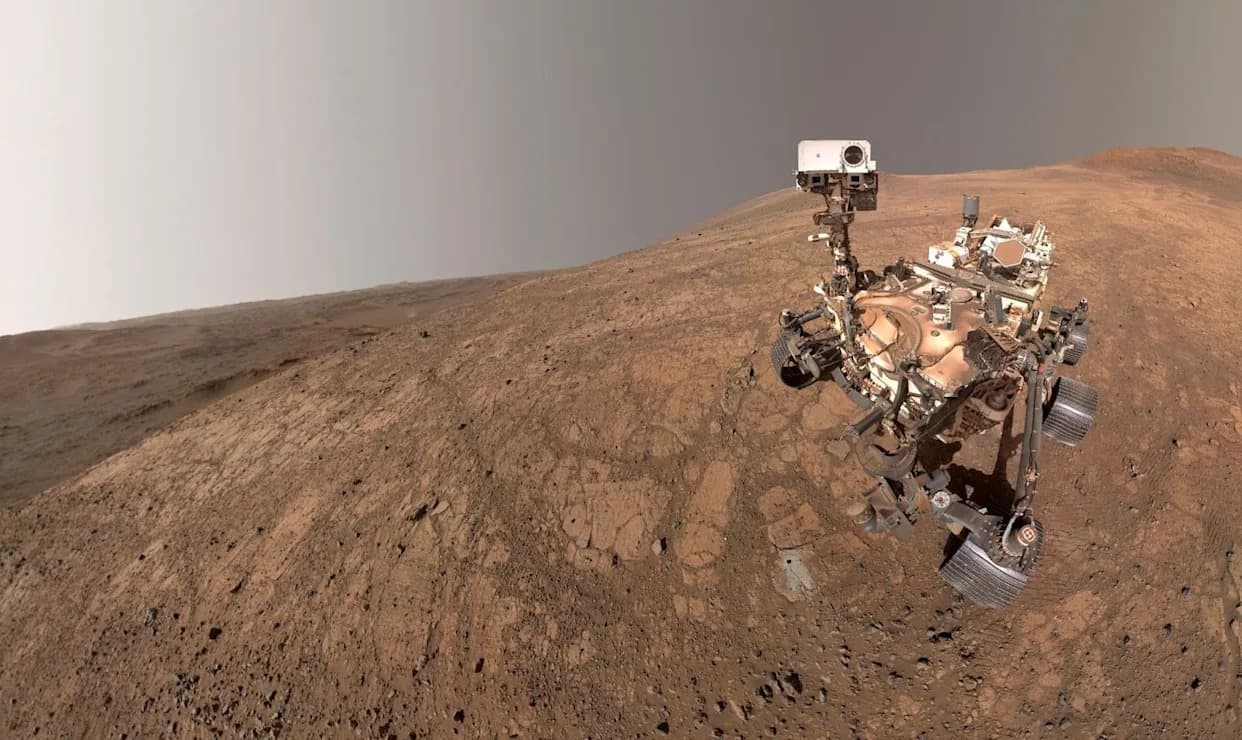
Planetary scientists have new evidence that casts doubt on a high-profile 2018 claim of liquid water beneath Mars' south polar ice. Engineers commanded the Mars Reconnaissance Orbiter (MRO) to roll 120° so its Shallow Radar instrument (SHARAD) could directly image a suspected subsurface reflector, and the results were far weaker than expected for a lake.
The original 2018 detection by a different spacecraft found unusually bright radar echoes beneath the south polar cap, a signal some researchers interpreted as consistent with a modern subglacial lake. Confirming liquid water on present-day Mars would have major scientific implications, so teams sought independent verification.
SHARAD is mounted on the rear of MRO, and the spacecraft's normal orientation blocked a direct radar view of the exact target area. To overcome that limitation, engineers at the Jet Propulsion Laboratory and Lockheed Martin uploaded a sequence of commands to roll the orbiter 120°—effectively flipping it—allowing SHARAD to probe a roughly 12.5-mile (20-kilometer) diameter region buried beneath about 1 mile (1.6 kilometers) of ice.
If a liquid interface were present, scientists expected a strong, bright radar return from the reflective boundary between ice and water. Instead, a SHARAD pass in May produced only a very faint echo, significantly weakening the interpretation of a subglacial lake and suggesting the reflector has different physical properties than liquid water would produce.
"A different very-large-roll observation of an adjacent area didn't detect a signal at all, suggesting something unique is causing the quirky radar signature," said Than Putzig, SHARAD instrument scientist at the Planetary Science Institute.
These new measurements, reported on Nov. 17 in Geophysical Research Letters, do not close the case. Rather, they narrow the range of plausible explanations for the original bright echoes and point researchers toward alternative hypotheses—such as unusual rock, salt-rich ice, layering effects, or local scattering conditions—that could mimic a strong radar reflection.
Beyond this specific mystery, the flip maneuver demonstrates a useful technique for future targeted radar surveys. By changing the spacecraft orientation, SHARAD can access previously obscured areas, enabling follow-up observations that may resolve the nature of buried ice and other subsurface materials across Mars.
Help us improve.