Professor Tomonori Totani reanalyzed NASA Fermi gamma-ray data and reports a pattern that aligns with the predicted shape of the Milky Way’s dark matter halo and a particle mass around 500 times that of a proton. The full study appears in the Journal of Cosmology and Astroparticle Physics, but the result remains preliminary. Key tests—especially finding the same spectral signature in dwarf galaxies—are needed for confirmation, and experts urge caution.
Possible Dark Matter Signal Found in Fermi Gamma-Ray Data — Promising but Unconfirmed

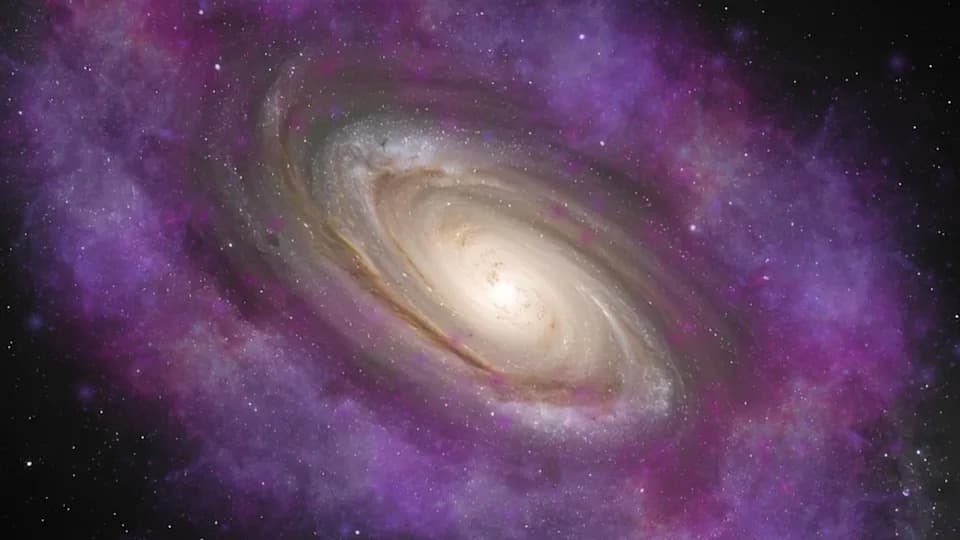
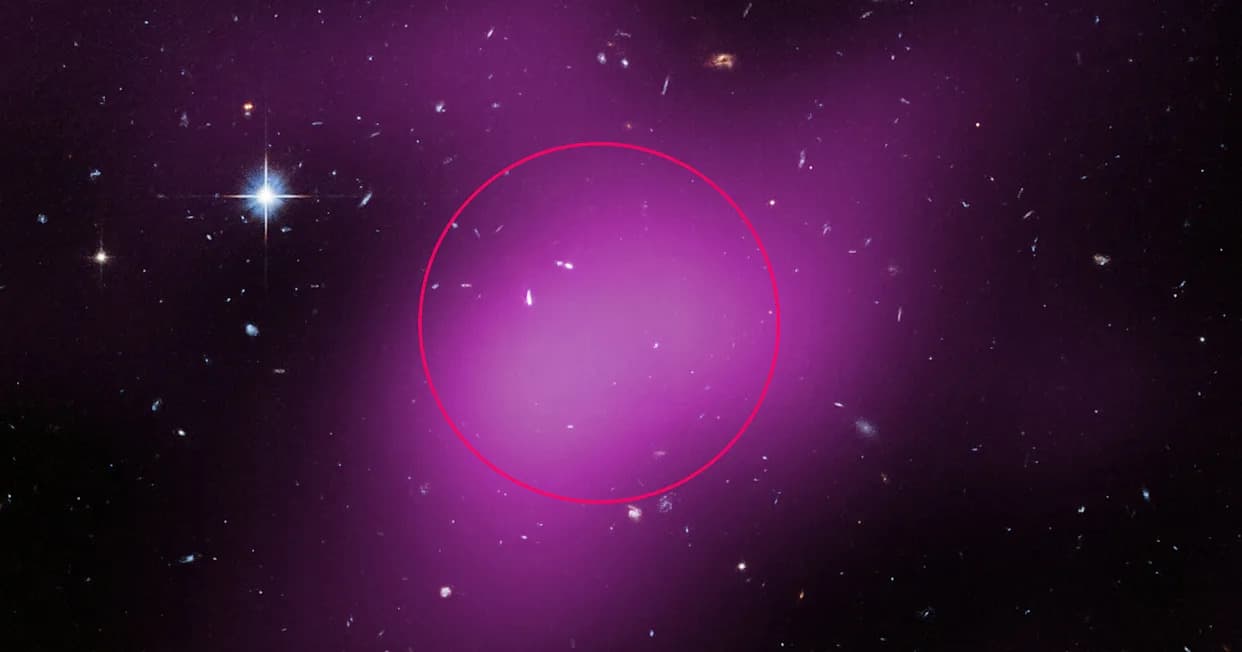
After nearly a century of searching, researchers report a new, intriguing gamma-ray pattern that could be the first direct sign of dark matter. Professor Tomonori Totani of the University of Tokyo reanalyzed data from NASA’s Fermi Gamma-ray Space Telescope and identified an emission whose spatial distribution matches the expected shape of the Milky Way’s dark matter halo.
What was observed
Totani’s study finds a distinct gamma-ray signal concentrated around the Galactic center with a spectrum consistent with theoretical predictions for the annihilation of Weakly Interacting Massive Particles (WIMPs). From the observed radiation, the analysis infers that, if the signal is from dark matter, the particles would have masses roughly 500 times that of a proton.
Why this matters
Dark matter was first proposed in the 1930s to explain anomalous galactic rotation rates. For decades, experiments—ranging from underground detectors to particle colliders—have searched for the particles responsible without a clear detection. A confirmed gamma-ray signature tied to dark matter annihilation would be a major breakthrough in cosmology and particle physics.
Scientific caution and next steps
Totani has published his full analysis in the Journal of Cosmology and Astroparticle Physics. He emphasizes that the decisive test will be finding the same gamma-ray spectrum in other dark matter–dominated systems, such as dwarf galaxies. Reproducing the signature elsewhere would strengthen the dark matter interpretation.
“The detected emission closely matches the properties of gamma-ray radiation predicted to be emitted by dark matter,” Totani says.
However, several experts urge restraint. Professor Justin Read (University of Surrey) notes that dwarf galaxies—expected to be relatively clean laboratories for dark matter—have not shown comparable signals, which complicates the annihilation explanation. Professor Kinwah Wu (University College London) likewise warns that extraordinary claims require extraordinary evidence and that the analysis is encouraging but not definitive.
Bottom line
This result is an intriguing and potentially important development, but it is not yet conclusive. Further independent analyses of Fermi data, targeted observations of dwarf galaxies, cross-checks at other wavelengths, and confirmation with different instruments are required before the community can accept a dark matter detection.
Help us improve.