Kip Thorne, Nobel laureate and a driving theoretical force behind LIGO, spoke at BYU about the decades-long effort that led to the 2015 detection of gravitational waves and the 2017 Nobel Prize. He traced the project’s evolution from early skepticism to a global collaboration and described how numerical relativity made signal interpretation possible. Thorne outlined ambitious next steps — Cosmic Explorer, Einstein Telescope, LISA, pulsar timing arrays and CMB polarization studies — and suggested upcoming observations of primordial gravitational waves could challenge the inflationary Big Bang model, potentially sparking a major shift in cosmology.
Kip Thorne at BYU: How LIGO Confirmed Einstein and What's Next for Gravitational-Wave Astronomy

About 1.3 billion years ago, two black holes in a distant galaxy merged in a violent collision that sent ripples through space-time. Those ripples — gravitational waves predicted by Albert Einstein in 1916 — traveled across the cosmos and were finally recorded on Earth on Sept. 14, 2015, by the Laser Interferometer Gravitational-Wave Observatory (LIGO).
At a packed lecture at Brigham Young University, Nobel laureate Kip Thorne recounted the long path from a skeptical conversation in the early 1970s to the era of routine gravitational-wave astronomy. A small group of physicists at MIT, Caltech and elsewhere, including Rainer Weiss and Thorne, began exploring detector concepts in 1972. Over four decades that effort grew into an international collaboration of roughly 1,000 scientists and engineers and culminated in the first direct detection of gravitational waves — recorded first at LIGO’s Livingston, Louisiana facility and seven milliseconds later at its Hanford, Washington station. The observation confirmed Einstein’s prediction and opened a new window on the universe.
From doubt to discovery
Thorne told the audience he was initially skeptical of the detector idea proposed by Rainer Weiss but, after years of study and discussion, committed his time and the efforts of his students to the project. He later stepped back from day-to-day operations in 2001 to lead supercomputer efforts that numerically solved Einstein’s general-relativity equations, producing the templates needed to interpret LIGO’s signals.
For their central roles, Rainer Weiss, Kip Thorne and Barry Barish shared the 2017 Nobel Prize in Physics. Thorne has consistently acknowledged the thousands of collaborators whose work made detection possible and has argued the achievement was truly a team effort.
Why it matters
Gravitational waves carry information that electromagnetic observations cannot, revealing collisions of black holes, neutron star mergers and other extreme events. Thorne emphasized that we are only at the beginning of gravitational-wave and multi-messenger astronomy — the coordinated study of events using both gravitational and electromagnetic signals — and that combining these channels will profoundly expand our knowledge of the cosmos.
Looking ahead: bigger detectors and new frequency bands
Current LIGO interferometers use two perpendicular arms each 4 kilometers long. Planned next-generation ground observatories aim to be vastly larger: the U.S. Cosmic Explorer concept envisions 40-kilometer arms, and Europe’s Einstein Telescope proposes a similarly ambitious facility. These would extend sensitivity and reach, allowing detection of fainter and more distant sources.
Complementing ground-based interferometers, astronomers expect three other detector classes to operate across different frequency bands in the coming decades:
- LISA — a space mission of three spacecraft linked by lasers that will search for gravitational waves with periods of minutes to hours.
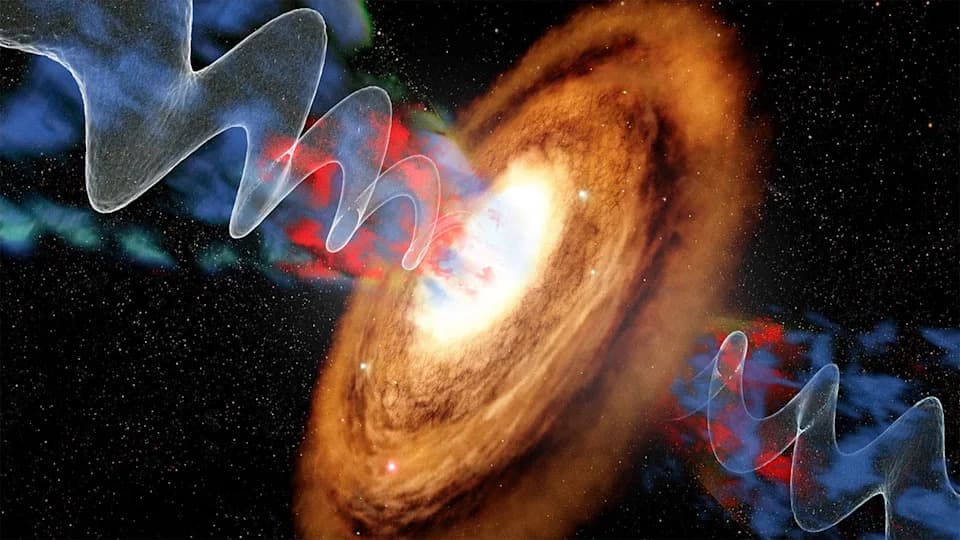
- Pulsar timing arrays — networks of radio telescopes monitoring millisecond pulsars; their precise timing is sensitive to waves with multi-year periods and has already reported signals consistent with a background produced by supermassive black-hole binaries.
- Cosmic microwave background (CMB) polarization studies — searches for primordial gravitational waves imprinted as characteristic polarization patterns on the oldest light in the universe, probing enormous periods and the earliest moments after the Big Bang.
Thorne also discussed longer-term plans: a mid-century successor to LISA might consist of an expanded constellation of spacecraft capable of detecting primordial gravitational waves at shorter periods, potentially providing direct tests of early-universe theories.
“I speculate that this beautifully simple theory, called inflation, will be proved wrong in the coming few decades by observations of primordial gravitational waves,” Thorne told the BYU audience. He added that overturning inflation would trigger a profound revolution in cosmology.
Beyond the lecture hall
Thorne’s influence extends into popular culture: he served as a science consultant for the film Interstellar, helping to shape its realistic portrayal of black holes and gravitational physics. Speaking to students, faculty and community members at BYU, he encouraged continued curiosity and investment in both theory and experiment.
As gravitational-wave astronomy matures, new observatories and complementary techniques promise to map the universe in previously inaccessible ways — testing fundamental physics, revealing the population of black holes across cosmic time, and probing the physics of the very early universe.
Help us improve.