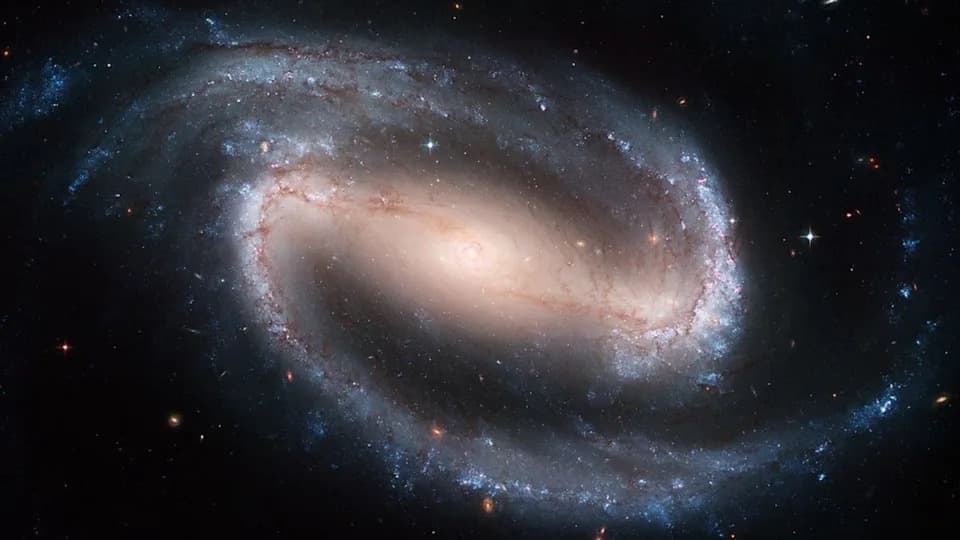
NGC 2775 resists easy classification: it combines a large, smooth central bulge like an elliptical galaxy with a dusty outer ring of star clusters typical of spirals. Located about 67 million light‑years away in Cancer, it also has a hydrogen tail stretching nearly 100,000 light‑years, likely the remnant of past mergers. For now most researchers call it a flocculent spiral, but further multiwavelength observations are needed to determine its true nature.
NGC 2775: A Galaxy That Defies Classification

Picture a galaxy: stars sparkling amid swirls of dust and gas. The Hubble Space Telescope's recent image of NGC 2775, about 67 million light‑years away in the constellation Cancer, challenges that familiar picture by blending features normally assigned to different galaxy types.
NGC 2775 has a large, smooth central bulge that looks much like an elliptical galaxy, yet surrounding that calm core is a dusty ring of outer star clusters more typical of spiral systems. That combination makes a simple, unanimous classification difficult.
How astronomers classify it
Traditional schemes such as the Hubble sequence and the more detailed de Vaucouleurs system expect clear categories (elliptical, spiral, lenticular), but NGC 2775 blurs those boundaries. Some researchers describe it as elliptical, others as spiral, and many consider its mixed traits consistent with a lenticular galaxy — an intermediate class whose origins are still debated. At present, the majority favor labeling it a flocculent spiral, meaning its spiral arms are patchy and discontinuous rather than well defined.
Evidence of a turbulent past
One important clue is a faint hydrogen gas tail extending nearly 100,000 light‑years from the galaxy. Although this structure is not prominent in Hubble's optical image, it likely represents leftover debris from past mergers with smaller galaxies — events that could have reshaped NGC 2775 and produced its hybrid appearance.
To settle the question conclusively, astronomers will need deeper, multiwavelength observations. Infrared and radio data can reveal faint stellar streams and gas dynamics, while spectroscopy can probe the motions of stars and gas to reconstruct the galaxy's history.
Bottom line: NGC 2775 is a compelling reminder that galaxies often resist neat labels. Its mixed morphology and extended hydrogen tail make it a valuable target for astronomers studying how interactions and mergers shape galaxy evolution.
Help us improve.