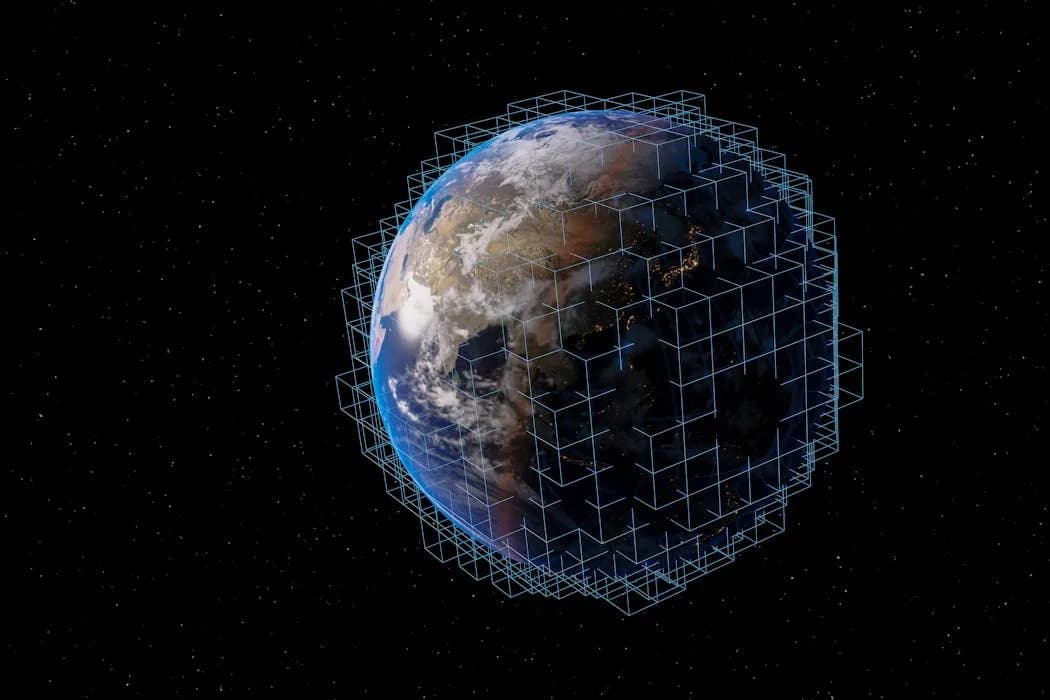
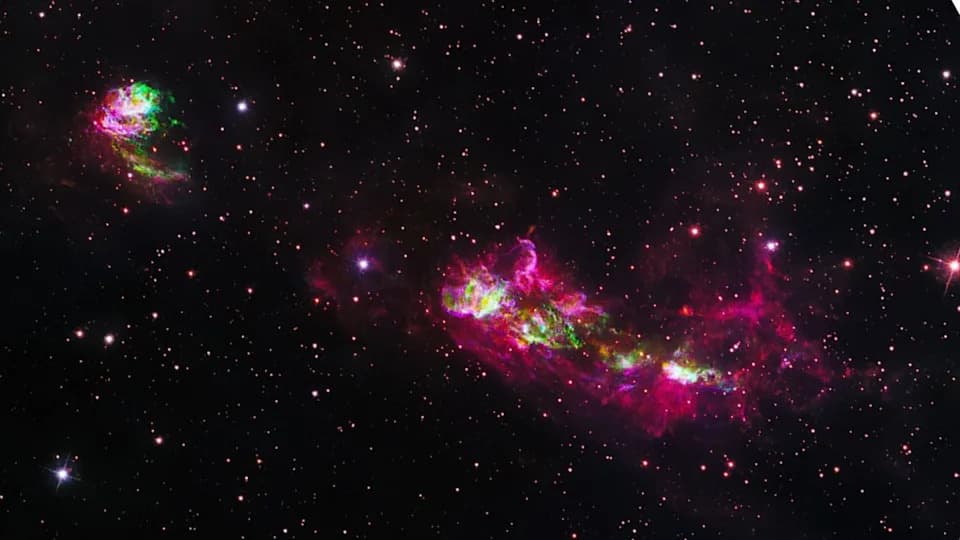
Alcubierre’s 1992 insight launched a serious scientific debate about warp drives. His metric envisions a bubble that contracts space ahead and expands it behind, allowing apparent faster-than-light travel while keeping the ship locally at rest. Early models demanded impractical amounts of negative energy, but subsequent work — from Krasnikov, Van Den Broeck and Natário to recent sublight, non-exotic proposals by Martire, Bobrick, Fuchs and Helmerich — has reduced or eliminated exotic requirements. Researchers are now building toolkits and exploring detection strategies (including gravitational-wave signatures), moving the topic from science fiction toward structured, testable theory.
From Star Trek to Science: How Warp Drive Went From Fiction to a Testable Theory

In 1992 a young PhD student named Miguel Alcubierre watched Star Trek: The Next Generation and turned a late-night thought experiment into a mathematical one. Inspired by the show’s fictional warp drive, he asked whether Einstein’s general relativity could be used to shape space-time so a ship could be carried between two points faster than light would travel through ordinary space. His answer — a theoretical "warp bubble" — sparked three decades of debate, refinement and new approaches to interstellar propulsion.
How a warp bubble would work
Alcubierre’s 1994 paper proposed a metric in which a region of flat space-time (a bubble) is surrounded by manipulated space that contracts in front and expands behind. From the ship’s frame the vessel stays locally at rest inside the flat region; from an outside viewpoint, the bubble carries it across vast distances faster than light without locally breaking relativity. A common analogy is a taut bedsheet deformed by mass: warp-drive physics manipulates that sheet so the ship rides a moving distortion.
The central obstacle: exotic energy
The original Alcubierre solution required "negative energy" or exotic matter in quantities that were effectively astronomical — initially comparable to the mass of the observable universe. While quantum effects like the Casimir effect can produce extremely small negative-energy regions in laboratory settings, those amounts are tiny compared with what Alcubierre’s first calculations demanded. That gulf made the idea physically intriguing but practically impossible with current understanding.
Decades of refinement
Researchers refined, reimagined and critiqued the warp concept. Notable milestones include:
- Serguei Krasnikov (1995): proposed a "warp tube" to solve the horizon problem (how to steer a superluminal bubble), effectively pre-building navigable corridors through distorted space-time.
- Chris Van Den Broeck (1999): showed that shrinking the bubble’s surface area could dramatically reduce negative-energy requirements (down to a few solar masses in his model).
- José Natário (2001): described a "zero-expansion" sliding bubble that avoids the contracting/expanding mechanism, changing the underlying kinematics.
- Richard Obousy & Gerald Cleaver (2008): explored manipulating extra dimensions and vacuum energy to lower exotic-energy needs (to roughly Jupiter-scale masses in their construction).
From thought experiment to structured research
Interest moved from fringe to more formal research in the 2010s. Harold "Sonny" White, while at NASA’s Eagleworks Advanced Propulsion Physics Laboratory, published "Warp Field Mechanics 101" and explored geometries that reduced energy-density requirements by changing the bubble shape and field dynamics. White and collaborators publicized designs (including an IXS Enterprise concept) and argued that careful optimization could reduce energy demands by many orders of magnitude.
Sublight and non-exotic approaches
More recently the focus has expanded beyond exotic solutions. Gianni Martire and Alexey Bobrick (2021) proposed warp metrics that avoid negative energy entirely by limiting speeds to subluminal values — roughly 10% of light speed (about 18,600 miles per second). Their "crawl before you walk" approach emphasizes experimentally feasible steps. Inspired grants seeded further work: Jared Fuchs and Christopher Helmerich (2024) presented warp constructions that satisfy the classical energy conditions (null, weak, strong, dominant), and made tools such as the publicly available Warp Factory for researchers to test metrics against known physics.
Could we detect someone else’s warp drive?
British astrophysicist Katy Clough explored whether gravitational-wave detectors could spot a collapsing warp bubble or "warp core breach." Using simulation techniques from black hole physics, she modeled a breach from a craft traveling at ~10% of light speed and showed that, in principle, instruments could register such an event within about one megaparsec if the frequency band were right. However, the simulated signal peaks near ~300 kHz — far above the sensitivity range of current detectors like LIGO and the planned low-frequency LISA mission. Detecting warp breaches would require high-frequency gravitational-wave instruments, which might also serve other scientific goals (for example, searches for primordial or very small black holes).
Why this research matters
Beyond the romance of interstellar travel, many researchers justify long-term work on warp-like concepts as preparation for humanity’s deep future. Models and surveys suggest there may be hundreds of millions of potentially habitable worlds in our galaxy, and a handful of so-called "superhabitable" candidates; yet travel with conventional propulsion is effectively prohibitive. Long-term astronomical evolution also motivates planning: increasing solar luminosity could disrupt Earth’s biosphere within roughly 600 million years, and in billions of years the Sun will become a red giant. If humanity hopes to be a multi-planetary or interstellar species in the far future, breakthroughs in propulsion or space-time engineering may eventually be required.
The long view
Alcubierre’s original paper helped catalyze a field that today spans speculative concepts, serious theoretical constraints and practical tool-building. Whether the result will ever be a true warp drive, a sublight "space-bending" engine, or simply better understanding of gravity and quantum fields, the effort is a multi-decade, cross-disciplinary project. As Alcubierre and many colleagues note, the history of science contains many examples of ideas once dismissed as fiction that later found realizations — but achieving anything like a warp drive will likely require sustained research across generations.
Miguel Alcubierre: "That paper has made me known beyond academia; I use that platform to inspire new scientists. The work ahead will take time, but dreaming big brings people into science."
Help us improve.