C/2025 K1 (ATLAS), an Oort Cloud comet discovered in May, began fragmenting after its Oct. 8 perihelion at about 31 million miles (50 million km) from the Sun. A timelapse from astrophotographer Michael Jäger shows multiple fragments separating on Nov. 12, 14, 18, 19 and 20; observers reported three main pieces and a later, smaller fourth fragment. The comet’s rare golden color likely reflects a scarcity of carbon‑bearing molecules. Although planned close study around its Nov. 25 Earth approach is now less likely, the fragments remain visible in Leo with modest telescopes or binoculars.
Timelapse Shows the 'Other ATLAS' Comet Shredding into Fragments After Near-Sun Passage

In a dramatic celestial finale, comet C/2025 K1 (ATLAS) — the so-called “other ATLAS” — is breaking apart after surviving a close pass by the Sun. New timelapse images capture the comet’s nucleus fragmenting and the pieces slowly drifting apart, offering a rare close‑up look at a comet's destructive end.
C/2025 K1 originates in the distant Oort Cloud and was discovered in May by the ATLAS (Asteroid Terrestrial‑impact Last Alert System) survey. The comet reached perihelion on Oct. 8, coming within roughly 31 million miles (50 million kilometers) of the Sun. Observers first took special notice earlier this month when the comet developed an unusual golden tint in its coma and tail.
On Nov. 13 astronomers reported that the nucleus had fractured. Austrian astrophotographer Michael Jäger, who has closely monitored the object, released a timelapse animation that shows multiple fragments separating over several nights. "Following brightness surges in early November, we have been able to observe this comet splitting into three brighter fragments for the past two weeks," Jäger told Spaceweather.com. His animation shows the fragments on Nov. 12, 14, 18, 19 and 20.
Scientists had expected the comet might not survive the intense heating and tidal stresses of its near‑Sun passage. Early observations after perihelion hinted the nucleus might have survived intact, but a sudden brightening was followed by fragmentation into at least three main pieces. Subsequent images reported a smaller, fourth fragment, though that tiny piece does not appear in Jäger’s animation.
One striking feature of C/2025 K1 is its rare golden hue. Astronomers attribute that color to a relative scarcity of common carbon‑bearing molecules — such as dicarbon (C2), carbon monoxide (CO) and cyanide (CN) — in the comet’s nucleus. David Schleicher of Lowell Observatory has noted that only two other comets on record show similarly low abundances of these molecules.
Researchers had planned follow‑up observations around the comet’s close approach to Earth on Nov. 25, but the disrupted nucleus makes some of those measurements less likely to yield clear results. Still, the remaining fragments should be visible to amateur astronomers: the pieces can be seen in the constellation Leo using a decent telescope or good stargazing binoculars.
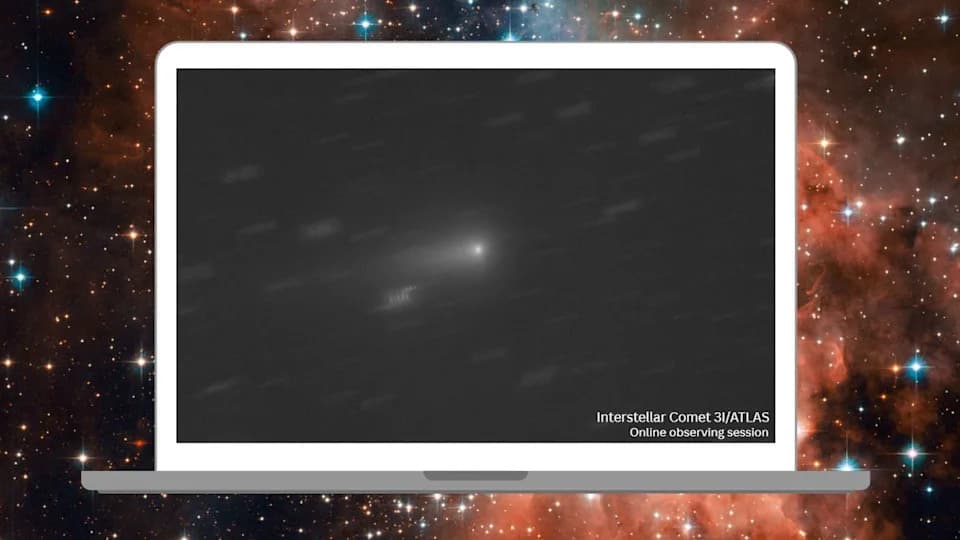
The ATLAS survey, funded by NASA, has discovered many comets since 2015 using telescopes in Hawaii, South Africa and Chile. Several ATLAS discoveries have attracted attention in recent years, but the most prominent ATLAS visitor in 2025 is the interstellar object 3I/ATLAS — an unrelated comet that passed perihelion on Oct. 29 and will make its nearest approach to Earth on Dec. 19 at about 168 million miles (270 million km). Astronomers emphasize that 3I/ATLAS is a natural object, not a spacecraft.
Observers and researchers will continue to track C/2025 K1’s fragments to learn how the pieces evolve and what they reveal about the comet’s internal structure and composition. Although the nucleus is gone, its breakup provides a valuable natural experiment for comet science.
Help us improve.