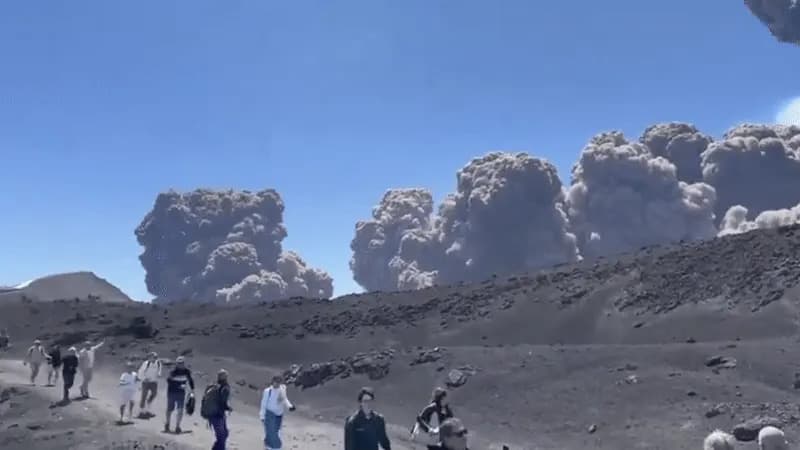
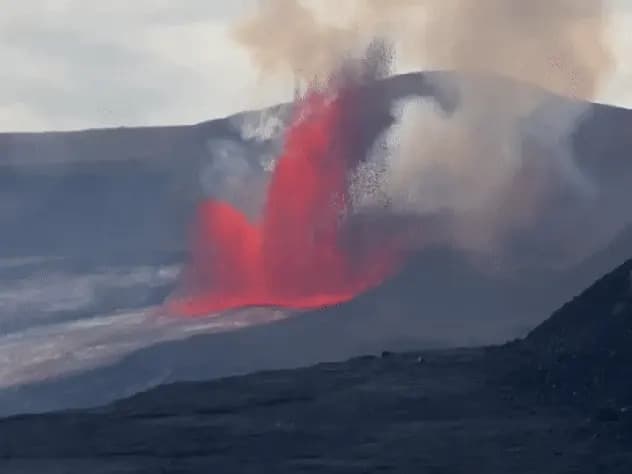
The Hayli Gubbi volcano in Ethiopia's Afar region erupted for several hours, launching ash plumes up to nine miles (≈14.5 km) into the sky. The eruption appears to be the first known activity in nearly 12,000 years, with no Holocene record for this vent. Ash drifted east across Yemen and Oman toward the Arabian Sea and on to NW India and Pakistan, and officials warn that ash-covered grazing land could hurt pastoral livelihoods. No casualties have been reported; scientists and authorities are monitoring ash movement and hazards.
Ethiopia’s Hayli Gubbi Volcano Erupts for First Time in ~12,000 Years, Sends Ash Plumes Nine Miles High

The Hayli Gubbi volcano in Ethiopia's Afar region erupted on Sunday, producing dense ash and smoke plumes that reached as high as nine miles (about 14.5 km) into the atmosphere. The Toulouse Volcanic Ash Advisory Centre (VAAC) reported the eruption lasted several hours and published maps showing the ash cloud's trajectory.
Hayli Gubbi sits roughly 500 miles (800 km) northeast of Addis Ababa near the Eritrean border. The vent rises about 1,500 feet (approximately 450 m) above the surrounding plain and lies within the East African Rift, a tectonically active zone where continental plates are pulling apart.
VAAC said the ash drifted eastward over Yemen and Oman and across the Arabian Sea toward northwestern India and northern Pakistan, carried by the subtropical jet stream. Volcanologist Simon Carn of Michigan Technological University confirmed on the social platform Bluesky that the ash cloud was "spreading rapidly east in the subtropical jet stream, over the Arabian Sea towards NW India and Pakistan."
The Smithsonian Institution's Global Volcanism Program reports that Hayli Gubbi has no recorded eruptions during the Holocene epoch (the last ~12,000 years), making this the first known activity from the vent in nearly 12 millennia. Scientists are monitoring the event closely for further activity and potential hazards.
Local officials say there have been no reported human casualties so far, but communities of pastoralists face economic hardship after grazing lands were coated in ash. Authorities warn that ash cover can reduce available forage for livestock and harm livelihoods.
"While no human lives and livestock have been lost so far, many villages have been covered in ash and as a result their animals have little to eat," said Mohammed Seid, a local administrator.
"It felt like a sudden bomb had been thrown with smoke and ash," said resident Ahmed Abdela, describing a loud blast and a perceived shock wave.
Footage circulating on social media shows a towering white column rising from the vent; these clips have not been independently verified. Authorities and volcanologists continue to track ash dispersion because of potential impacts on air quality, public health, agriculture and aviation.
What to watch: agencies monitoring ash trajectories may issue aviation advisories; local authorities are likely to advise residents to avoid ash exposure and protect water and livestock where possible.
Help us improve.