Authorities raised Mayon Volcano’s alert to Level 3 after intermittent rockfalls and pyroclastic flows led to the evacuation of nearly 3,000 people from a designated 6-kilometer danger zone. More than 2,800 residents from 729 households were moved from within the permanent exclusion area, while about 600 others evacuated voluntarily. Volcanologists say lava dome swelling and rockfalls are occurring but other key eruption signals, such as spikes in seismicity and high sulfur dioxide emissions, have not yet been observed.
Mayon Volcano Alert Raised to Level 3 — Nearly 3,000 Evacuated After Rockfalls and Pyroclastic Flows
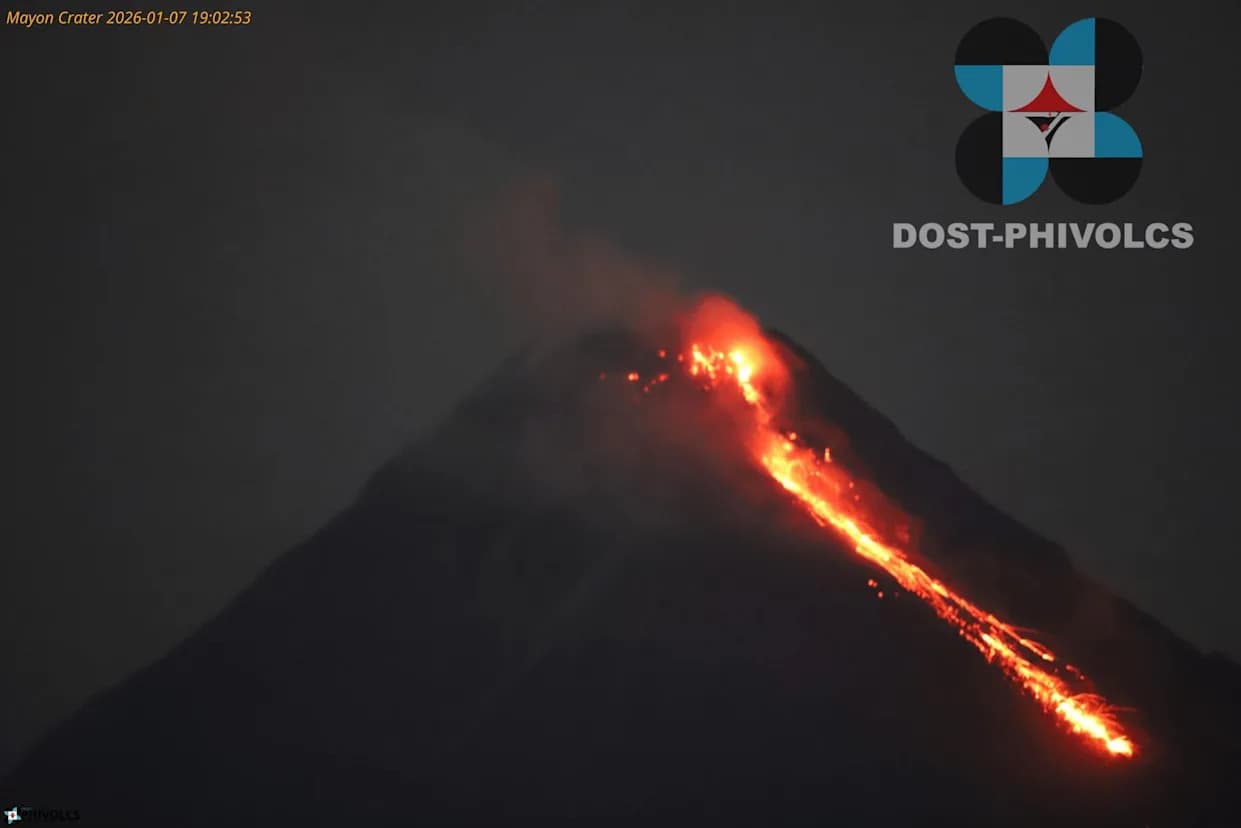
In this photo provided by the Philippine Institute of Volcanology and Seismology, lava flows from the crater of the Mayon volcano as alert level 3 remains raised in Albay province, north eastern Philippines on Wednesday Jan. 7, 2026. (Philippine Institute of Volcanology and Seismology via AP)
Philippine authorities raised the five-step alert for Mayon Volcano in Albay province to Level 3 on Tuesday after renewed activity at the country’s most active volcano prompted the evacuation of nearly 3,000 residents.
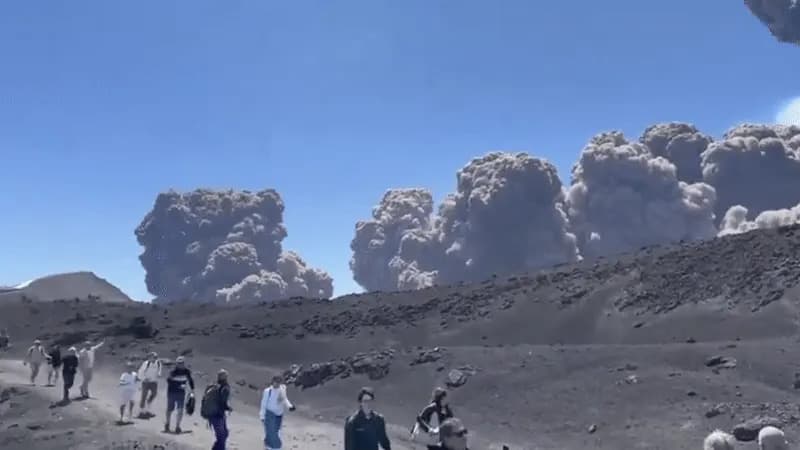
Scientists reported intermittent rockfalls from Mayon’s summit crater — some blocks as large as cars — and dangerous pyroclastic flows, fast-moving avalanches of superheated rock, ash and gas. Officials said lava has been building on the peak and the dome has swollen and cracked in places, producing the rockfalls.
Teresito Bacolcol, the Philippines’ chief volcanologist, told The Associated Press: “This is already an eruption, a quiet one, with lava accumulating up the peak and swelling the dome, which cracked in some parts and resulted in rockfalls, some as big as cars.”
Bacolcol cautioned that other key indicators of a major explosive eruption — such as a sharp rise in volcanic earthquakes and elevated sulfur dioxide emissions — have not yet been detected, so it remains too early to say whether unrest will escalate.
Evacuations and Response
Troops, police and disaster-mitigation teams helped evacuate more than 2,800 residents from 729 households inside a 6-kilometer (3.7-mile) permanent danger zone around the crater, provincial officials said. Another roughly 600 villagers living outside the permanent danger zone moved voluntarily to government-run emergency shelters to stay clear of the volcano.
Entry to the permanent danger zone is prohibited and marked by concrete warning signs, but thousands have historically lived, farmed or run businesses there despite the risk. Authorities continue to urge residents and visitors to comply with the ban to avoid life-threatening hazards.
Context And Historical Risk
Standing 2,462 meters (8,007 feet) tall, Mayon is famed for its near-perfect cone and is a major tourist draw, but it is also the most active of the Philippines’ 24 restless volcanoes, erupting 54 times since records began in 1616. A stark reminder of its destructive power is the 16th-century Franciscan church belfry at Cagsawa, the lone remnant of a town buried by volcanic mudflows during Mayon’s deadly 1814 eruption that killed about 1,200 people.
The presence of thousands of people living inside the danger zone highlights broader social challenges: many impoverished Filipinos are forced to inhabit hazard-prone areas across the archipelago — near active volcanoes, on landslide-prone slopes, along exposed coastlines and in low-lying settlements prone to flash floods. The Philippines also faces roughly 20 typhoons and major storms each year and sits on the Pacific "Ring of Fire," a region frequently affected by earthquakes and volcanic eruptions.
What To Watch
- Monitoring: Authorities will track volcanic earthquakes, gas emissions and ground deformation for signs of escalation.
- Safety: The 6-kilometer permanent danger zone remains off-limits; residents are urged to follow evacuation orders and guidance from officials.
- Support: Evacuees are being sheltered in government facilities; assistance and relief operations are ongoing.
Help us improve.