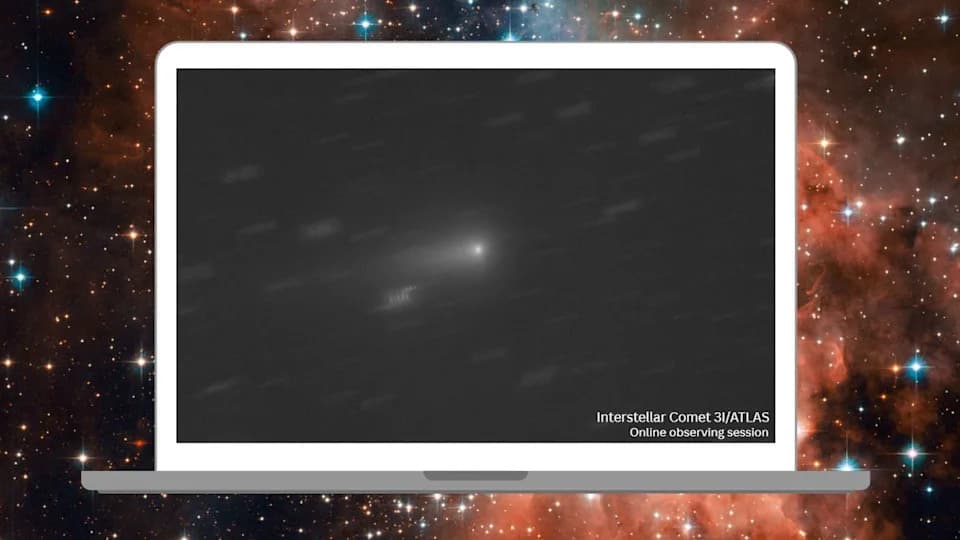
Harvard astrophysicist Avi Loeb highlights 3I/ATLAS’s planned close pass by Jupiter on March 16, 2026, when it should be about 33 million miles away. NASA’s latest images indicate a comet with unusual traits, but Loeb says questions remain about the object’s size, chemical signatures and apparent jets. He argues that empirical data — not institutional judgment — should determine the object’s nature and expects clearer answers after upcoming Earth‑based observations.
Avi Loeb: 3I/ATLAS Will Pass 33 Million Miles from Jupiter — Why That Fuels Questions About Its Nature

Harvard astrophysicist Avi Loeb continues to argue that the interstellar visitor known as 3I/ATLAS may not be a routine comet and is drawing attention to the object’s planned close pass by Jupiter as it leaves the solar system early next year.
Loeb says 3I/ATLAS will make its closest approach to Jupiter on March 16, 2026, when it is expected to be roughly 33 million miles from the giant planet. By comparison, the object’s distance from Earth on Dec. 19 is estimated at about 170 million miles.
He argues that the Jupiter encounter matters because Jupiter’s strong gravity can dominate trajectories in that region. "It comes exactly at the right distance from Jupiter for Jupiter’s gravity to dominate," Loeb has said, suggesting that if an object were intentionally deploying probes or taking advantage of a planet’s gravity, that would be the logical place to do it.
“Jupiter is easy to recognize, the biggest planet in the solar system, and perhaps that’s what attracted their visit. We tend to think that it’s all about us.” — Avi Loeb
Loeb has also raised the possibility that 3I/ATLAS could be using propulsion, asking whether the object might be "revving an engine," a phrase intended to highlight observed motion that some interpret as non‑passive. He points to several features he says deserve closer scrutiny: uncertainties about the object’s size, unusual chemical signatures reported in observations, and apparent jets streaming from its surface.
NASA has released images and data indicating that 3I/ATLAS appears cometary, though with atypical characteristics. Agency scientists favor a natural explanation, but Loeb and others maintain that several anomalies remain unresolved and should be examined openly and quantitatively.
The debate, Loeb emphasizes, should be settled by data and transparent analysis rather than institutional pronouncements. He expects that additional observations when the object is nearest Earth next month will allow researchers to draw firmer conclusions.
Why this matters: Interstellar objects like 3I/ATLAS offer a rare opportunity to study material formed around other stars. Whether natural or artificial, the object’s trajectory and unusual features warrant careful, data‑driven investigation by the scientific community.
Help us improve.