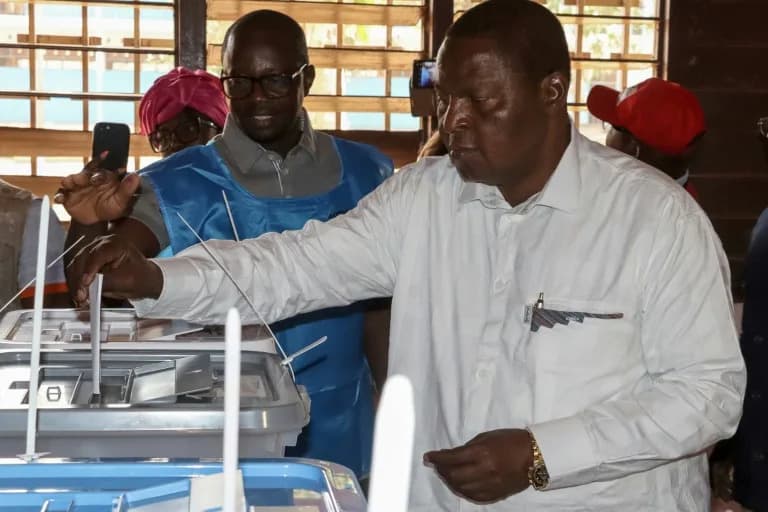
Guinea-Bissau held presidential and parliamentary elections amid a contentious exclusion of the main opposition party, PAIGC. Incumbent Umaro Sissoco Embaló seeks a second term against Fernando Dias da Costa in a race that could go to a runoff. The vote highlights deep institutional strains—parliament was dissolved last year and the country faces chronic poverty, drug-trafficking routes and repeated coups. Observers warn the outcome will test both national governance and regional stability.
Guinea-Bissau Vote Tests Democracy as Main Opposition Is Barred and President Seeks Second Term

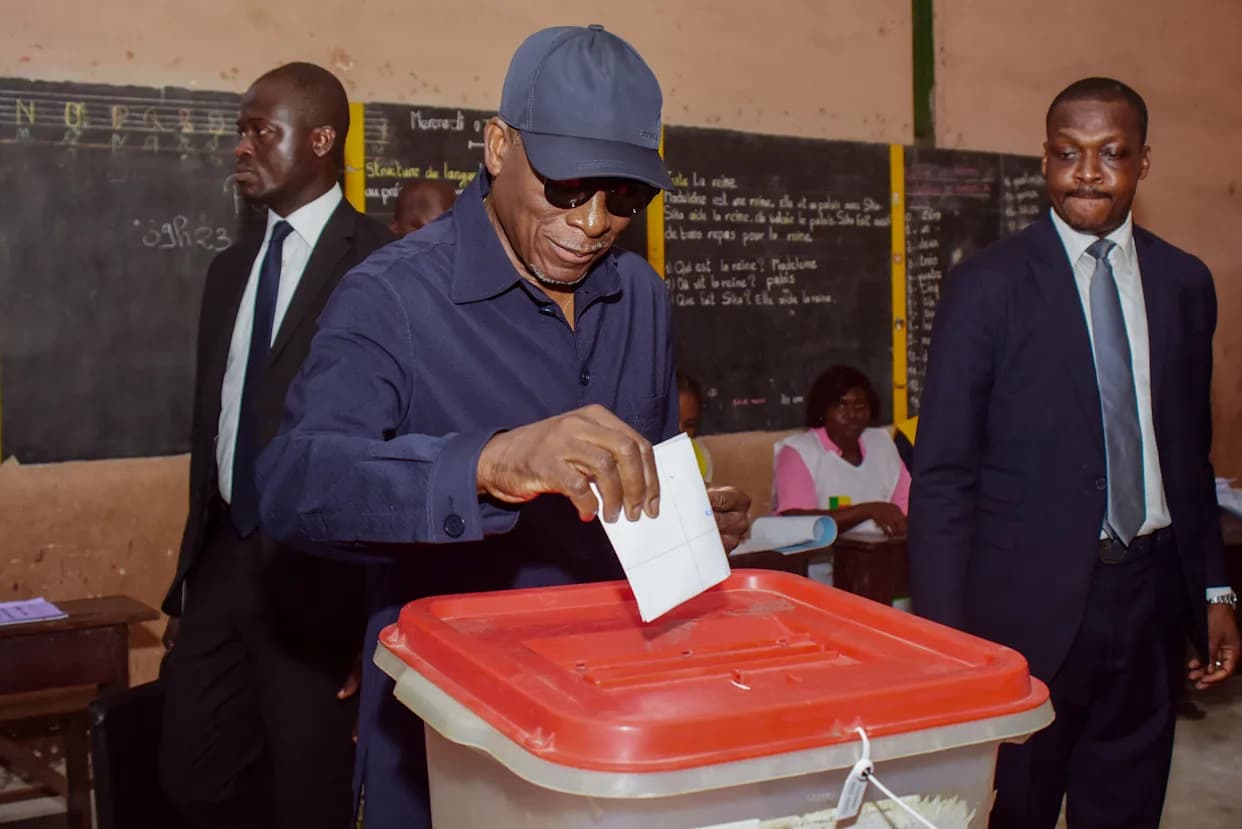
Voting began Sunday in Guinea-Bissau as President Umaro Sissoco Embaló seeks a second term in a country long marked by political instability and repeated coups.
The presidential and parliamentary elections come at a sensitive moment for West Africa, where disputed ballots have raised concerns that democratic backsliding could encourage military interventions elsewhere in the region.
Main contestants and a controversial exclusion
Political observers say the presidential race is tight between incumbent President Umaro Sissoco Embaló, a 53-year-old former army general who first assumed power in 2021, and Fernando Dias da Costa, a 47-year-old challenger supported by former prime minister Domingos Simões Pereira. A candidate must secure more than 50% of the vote to avoid a runoff.
Notably, Pereira and his party—the African Party for the Independence of Guinea and Cape Verde (PAIGC), the main opposition—were barred from the ballot after authorities said they missed the candidate-registration deadline. The exclusion of PAIGC has made this one of the country’s most contentious elections in recent memory.
“The democracy we knew ... is no longer the model we are experiencing; we are experiencing a model defined by a single person,” said political analyst Augusto Nansambe, reflecting widespread concern about concentration of power.
Political and institutional background
Nearly half of Guinea-Bissau’s roughly 2.2 million people are registered to vote. The country is among the world’s poorest; the World Bank estimates about half the population lives in poverty. It has also become a transit hub for drug trafficking between Latin America and Europe and has a long history of coups and attempted coups since independence from Portugal more than five decades ago.
The vote is shadowed by a recent legitimacy dispute over Embaló’s term. He won a vote in November 2019, was sworn in February 2020, and the Supreme Court validated the result on Sept. 4, 2020. The opposition argues his term should have ended in February 2024, while the court ruled it extended to September; the 2024 election was subsequently delayed to November.
The legislative contest is also unusual: the opposition-dominated parliament has not convened since December 2023, when Embaló dissolved it after an attempted coup. The PAIGC had won the legislative polls in both 2019 and 2023.
Campaign themes and risks
The campaign was marred by mutual accusations among candidates — including allegations of hate speech, murder and corruption — concerns that peacebuilders say could further destabilize the country. Embaló ran on an infrastructure platform, promising road projects and an upgrade to the main airport. Dias emphasized stability, civil liberties and security, accusing the government of systematic human rights abuses and urging voters to choose reconciliation and an end to authoritarian tendencies.
In the capital, resident Marinho Insoldé said he hoped the elections would bring calm and relief from hunger: “I hope that these elections will bring peace and tranquility so that there is no more hunger.”
Political analysts say the outcome will not only determine who leads Guinea-Bissau but will also test the resilience of its institutions and the wider region's stability.
Reporting by Asadu in Dakar, with contributions from Caitlin Kelly in Dakar.
Help us improve.