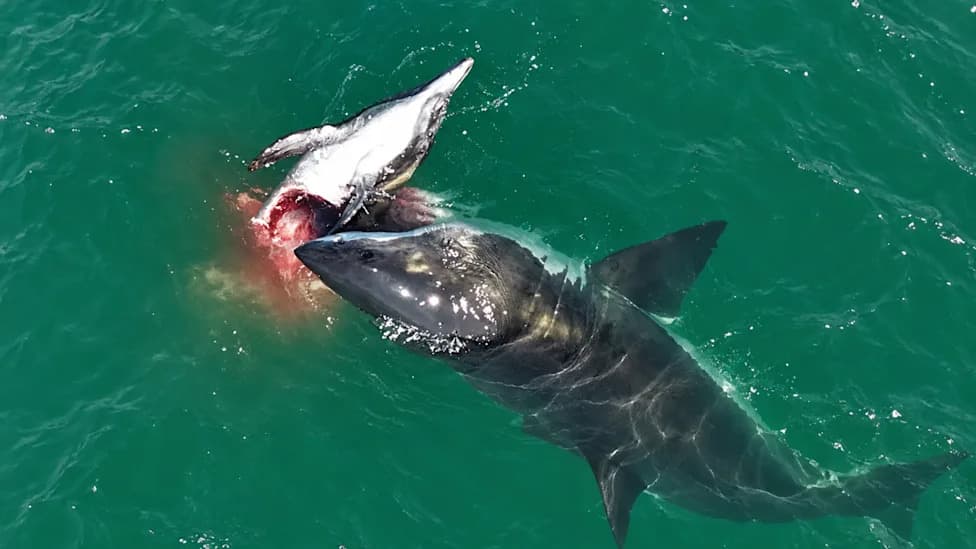
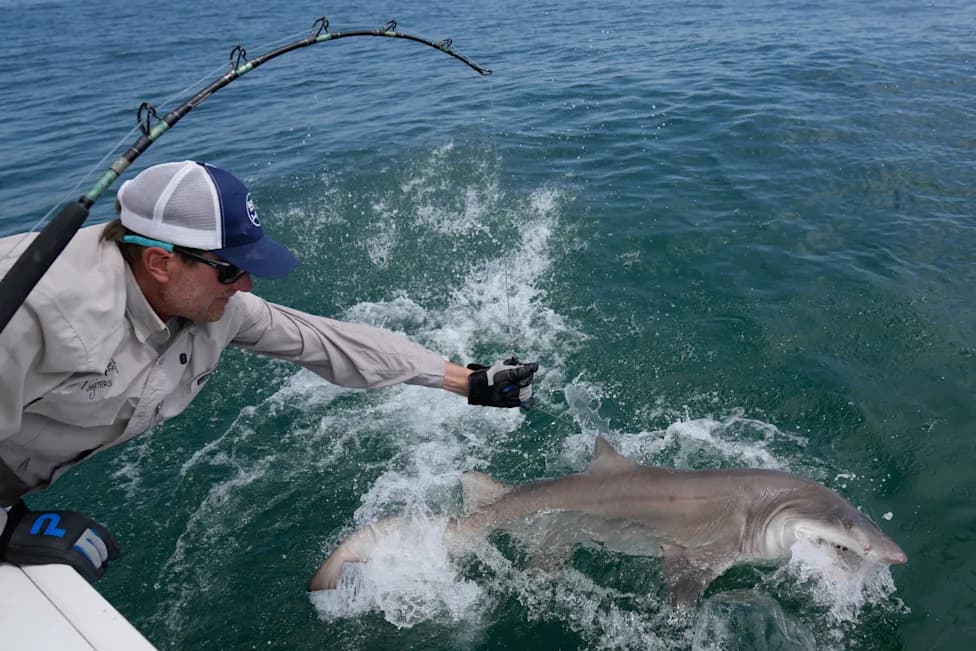
The Shark Research Foundation used more than 20 years of data to show that great white sharks declined at Seal Island starting around 2010 and were largely absent by 2018. Their loss has allowed broadnose sevengill sharks to move in and emboldened Cape fur seals, while prey species such as anchovies and Cape horse mackerel have plummeted. Researchers describe these linked shifts as a trophic cascade and point to both orca predation and human impacts—including lethal shark nets—as likely contributors. Experts recommend ending lethal netting, adopting non-lethal beach-safety measures, and supporting conservation reforms.
Great White Sharks Vanish from South Africa’s Seal Island — Local Food Web Upended

For decades, Seal Island off South Africa’s coast was renowned for spectacular displays of great white sharks breaching the surface to hunt seals. A new analysis from the Shark Research Foundation, drawing on more than 20 years of observations and published in Frontiers in Marine Science, finds that these iconic predators declined beginning around 2010 and were effectively absent from the area by 2018.
Their disappearance has produced a surprising and rapid reshuffling of the local marine community.
Key ecological changes
With great whites no longer present to limit mid-level predators, broadnose sevengill sharks—normally resident in nearby kelp forests—have moved into the Seal Island area and have been observed in groups as large as 15. Cape fur seals have grown noticeably bolder, rafting in larger, more conspicuous groups and sometimes approaching bait used by cage-diving operators.
Researchers recorded simultaneous increases in seals and sevengills alongside steep declines in their prey, including anchovies, Cape horse mackerel and several smaller shark species. These linked changes are characteristic of a trophic cascade, in which the loss of an apex predator triggers cascading shifts throughout the food web.
Possible causes
The study does not identify a single cause for the declines but points to multiple pressures. Predation by killer whales (orcas) has been implicated in great white losses in some regions. Human impacts also appear important: shark nets and other lethal beach-protection measures are known to kill great whites, and the researchers estimate that nets may remove up to several dozen adult individuals per year. Because great whites mature late and reproduce slowly, even modest increases in adult mortality can greatly impede population recovery.
“We saw things that we'd never expect,” said Neil Hammerschlag, marine ecologist, executive director of the Shark Research Foundation and a coauthor of the paper.
Recommendations
The authors and other experts call for rethinking lethal beach-protection strategies. They recommend phasing out shark nets in favor of non-lethal measures—such as trained shark-spotter programs, aerial surveillance, perimeter deterrents and electronic technologies—and pursuing fisheries reforms that reduce bycatch and overfishing of key prey species.
On an individual level, the researchers encourage supporting independent shark-conservation organizations and advocating for science-based marine policies that protect apex predators and their habitats.
Why it matters
Apex predators like great white sharks help maintain healthy ocean ecosystems by culling sick and weak individuals and by keeping prey populations and behavior in balance. The Seal Island findings provide a striking, real-world example of how removing a top predator can reverberate through an entire marine community—underscoring the need for precautionary, non-lethal management where possible.
Help us improve.