The so‑called "Diamond Ring" in Cygnus is not a jewel but the flattened remnant of a stellar bubble that burst through a thin, slab‑like gas cloud. New observations and 3D simulations led by Simon Dannhauer show the bright "diamond" is an unrelated, nearer star cluster along the line of sight. The modelling revises the ring's age to about 400,000–500,000 years and suggests the bubble blew out above and below a roughly six‑light‑year slab, leaving a pancake‑shaped rim. The study, published Nov. 17 in Astronomy & Astrophysics, argues slab environments may be common in star formation.
How the 20‑Light‑Year 'Diamond Ring' in Cygnus Formed — A Stellar Bubble That Burst

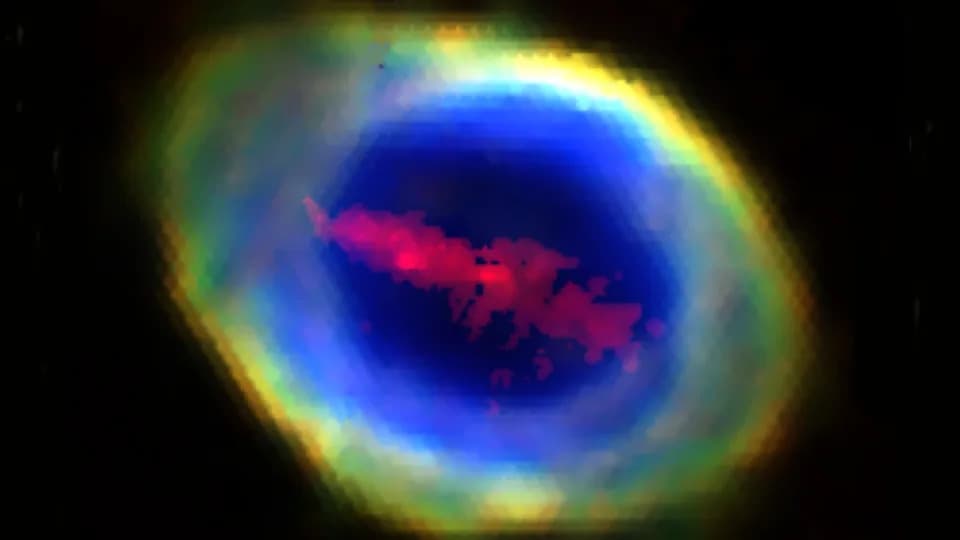
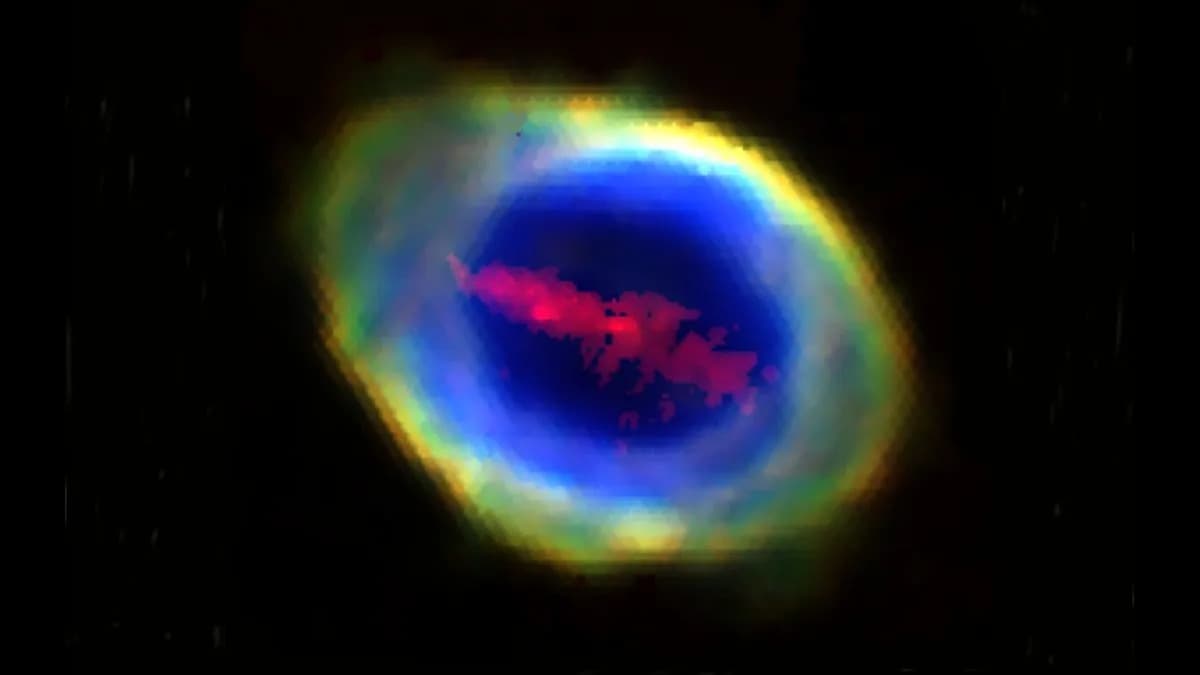
A striking, nearly perfect circle of glowing gas and dust in the constellation Cygnus — nicknamed the "Diamond Ring" because a bright knot of stars appears to sit on its rim — has been reinterpreted by astronomers using new observations and 3D simulations. The luminous "diamond" is not part of the ring; it is an unrelated cluster of young stars a few hundred light‑years closer to Earth that only appears aligned by chance.
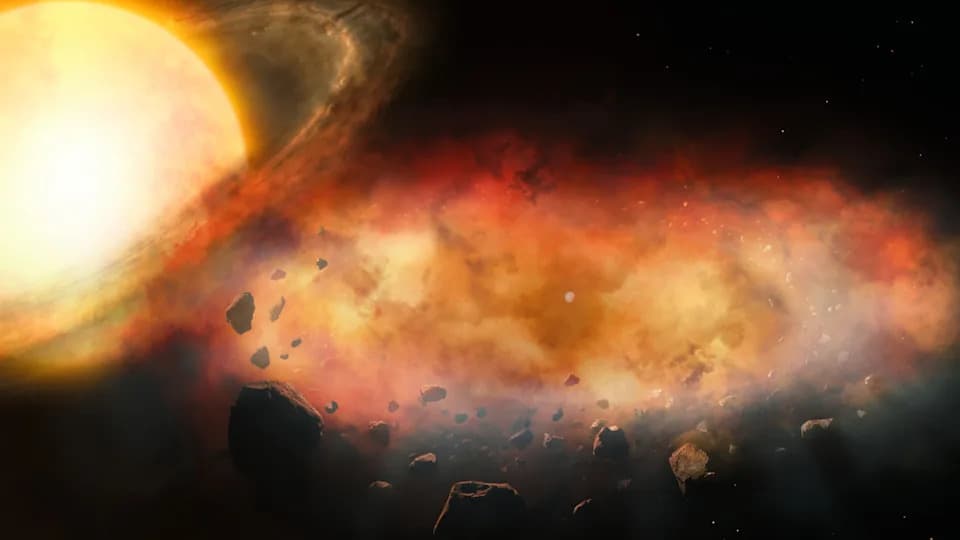
A team led by Simon Dannhauer of the University of Cologne combined fresh data with detailed computer models to show that the ring is the flattened remnant of an expanding stellar bubble driven by the intense radiation and winds of a massive young star. Their analysis indicates the bubble grew beyond the confines of its birth cloud and effectively "burst," leaving a broad, slow‑moving ring in the plane of the original cloud.
"All that remained was the particular flat shape," Dannhauer said, noting this is the first time researchers have observed the final stage of such a gas bubble in a clearly flat cloud structure.
Typically, stellar bubbles carved by massive stars expand roughly spherically and exhibit telltale red- and blue-shifted gas signatures that reveal their three‑dimensional motion. Observations from the now‑retired SOFIA airborne observatory, however, did not show those signatures for the Diamond Ring. Instead, SOFIA recorded only a thin, tilted ring of gas moving much more slowly than comparable shells.
When the team input the observed velocities and geometry into their simulations, they found the most consistent scenario was that the progenitor star formed inside a thin, slab‑like layer of gas roughly six light‑years thick rather than within a thick, roughly spherical molecular cloud. In that configuration, bubble segments pushing perpendicular to the slab quickly spilled into the lower‑density regions above and below. Those parts dispersed rapidly, leaving behind the dense, swept‑up rim confined to the slab plane that remains visible today.
The models also revise the ring's age significantly. Earlier estimates that assumed spherical expansion placed the feature at several million years old. The new study suggests the remnant is only about 400,000–500,000 years old — a stellar newborn in cosmic terms. The bubble likely expanded in three dimensions for roughly the first 100,000 years before its top and bottom blew out and dissipated, producing the pancake‑like ring.
These findings imply slab‑like star‑forming environments may be more common than the idealized spherical clouds often used in theoretical models. That has important consequences for how models of stellar feedback, cloud dispersal, and star formation are constructed across the Milky Way.
Publication: The study reporting these results was published on Nov. 17 in the journal Astronomy & Astrophysics. Lead author: Simon Dannhauer; co‑author quote provided by Robert Simon, both of the University of Cologne.
Help us improve.