This large meta‑analysis of 89 studies finds trophy hunting in sub‑Saharan Africa produces mostly positive outcomes when local communities or private landowners hold rights and receive revenues. Overall, 65% of outcomes were positive, rising to over 80% with local benefits; trophy hunting was linked to increased land under conservation in 92% of cases. The authors urge targeted import standards (e.g., proven conservation benefits, fair revenue sharing, science‑based quotas) instead of blanket bans to avoid harming well‑managed programs.
Study Finds Trophy Hunting Linked to Habitat Gains in 92% of Cases — Local Benefits Drive Success
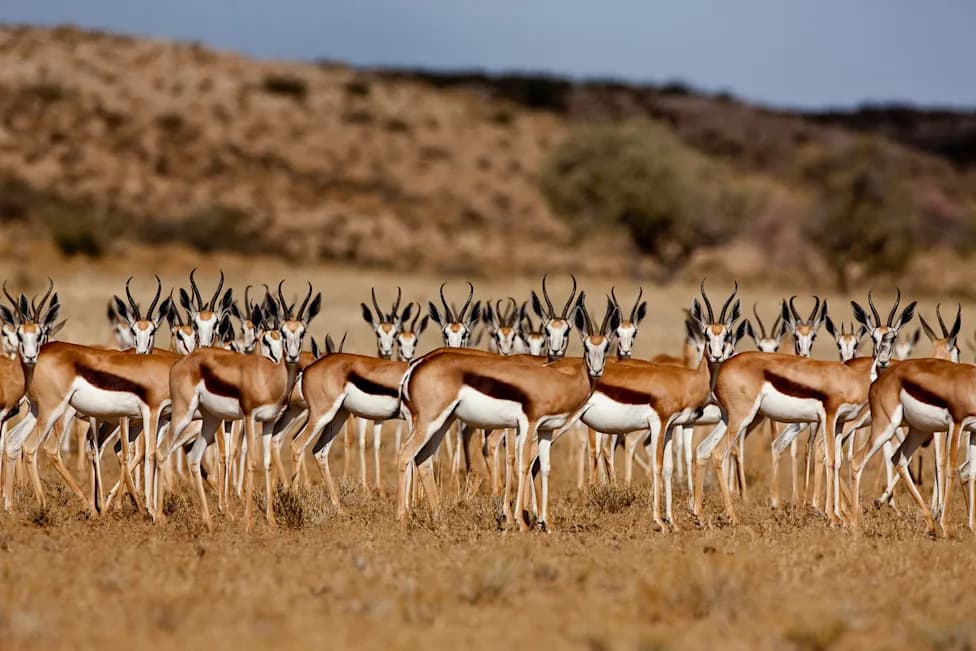
A herd of springbok in Namibia.
A major new meta-analysis of trophy hunting in sub‑Saharan Africa finds that, when managed so local communities or private landowners benefit, trophy hunting is more often associated with positive outcomes for both habitat and people. Published Sept. 9 in Conservation Letters, the review synthesizes results from 89 scientific papers across 13 African countries to paint a nuanced picture of hunting's conservation role.
Study Design and Scope
Researchers compiled and analyzed published studies that measured the effects of trophy hunting on three broad outcomes: wildlife populations, native habitat protection, and the well‑being of local people (income, employment and food security). The international research team included contributors from South Africa, the United States, Canada and Finland.
Headline Findings
- Positive Outcomes Overall: 65% of documented outcomes were positive for conservation objectives and local livelihoods.
- Local Rights Matter: Positive outcomes rose to more than 80% in cases where communities or private landowners held formal rights to land and received hunting revenues — notably in Namibia and South Africa.
- Habitat Gains: Trophy hunting was associated with increased land under conservation in 92% of documented cases.
- Local Livelihoods: At least 85% of measured cases showed positive effects on income, employment or food security where benefits reached local stakeholders.
Mixed And Negative Outcomes
Not all outcomes were positive: 26% of documented outcomes were negative and 9% were ambiguous. Problems were most common where governments retained tight control over wildlife on communal lands and where communities received only partial revenue shares — for example, in parts of Tanzania and Zambia.
Ecological effects on hunted species were complex. Populations of many hunted species were more often stable or increasing than declining, but demographic indicators such as age and sex ratios were frequently skewed and impacts on animal movement patterns were mixed.
"Trophy hunting is one of Africa's most contested conservation strategies," said lead author Dr. Hayley Clements. "Public debates are often driven by ethics and assumptions rather than evidence; our review shows outcomes are highly context‑specific — and policymakers can act on that context."
Policy Implications
The authors caution that blanket import bans on hunting trophies can be a "blunt instrument" that risks harming livelihoods and effective conservation programs in countries that manage hunting well. Instead, they recommend that importing nations consider targeted standards for trophy imports, such as requirements that hunting demonstrably contributes to conservation, that revenues reach local people equitably, and that quotas are science‑based and adaptively managed. Such standards could protect well‑managed programs while incentivizing governance improvements in weaker systems.
Bottom line: The study emphasizes that trophy hunting's conservation value is not inherent or universal — it depends on local tenure, benefit sharing and robust, science‑based management.
Help us improve.