Designing the Just Transition by Damian White and Nicholas Pevzner reframes how designers can respond to climate breakdown by mapping the political, labor, and material constraints that create "scalar overwhelm." The book is a survey, not a blueprint: it synthesizes labor and design histories, evaluates contemporary initiatives, and explores frameworks like the Green New Deal and speculative design. Its central claim is that adaptation must be iterative, labor-aware, and politically grounded, with sustainability one aim among wider goals such as meaningful work and shared prosperity.
Designing for a Warming Planet: Rethinking Design, Labor, and a Just Transition
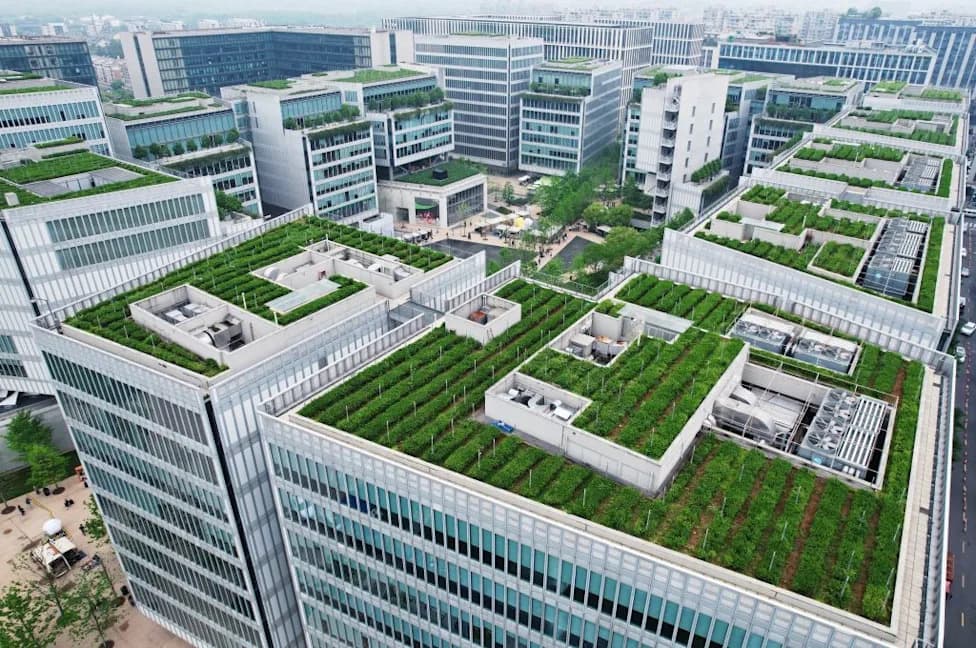
More than 6000 square meters of West Lake Longjing tea are planted on the roof of eleven high-rise buildings in Hangzhou, China, which can block the sun in summer, thereby reducing the energy consumption level of buildings and reducing carbon emissions. (Costfoto / NurPhoto via Getty Images)
The central problem is urgent and uncompromising: the world as we know it cannot continue unchanged. Transformation is required now, and while some argue that capitalism is the ultimate target, there isn't enough time to overhaul global economic systems before climate breakdown accelerates. The crisis is already visible — and it raises a pressing question for designers and architects: where do you begin when every element of the built environment — supply chains, information systems, labor practices, policy choices and economic incentives — is tightly interconnected and the scale of intervention feels paralyzing?
This feeling of "scalar overwhelm" has produced varied responses in the design world. Some practitioners retreat into pragmatic accommodation — designing for clients and developers, chasing revenue, and accepting the constraints of project-level decision-making. Others propose ambitious, sometimes utopian solutions that are difficult to finance or implement. A persistent structural constraint is that designers often lack formal power in the capital and policy ecosystems that shape material outcomes: architects are routinely asked to minimize upfront costs and maximize developer returns even as the built environment drives emissions — buildings and construction are responsible for roughly 40% of global greenhouse gas emissions.
Many of the decisions that determine environmental impact are outside an individual designer's control: how concrete is produced, which fuel powers material transport, whether the power grid you connect to runs on fossil fuels. That structural reality can make individual ethical choices feel insignificant, fostering resignation and nihilism.
Damian White and Nicholas Pevzner's book Designing the Just Transition offers a different approach to that impasse. It does not prescribe a single blueprint. Instead, the book functions as a topographical map: a careful survey of how designers and design thinkers have engaged with a warming world and a guide to the political, labor, and material fault lines that will shape any transition. Its purpose is to make the scale of the problem legible and therefore more actionable for practitioners, workers, and civic actors.
History, Framing, and the Pivot to Possibility
The book's first three chapters provide historical grounding: the contested relationship between labor and environmental movements; the evolution of environmental, ecological, and nature-inspired design; and the ways architecture and planning industries have engaged (or failed to engage) with green design. For readers versed in labor or design histories, much of this material will feel familiar; White and Pevzner's contribution is the synthesis of these strands under a unified political frame. For newcomers, these chapters act as a clear, focused primer.
Chapter four — provocatively titled "Labor-Centered and Worker-Centered Design for Just Transitions?" — acknowledges the difficulty of aligning labor and environmental priorities. The authors examine historical precedents and contemporary initiatives that attempt such alignment, testing whether design can be both worker-centered and environmentally ambitious.
From Practice to Imagination
The latter part of the book looks forward. It considers the role of noncredentialed designers and the contributions and limits of critical-design practices; it evaluates how political frameworks like the Green New Deal can broaden discussions about labor, decarbonization, and public investment; and it explores models and provocations found in political theory, climate fiction, speculative design, and current practice.
"The core position here . . . is that life on a hotter, more turbulent, and more dynamic planet will require design interventions that will have to be iterative and inventive, taking place again and again and again in climate-challenged worlds."
This orientation toward the world's inherent instability is the book's organizing idea: adaptation should be conceived as an ongoing, iterative process that embraces continuous change. Within that project, design is neither a panacea nor irrelevant; it must be coordinated with labor interests and embedded within broader social aims such as meaningful work, wellbeing, economic security, and shared prosperity. Sustainability is crucial, but it should be one objective among several that together define a just transition.
Confronting Scalar Nihilism
White and Pevzner do not offer naïve optimism. They directly address the widespread sense of scalar nihilism — the belief that entrenched interests will cement fossil capitalism and lock the world into a much warmer, more turbulent future. The book's value lies in expanding, clarifying, and historicizing such questions. If Designing the Just Transition is a topographical map, it does not tell us when the next quake will strike, but it shows where the fault lines run and where footholds may be found to climb seemingly unscalable terrain.
Why this matters: For designers, planners, and policy-minded citizens, the book reframes the role of design as a politically and labor-aware practice. It asks professionals to pair technical craft with coalition building, worker-centered priorities, and iterative strategies capable of operating in non-equilibrium conditions. For anyone looking to move beyond paralysis, the text provides context, precedents, and strategic directions rather than false certainty.
Help us improve.