China's Hefei Advanced Light Facility (HALF) has produced its first electron beam, accelerating particles to 2.2 GeV through a 192‑metre linear accelerator — a critical milestone toward a fourth‑generation synchrotron. HALF aims to deliver X‑rays more than 100 times brighter and far more coherent than third‑generation sources, enabling atomic‑scale imaging and ultrafast dynamics studies previously out of reach. The facility will host up to 35 experimental stations (the first 10 cover fields from superconductivity to EUV lithography) and is expected to be completed by 2028.
HALF Fires First 2.2‑GeV Beam — Paving the Way for 4th‑Generation X‑Ray Science
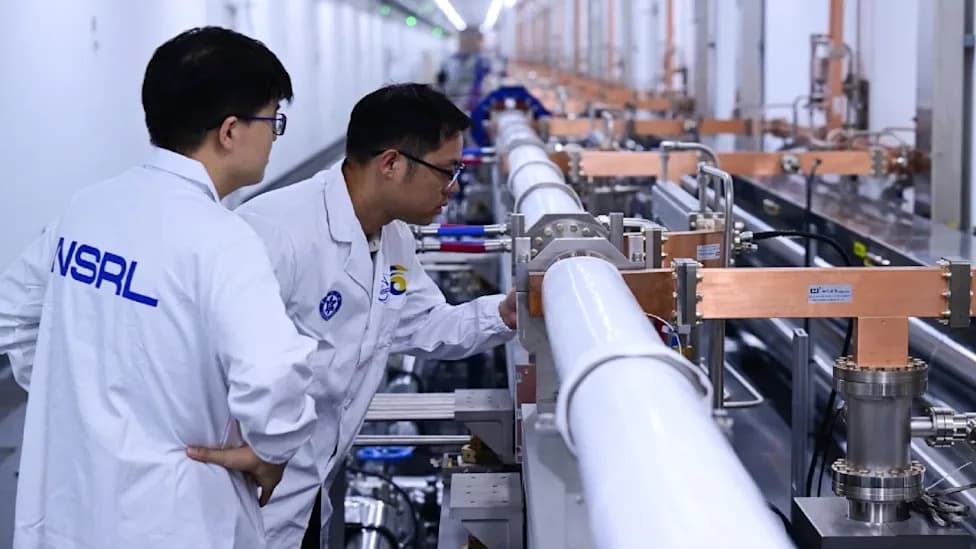
100 times-brighter fourth-gen X-rays: HALF fires first 2.2-GeV electron beam
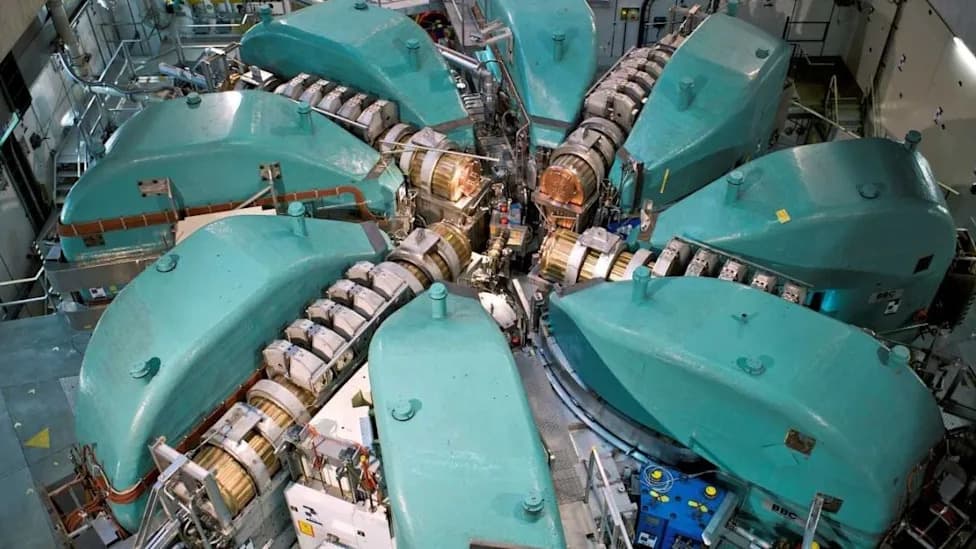
China's Hefei Advanced Light Facility (HALF) has produced its first electron beam, accelerating particles to 2.2 billion electron volts (GeV) along a 192‑metre linear accelerator — a landmark step toward bringing a fourth‑generation synchrotron light source online.
Why This Matters
Fourth‑generation synchrotrons deliver X‑rays that are dramatically brighter and far more coherent than earlier sources. According to project documentation, HALF's design aims to produce X‑ray beams more than 100 times brighter and considerably more coherent than typical third‑generation facilities. That leap in brightness and coherence enables experiments that were previously impossible: imaging atomic‑scale dynamics in real time, resolving structures that are extremely fragile or heterogeneous, and following ultrafast processes with unprecedented clarity.
Technical Highlights
Recent milestone: FIRST electron beam at 2.2 GeV through a 192 m linac.
Planned capability: A 480‑metre circumference storage ring designed to run at 350 mA beam current, and up to 35 experimental stations when complete.
Timeline: Construction began in 2023; facility completion is expected by 2028.
Scope and Applications
HALF's first tranche of 10 experimental stations has been chosen to span a wide range of scientific and technological needs: high‑temperature superconductivity, next‑generation batteries, advanced materials science, life‑sciences studies including Alzheimer's research, and nano‑device development. Notably, the initial suite includes an extreme ultraviolet (EUV) lithography research station — highlighting HALF's role not only in basic science but also as infrastructure relevant to semiconductor development and industrial applications.
"Producing a beam successfully means we've taken a key step towards our final goal," said He Zhigang, a project scientist. "The beam's quality, stability and reliability have a major impact on the experiments conducted with HALF."
The University of Science and Technology of China, which oversees the project, states that HALF's designed brightness and stability will be among the highest in the world. Project chief Feng Donglai, an academician of the Chinese Academy of Sciences, confirmed that all key components for the linear accelerator were manufactured domestically.
National And International Context
Once operational, HALF will complement China's High Energy Photon Source in Beijing and the Shanghai Synchrotron Radiation Facility to form a three‑node national light‑source network covering high, medium and low photon energies. The distributed system is intended to serve both domestic and international researchers and positions China among the small number of countries operating cutting‑edge fourth‑generation X‑ray facilities.
Legacy And Outlook
This milestone continues a development arc that began in 1989 with the original Hefei Light Source. Previous generation facilities in China have supported high‑impact discoveries — from structural biology breakthroughs to paleontological imaging — and HALF is designed to extend those capabilities, enabling new science across physics, chemistry, materials and the life sciences.
Help us improve.