Researchers warn the Chesapeake's osprey recovery is unraveling. A coastwide survey found dramatically elevated nest failures in saltwater areas where ospreys depend on Atlantic menhaden. Scientists suspect fewer or later‑arriving menhaden—and debate centers on industrial reduction fishing versus environmental change. Virginia has provided $2 million to VIMS for targeted research while regulators weigh cuts to the Chesapeake harvest cap of up to 50%.
Ospreys Vanish Along the East Coast — Menhaden Shortages and a Brewing Fishing Fight Threaten the Recovery
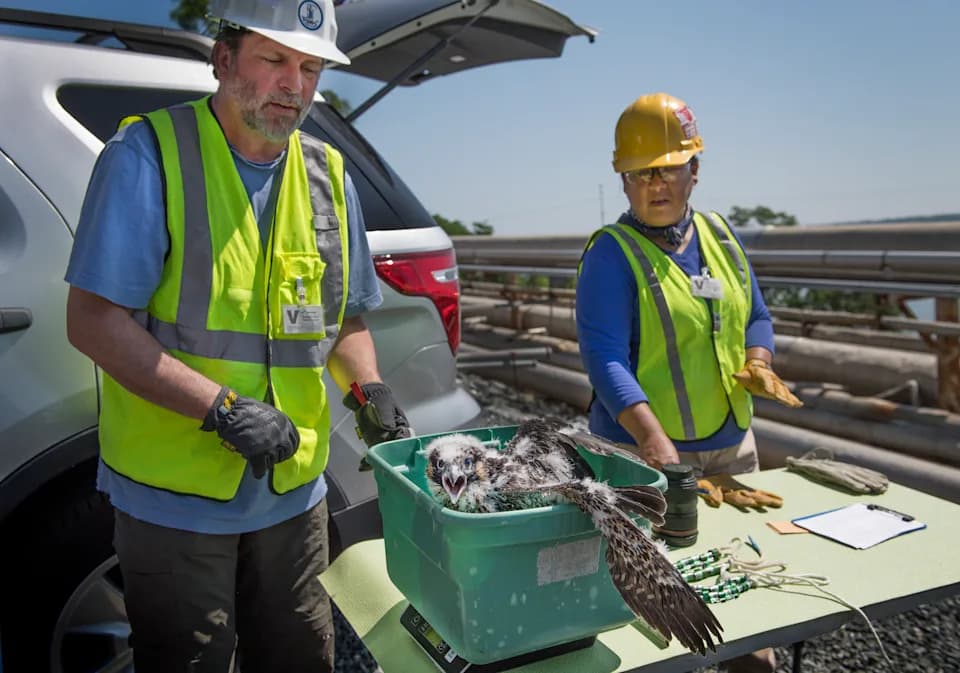
Watts and his wife, Marian, weigh a peregrine falcon fledgling in Dumfries, Virginia, in 2017. - (Linda Davidson/The Washington Post)
Bryan Watts has spent more than three decades watching ospreys reclaim the Chesapeake Bay, returning each spring from South America to hunt along tidal rivers, creeks and shorelines. After recovering from the DDT era to form the world's largest breeding population, that comeback now appears at risk: researchers are documenting the worst osprey breeding season on record in parts of the Mid‑Atlantic.
What Researchers Are Seeing
In a coastwide snapshot of the 2026 breeding season, scientists monitored 2,886 osprey pairs in 65 study areas across 10 Atlantic states. Only 28% of saltwater study areas produced enough young to maintain their populations, compared with 93% of freshwater areas. In the Bay's saltier reaches—where ospreys rely heavily on Atlantic menhaden—81% of nesting pairs failed to raise a single chick in 2026.
The Central Role of Menhaden
Atlantic menhaden are small, oily forage fish that are calorie‑rich and critical prey for ospreys, striped bass, bluefish, whales and many seabirds. Scientists and fishermen report two worrying patterns: fewer menhaden in many coastal waters, and shifts in timing, with large schools arriving later than the peak demand period for ospreys (typically mid‑May through mid‑July). At some Chesapeake nests, menhaden deliveries are now more than 80% less frequent than in the 1980s.
The Industrial Fishery And The Debate
Critics point to the industrial reduction fishery that supplies the Reedville, Virginia, plant—operated by Omega and supplied largely by Ocean Harvesters. Ocean Harvesters delivered nearly 300 million pounds of menhaden to Reedville in 2024. The plant processes the catch into fishmeal, fish oil and other concentrated products sold into pet food, aquaculture and other markets.
Industry representatives caution against attributing complex ecological change to a single cause. Ben Landry of Ocean Fleet Services described the link between harvests and osprey starvation as an "oversimplified explanation," noting that water quality, alternative prey, predators and habitat shifts also matter. Watts and other scientists describe the evidence as a strong association, not definitive proof of causation.
Management, Science And Economics
The Atlantic States Marine Fisheries Commission (ASMFC) manages menhaden coastwide and currently classifies the species as "not overfished." However, that coastwide assessment cannot resolve whether menhaden are being depleted in smaller, ecologically critical areas such as the Chesapeake Bay.
Scientific uncertainty is a flashpoint. A reanalysis by University of Miami scientists led ASMFC to revise a key assessment parameter—natural mortality—last year; those researchers now warn even the revised estimate may be too high, which could mask true population vulnerability. Virginia lawmakers repeatedly stalled funding for local menhaden research until the governor included $2 million over two years in the state budget for the Virginia Institute of Marine Science (VIMS) to begin the work.
Regulators are now considering reductions to the Chesapeake reduction cap ranging from none to a 50% cut. Economic estimates heighten the stakes: a June 2026 study commissioned by the Theodore Roosevelt Conservation Partnership estimated East Coast anglers spent $804 million in 2025 on trips that used menhaden as bait, chum or scent. By contrast, Omega says its combined Atlantic and Gulf operations generate about $300 million in annual sales and that its Virginia operations directly employ roughly 260 people.
Where Things Go From Here
Without clearer, localized science and nimble management, researchers warn the osprey population in the Bay could decline dramatically—Watts projects the population could fall by roughly half within a decade if current trends persist. The dispute over menhaden highlights a larger dilemma in fisheries management: how to balance industrial harvest, recreational and commercial fishing interests, and ecosystem needs when stock assessments are uncertain at the regional scale.
Bottom line: Ospreys are signaling a broader ecological problem. Determining whether industrial menhaden harvests, shifting environmental conditions or a combination of factors are driving local shortages will require targeted research, precautionary management and cooperation among industry, scientists and stakeholders.
Help us improve.