The Holy Tunic of Christ, a relic kept in Argenteuil and venerated by some as the robe Jesus wore at the crucifixion, will be unveiled to Pope Leo XIV at the Stade de France during his three-day visit to France. The tunic is normally kept mostly hidden and was last publicly displayed from April 18 to May 11, 2025. Authorities will transport the relic nearly four miles under tight, secreted security; the garment was stolen in December 1983 and returned in February 1984. Scientific studies conflict on its age, including a 2004 radiocarbon analysis dating it to A.D. 530–650, a result its custodians dispute due to potential contamination factors.
Rare 'Holy Tunic' To Be Unfurled for Pope Leo XIV Under Tight Security
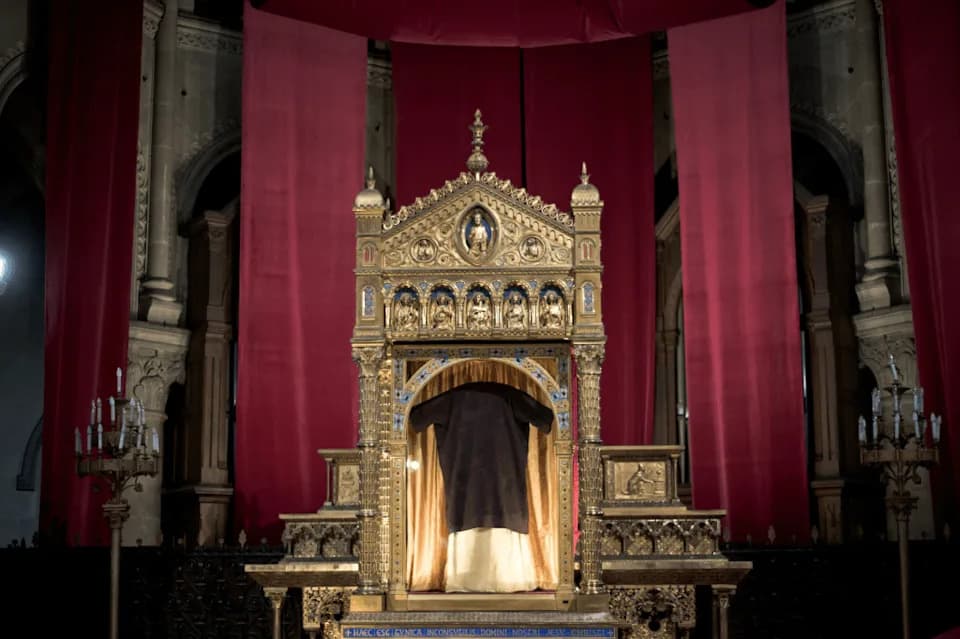
Holy Tunic of Christ at the Basilica of Argenteuil in Val-d'Oise, France, March 25, 2016.
A rarely seen relic, venerated by some Christians as the garment Jesus wore at his crucifixion, will be presented to Pope Leo XIV on Friday during his three-day visit to France.
The Diocese of Pontoise announced the Holy Tunic of Christ will be unveiled to the pontiff at the Stade de France, a northern Paris stadium where a prayer vigil for young people is planned. The diocese describes the tunic as "classified among the most sacred in Christianity," usually kept out of public view with only a small portion visible through an oculus.
Transport and Security
The relic will be moved nearly four miles from the Basilica of Argenteuil to the Stade de France under strict security measures. Authorities say the route will be kept secret and that both ground and aerial protection will be deployed, according to the Catholic broadcaster EWTN. These precautions reflect the tunic’s religious significance and past security concerns.
History and Custody
According to tradition and the tunic’s custodians, Sainte Tunique, the garment arrived in Argenteuil after being gifted to Charlemagne by the Byzantine Empress Irene around the end of the 8th century. Charlemagne is said to have given it to his daughter Theodrada, a nun at the Monastery of the Incarnation in Argenteuil, where it has been preserved and largely hidden for centuries. The relic is reportedly displayed only rarely, about every 50 years or for special occasions. It was most recently on public view from Good Friday, April 18, to May 11, 2025, at the Basilica of Saint-Denys in Argenteuil.

Pope Leo XIV is seen on the Vatican balcony on May 8, 2025.
Theft and Recovery
The tunic’s modern history includes a dramatic episode: it disappeared after being stolen on the night of December 12-13, 1983, and was returned in February 1984, according to France’s Ministry of Culture. Sainte Tunique says the relic was handed back to Father Guyard, then the parish priest, who never revealed who took it; public records provide no further detail on the theft or recovery.
Authenticity and Scientific Debate
Sainte Tunique describes the Holy Tunic as a woolen garment "stained with human blood" and cites a range of studies it says support authenticity, including analyses of pollen, weaving techniques and blood type. However, the relic’s age is contested. A 2004 radiocarbon analysis cited by France’s Ministry of Culture dated the fabric to between A.D. 530 and A.D. 650, centuries after the life of Jesus. The ministry noted this does not diminish the item’s historical or cultural value.
Sainte Tunique accepts the radiocarbon result but highlights the study authors’ caution about potential inaccuracies when dating very old wool or linen. The custodians point to possible contamination from water or fire damage, long contact with mold while stored in abbey walls, and burial during the French Revolution as factors that could affect dating results.
Religious Context
Devotees who revere the tunic as the seamless garment mentioned in the Gospel of John point to John 19:23–24. The passage reads:
"After the soldiers had crucified Jesus, they took his clothes and divided them into four parts, one for each soldier. They also took his tunic, which was seamless, woven in one piece from top to bottom. And they said to one another, 'Let's not tear it, but cast lots for it to see whose it shall be.' This took place to fulfill the Scripture that says, 'They divided my garments among them, and for my tunic they cast lots.' This is what the soldiers did."
The presentation at the Stade de France comes amid heightened public interest in the papal visit and reflects both the deep religious devotion surrounding relics and the ongoing historical and scientific debates about their origins.
Help us improve.