PANXEON is an investigational AI-driven liquid biopsy that detected stage I and II pancreatic cancer with ~87% sensitivity in nearly 1,800 participants across four countries, according to a Nature Medicine study published Sept 16, 2026. The assay integrates circulating microRNAs, exosomal microRNAs, and CA19-9 into a single risk score and achieved an AUROC of 91.7% for pancreatic ductal adenocarcinoma plus high-grade dysplasia. It also detected high-grade dysplasia in ~64% of cases, but false positives rose to ~16% in high-risk groups. PANXEON remains investigational; larger prospective trials are required before clinical adoption.
AI Blood Test PANXEON Detects Early Pancreatic Cancer With 87% Sensitivity — Promising But Investigational
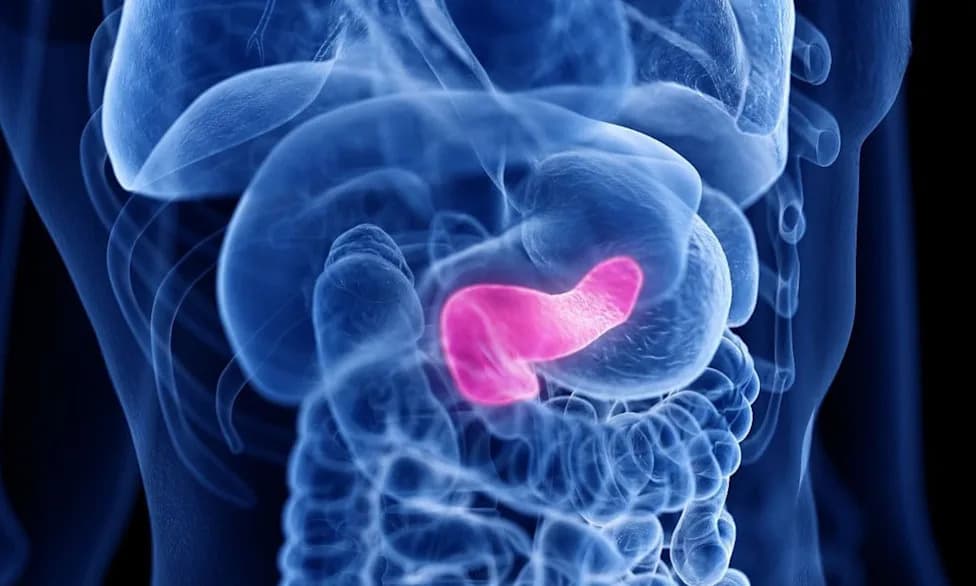
Image: Adobe Stock
Pancreatic cancer is deadly in large part because it often goes undetected until late stages. Most patients are diagnosed after the window for curative treatment has narrowed: published data estimate that roughly 90% of cases reach advanced stages by the time of diagnosis, and five-year survival is about 14%.
A study published in Nature Medicine on September 16, 2026, reports that an investigational blood test named PANXEON identified approximately 87% of stage I and II pancreatic cancer cases in a multicountry cohort of nearly 1,800 participants from the United States, Italy, Japan, and South Korea.
How PANXEON Works
PANXEON is a liquid biopsy that uses a single blood draw to measure three tumor-associated signals: circulating microRNAs, exosomal microRNAs (small regulatory molecules enclosed in extracellular vesicles), and CA19-9, a protein biomarker long associated with pancreatic cancer but limited when used alone. An artificial intelligence model integrates these three inputs into a composite risk score that outperformed each component on its own in the study.
Key Diagnostic Findings
The paper reports an area under the receiver operating characteristic curve (AUROC) of 91.7% for combined detection of pancreatic ductal adenocarcinoma and high-grade dysplasia. For stage I and II cancers specifically, sensitivity was about 87%.
False-positive rates were low in average-risk individuals (about 3%) but rose to roughly 16% in higher-risk groups, such as people with a family history of pancreatic cancer, known pancreatic cysts, or chronic pancreatitis. The authors note that elevated false positives in surveillance populations require caution and further validation before the test is used to direct clinical care.
Detection of Precancerous Disease
Notably, PANXEON detected high-grade dysplasia, an advanced precancerous lesion often described as stage 0, in about 64% of evaluated cases. No prior blood-based assay has shown reliable sensitivity for this condition at scale, making this an important and potentially practice-changing observation if confirmed prospectively.
Ajay Goel, Ph.D., the study's senior author, commented that earlier detection can meaningfully increase the chance for curative intervention, underlining the clinical importance of shifting diagnosis to earlier stages.
Intended Use and Limitations
PANXEON is intended as a triage tool for people already at elevated risk, not for population-wide screening. Current high-risk surveillance relies on frequent imaging (MRI, CT, endoscopic ultrasound) that is costly and sometimes invasive; a reliable blood-based triage could help focus imaging on those most likely to benefit. However, PANXEON is investigational and not approved for routine clinical use.
Important limitations of the current dataset include the fact that samples were collected around the time of clinical diagnosis or intervention. The study does not yet show that PANXEON detects cancer earlier than imaging or before symptoms in asymptomatic individuals. Larger prospective surveillance trials are needed to determine real-world performance and clinical utility.
Conflicts, Funding, and Next Steps
The study received public funding from the NIH and National Cancer Institute and support from the Italian Association for Cancer Research. City of Hope's Stephenson Global Pancreatic Cancer Research Institute led the work. The lead author serves as a paid consultant to Biocartis, which has an option on PANXEON, and that commercial relationship should be considered when interpreting the findings.
Overall, PANXEON shows promise as a front-line triage test for people at increased pancreatic cancer risk, but prospective surveillance studies and independent validation are necessary before it can be integrated into clinical guidelines or routine practice.
Help us improve.