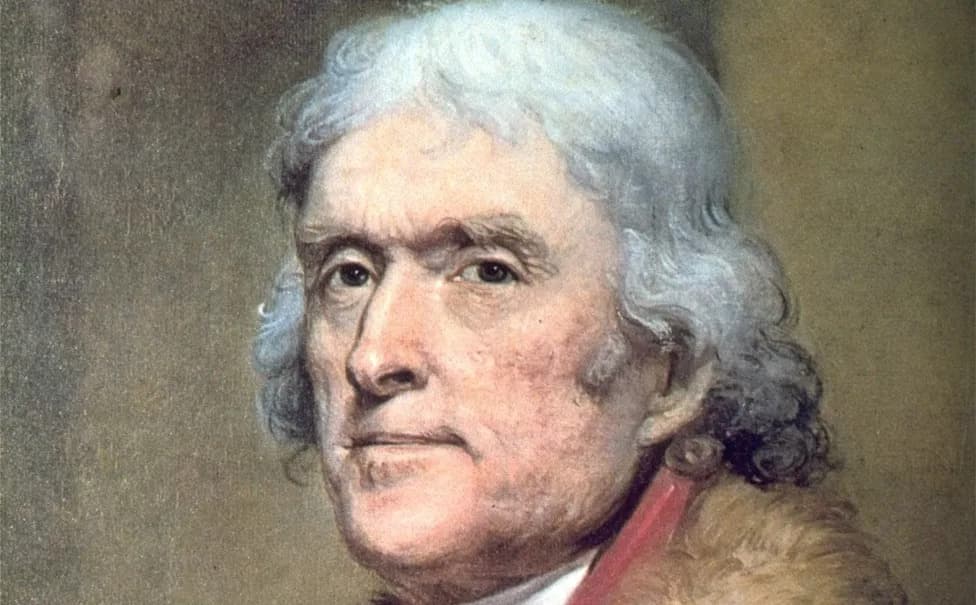
For more than two centuries historians have debated whether Thomas Jefferson, third president of the United States, fathered children with Sally Hemings, an enslaved woman at his Monticello estate. A team at the Smithsonian Institution now reports what it calls "extraordinary proof" that Jefferson was the father of at least two of Hemings's children — Madison and Eston — based on genome sequencing from a lock of hair reputedly clipped from Jefferson at his death in 1826. The investigation and laboratory work are described in the new book History by a Hair, which recounts a 15-year effort to settle a divisive question that touches on race, slavery and the legacy of the Founding Fathers.
Key Findings
Researchers say they sequenced Jefferson's full genome from the deathbed lock of hair and compared it with DNA from more than a dozen fifth-generation descendants of Jefferson and Hemings. After running more than 20,000 simulated paternity scenarios, the team reports that the odds were less than one in a thousand that Jefferson was not the father of Madison and Eston Hemings. In the study, the descendant with the highest proportion of Jefferson-like DNA was descended from Hemings rather than from Jefferson and his wife, Martha.
Research Team and Provenance
The project was led by Richard Kurin of the Smithsonian’s National Museum of American History. The team initially examined three light-red hairs found in Jefferson's personal Bible but, when mitochondrial testing showed those hairs were not from Jefferson or a close relative, researchers turned to a separate lock said to have been clipped at Monticello in 1826. Using that material, they report having sequenced nuclear DNA (the full genome) even though the hair lacked a follicle.
Methods: DNA, Simulations and Comparisons
Scientists sampled DNA from more than a dozen fifth-generation descendants — the last generation likely to retain enough ancestral signal for reliable analysis, averaging about 3.1% shared ancestry. The tested group included nine descendants traced to Hemings through Madison and Eston, two descended from Jefferson's daughter Maria, and two descendants of Randolph Jefferson. The team used advanced laboratory methods to recover nuclear DNA from hair without follicles and ran extensive statistical simulations (20,000+) to evaluate paternity hypotheses.
Jefferson enslaved hundreds of people at his Monticello estate in Virginia over the course of his lifetime - AP/Steve Helber
Historical Context
The allegation that Jefferson fathered children with Hemings dates back to the early republic and was reinforced by oral histories: Madison Hemings, in an 1873 interview, said his mother bore five children fathered by Jefferson. Scholarly skepticism persisted through much of the 19th and 20th centuries, but a 1998 DNA study (published in Nature) and a 2000 report from the Thomas Jefferson Foundation shifted the consensus toward Jefferson being likely the father of at least one son, Eston. In 2018, Monticello described the paternity as a "settled historical matter."
"It is very clear that Jefferson fathered children with Sally Hemings," said Richard Kurin, summarizing the team's view while noting institutions and some scholars may differ.
Limitations and Scholarly Debate
Although the new study reports strong statistical support for Jefferson's paternity of Madison and Eston, some questions remain about the provenance of historical hair samples, the limits of low-percentage descendant DNA, and alternative paternity hypotheses (for example, other male Jefferson relatives such as Randolph have been suggested in the past). The researchers acknowledge these complexities and present their findings as compelling but not necessarily the final word for all historians.
Ethical and Historical Considerations
Beyond the genetics, this story underscores the power imbalance of slavery. Sally Hemings was enslaved, had no legal protection against sexual coercion, was reportedly 16 when first impregnated, and was never emancipated; her children inherited her status. The findings therefore contribute to a broader reckoning with how slavery and the private lives of prominent historical figures are understood in American memory.
Significance: The technical advance of reliably sequencing nuclear DNA from hairs without follicles has also been applied in major criminal cases. This study builds on prior genetic and historical work and adds a substantial new piece of evidence to a long-running historical debate.