Researchers report a blood test that measures the ability of misfolded beta‑amyloid (Aβ) to "seed" further aggregation and distinguishes Alzheimer’s disease (AD) and Alzheimer’s‑related mild cognitive impairment (MCI) from control groups with high accuracy.
How the Test Works
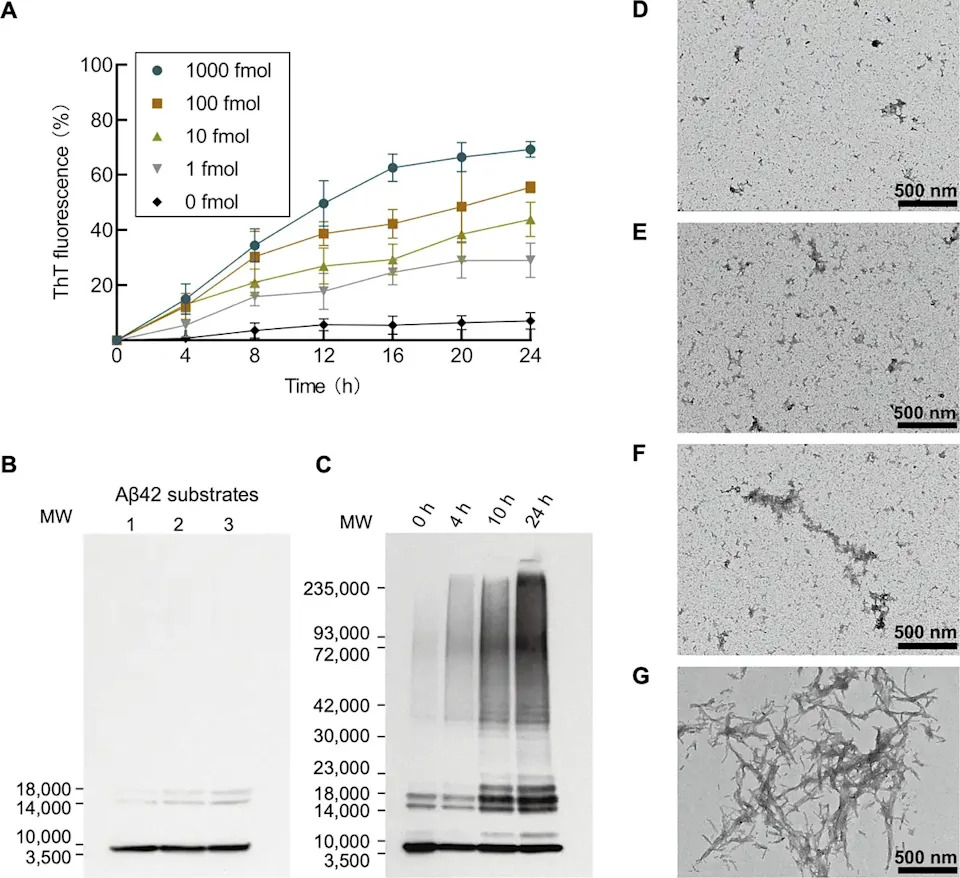
Detection of synthetic oligomeric Aβ seeds in vitro. (CREDIT: Chinese Medical Journal)
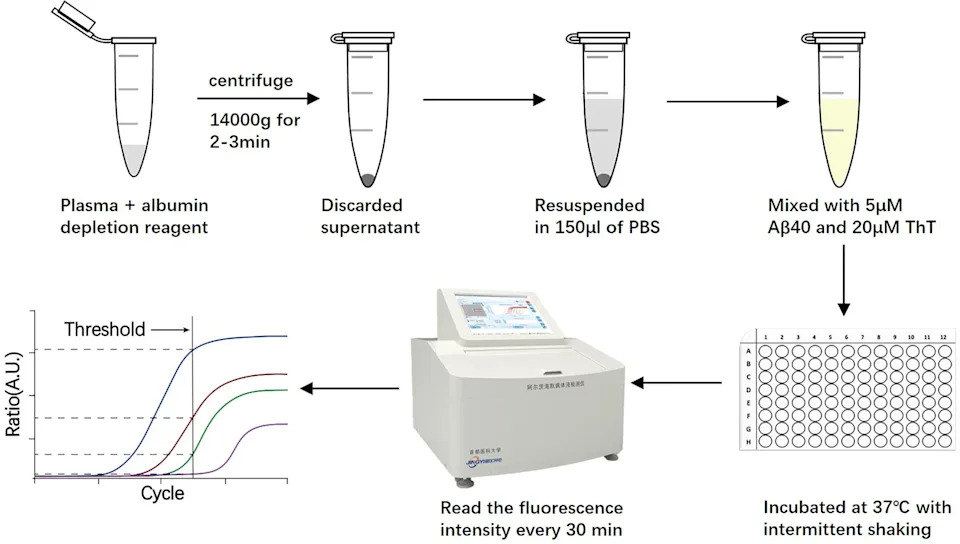
The assay uses real‑time ultrasonic protein misfolding cyclic amplification (PMCA) to amplify trace, misfolded Aβ particles. Instead of measuring only Aβ concentration, it probes a functional property: whether abnormal Aβ particles in plasma can trigger seed‑free Aβ42 to aggregate. Plasma is mixed with seed‑free Aβ42 and Thioflavin T, a dye that fluoresces as amyloid forms. Samples undergo repeated cycles of one minute of ultrasound followed by four minutes without ultrasound at 37°C, with fluorescence recorded every five minutes. The full assay completes within 24 hours.
Laboratory and Clinical Findings
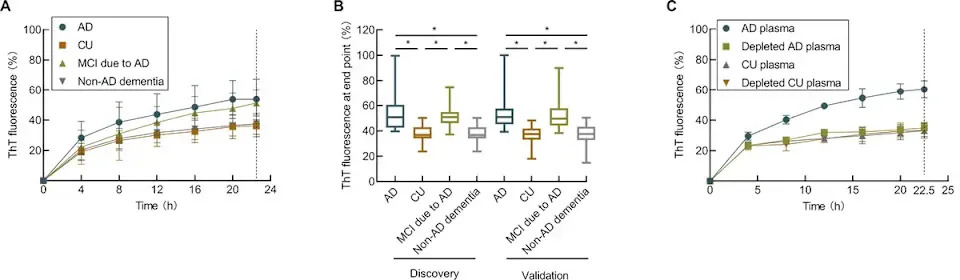
Detection of Aβ aggregation seeding activity in plasma samples. (CREDIT: Chinese Medical Journal)
In lab validation, the system clearly separated samples containing synthetic oligomeric Aβ seeds at concentrations as low as 1 femtomole from seed‑free controls. The developers at Xuanwu Hospital of Capital Medical University then tested the assay in a two‑stage clinical study totaling 549 participants (120 discovery, 429 independent validation).
In the validation cohort the average endpoint fluorescence was 53.31% for AD dementia, 52.61% for MCI due to AD, 36.91% for cognitively unimpaired participants and 37.06% for non‑AD dementia. Immunodepletion experiments—removing Aβ aggregates with antibodies—substantially reduced the signal in AD samples but had little effect on unimpaired samples, supporting specificity.
Schematic representation of steps during processing of plasma samples and the AD-seeds protein analyzer. (CREDIT: Springer Nature Link)
Diagnostic Performance
Receiver operating characteristic analysis in the validation cohort showed strong discrimination: AD dementia versus cognitively unimpaired participants yielded an AUC of 0.93 (95% CI 0.91–0.96); AD versus non‑AD dementia AUC was 0.91. MCI due to AD versus cognitively unimpaired reached 0.92, and MCI due to AD versus non‑AD dementia reached 0.90. These figures closely matched discovery‑phase AUCs (0.89–0.92).
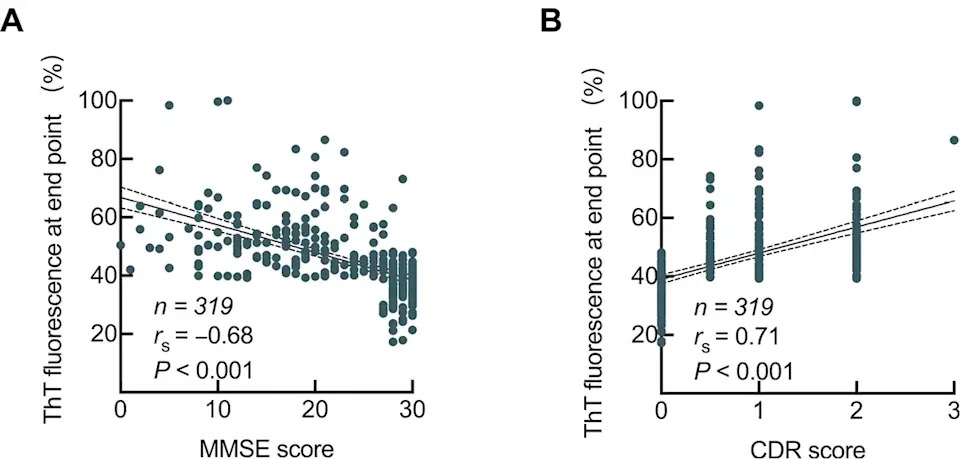
Association between Aβ aggregation seeding activity in plasma and cognitive function. (CREDIT: Chinese Medical Journal)
Among 319 participants with either AD or normal cognition, plasma seeding activity correlated with clinical severity (MMSE r = -0.68; CDR r = 0.71). In a subset with cerebrospinal fluid (CSF) data, plasma seeding activity produced an AUC of 0.90 for distinguishing AD from non‑AD dementia, comparable to some CSF ratios (for example, CSF p‑tau181/Aβ42 AUC ≈ 0.86 in this sample).
Limitations and Next Steps
Important limitations temper the findings: diagnoses were clinical rather than neuropathologically confirmed; CSF measurements were available for only a subset; all participants were of Chinese ethnicity; and the study was cross‑sectional, so it cannot demonstrate whether rising seeding activity predicts future decline or conversion from MCI to dementia. The investigators also did not directly compare seeding activity with several emerging blood biomarkers such as plasma Aβ42/40 or p‑tau217, leaving open whether the assay adds independent diagnostic value.
The team plans larger, more diverse and longitudinal studies to validate performance across populations, compare the assay with established blood tests, and assess whether seeding activity predicts progression or treatment response. If confirmed, the test could become a minimally invasive diagnostic tool, aid participant selection for trials, or provide an objective biomarker for tracking biological changes in response to therapy.
Significance
This method adds a different type of measurement to the growing field of blood‑based Alzheimer's diagnostics by quantifying a functional property of Aβ—its ability to seed aggregation—rather than only measuring concentration. The results, published in the Chinese Medical Journal, are promising but require broader validation before clinical deployment.