Researchers using the Schmidt Ocean Institute's ROV SuBastian filmed Mesopleustes abyssorum amphipods tightly clinging to the legs of giant sea spiders (Colossendeis colossea) at depths of 3,155 m and 2,698 m in the Southeast Pacific. The amphipods gripped the spiders with claw-like appendages and remained attached after collection, suggesting intentional phoresis—hitchhiking for transport. This behavior could help poor swimmers disperse long distances and provide mobile meeting spots for mating, though the authors caution the sample size is small and further study is needed.
Deep-Sea Commuters: Amphipods Hitch Rides on Giant Sea Spiders in the Southeast Pacific
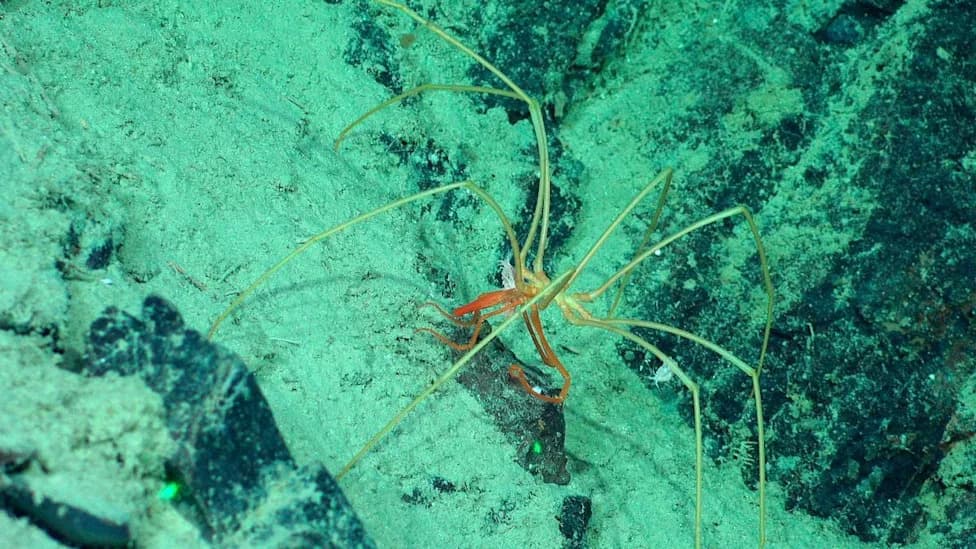
Tiny amphipods cling to the limbs of a giant sea spider (Colossendeis colossea) 3,155 meters beneath the Southeast Pacific Ocean. (Schmidt Ocean Institute/Pérez-Schultheiss et al., Ecology, 2026)
Far below the sunlit surface, where pressure is crushing, temperatures are near freezing and food is scarce, scientists have filmed a striking example of deep-sea ingenuity: tiny amphipods riding on the long legs of giant sea spiders.
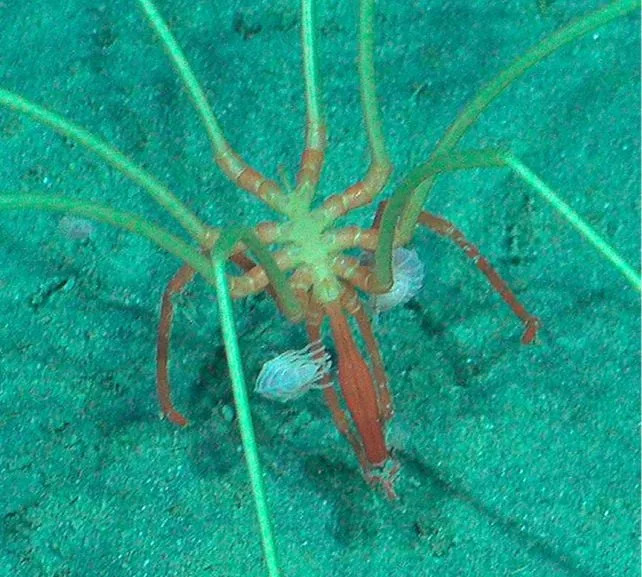
Whee! (Schmidt Ocean Institute/Pérez-Schultheiss et al.,Ecology, 2026)
Using the Schmidt Ocean Institute's remotely operated vehicle SuBastian, researchers recorded Mesopleustes abyssorum amphipods clinging tightly to the limbs of the pycnogonid Colossendeis colossea during two separate encounters in the Southeast Pacific. The first sighting occurred on 24 November 2024 at 3,155 meters depth along the Chilean margin; a second encounter four days later, roughly 225 kilometers (140 miles) away, was recorded at 2,698 meters depth.
YouTube Thumbnail
What the Videos Show
In both cases the amphipods used a long, claw-like appendage at the end of their legs to grasp the sea spider's limbs and maintained a remarkably firm hold, even after the animals were collected. The repeated, tight grip and the pairings observed—often an adult male and female together, and in one case a female carrying eggs—led the team to propose phoresis (hitchhiking) as a likely explanation.
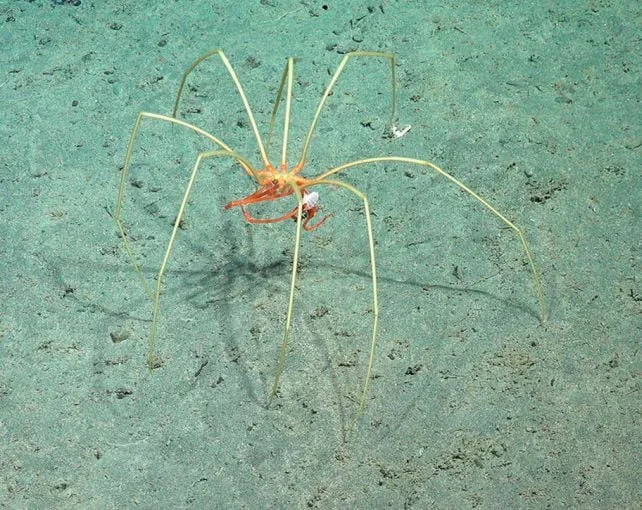
The second encounter. (Schmidt Ocean Institute/Pérez-Schultheiss et al.,Ecology, 2026)
Why This Matters
Mesopleustes abyssorum is a poor swimmer and lacks a planktonic larval stage that would allow passive spread on currents, yet it has been recorded across the Pacific, Atlantic, Indian and Southern oceans at depths between about 690 and 3,500 meters (2,264–11,483 feet). Riding mobile sea spiders could help explain how such amphipods disperse widely and also provide a mobile meeting place to find mates in the sparsely populated deep sea.
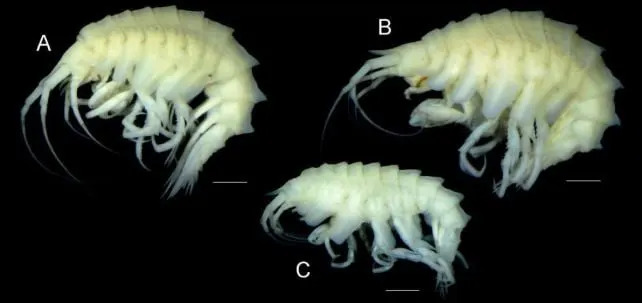
Three of the hitchhiking amphipods. (Jorge Pérez-Schultheiss)
About the Sea Spiders
Pycnogonids like Colossendeis are unusual arthropods with disproportionately long legs and small bodies; some organs even extend into their limbs. While many sea spiders walk along the seafloor, long-legged species can also swim by splaying their legs and catching deep currents—behavior that would make them effective "vehicles" for hitchhiking amphipods.

Subscribe to ScienceAlert's free fact-checked newsletter
Caveats and Next Steps
The authors, led by Jorge Pérez-Schultheiss (Invertebrate Zoology Area, National Museum of Natural History, Chile), note that the sample size is small—just two documented encounters—so they cannot yet rule out incidental contact. However, the apparent specificity and recurrence within a constrained search area suggest an underrecognized ecological strategy. An association between these species was noted as early as 1927, but these are among the first in situ video records documenting the behavior.
“In ecosystems where energy sources are scarce and environmental conditions are extreme, even subtle biological associations may play critical roles in survival and resource acquisition,” the team writes.
The observations and interpretations appear in Ecology (2026). The videos were captured during voyages of the Schmidt Ocean Institute's SuBastian ROV.
Help us improve.