Novaspace forecasts a more than fourfold increase in military ISR satellite launches in 2026–2035, projecting 2,306 defense platforms versus 485 in the prior decade. Growth will be led by defense-owned constellations as countries seek assured, persistent space intelligence after incidents such as the U.S. data-sharing pause in March 2025. Space-defense budgets are expected to rise—peaking around $121 billion in 2028—and SSA launches and spending will expand to cope with a far more crowded orbital environment.
Satellite Arms Race: Military ISR Launches Projected To Quadruple By 2035, Novaspace Says
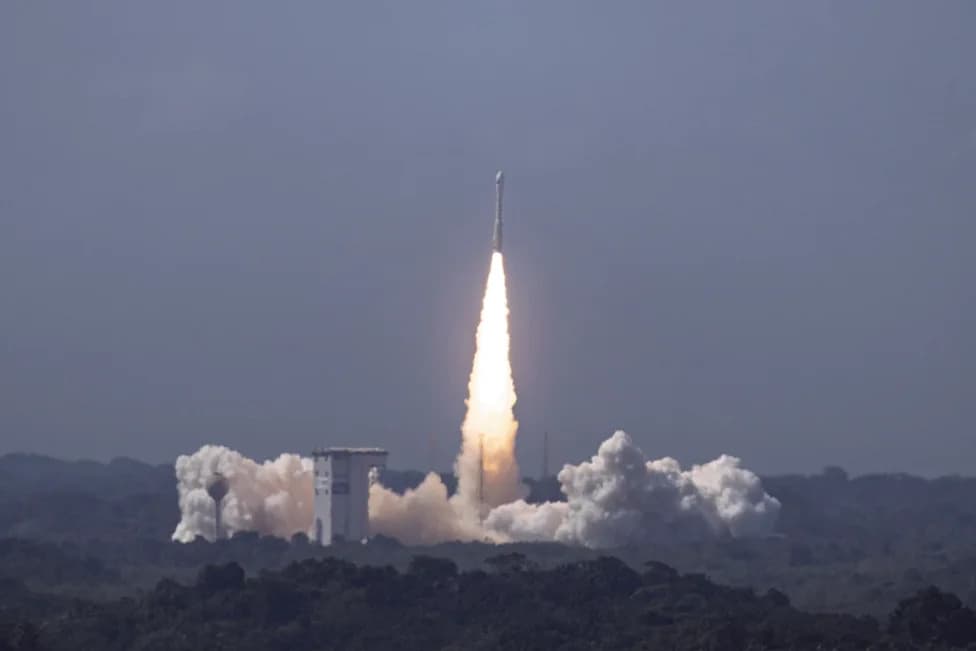
This photograph shows the European Space Agency (ESA) Vega-C rocket carrying the KOMPSAT-7 satellite (KOrea Multi-Purpose SATellite-7) during its launch at the Guiana Space Centre in Kourou, on the French overseas department of Guiana, on Dec. 1, 2025. (Ronan Lietar / AFP via Getty Images)
PARIS — Consultancy Novaspace warns that the number of satellites launched to provide militaries with intelligence, surveillance and reconnaissance (ISR) data is set to surge over the next decade, driven largely by defense-owned constellations and growing national space-defense budgets.
Novaspace projects 2,306 defense ISR satellites will be launched between 2026 and 2035, compared with 485 in the decade up to 2025. Those figures were presented by Novaspace Chief Executive Officer Pacôme Révillon at the Space Defense and Security Summit in Paris.
The war in Ukraine has highlighted the tactical value of space-derived intelligence, while a temporary U.S. pause in data-sharing in March 2025 underlined the need for governments to secure assured, resilient access to orbital information. That dynamic has also accelerated demand for commercial ISR providers such as Finland's ICEYE.
"ISR is obviously a key priority currently for most nations," Révillon said. "It's clearly a world that was already largely transparent, but the direction is as much for a diversification of assets for real-time and persistent intelligence."
Novaspace says most new defense ISR deployments will take the form of constellations rather than individual satellites, enabling more persistent, near-real-time coverage. The consultancy also forecasts a sharp rise in government spending on space defense: budgets are expected to climb to about $121 billion in 2028 from $74 billion in 2024, and Novaspace's dataset shows government space-defense budgets totaled roughly $53 billion in 2022.
Looking further ahead, Novaspace warns the number of operational systems in orbit could expand fivefold by 2036 — to an estimated 50,000–100,000 systems from around 18,000 satellites in 2026 — intensifying the need for space traffic management and monitoring.
To help manage a far more crowded orbital environment, Novaspace expects more than 400 satellites dedicated to space situational awareness (SSA) to be launched between 2025 and 2034, with global SSA spending forecast at about $61 billion across the period, roughly $52 billion of which would be defense-driven.
Implications: Rapid ISR growth will boost military capabilities and commercial opportunity, but it also raises operational, regulatory and safety challenges — from debris and collision risk to the political and strategic tensions of an increasingly militarized space domain. Governments and industry will need to invest in resilience, interoperability and robust SSA systems to manage the coming surge.
Help us improve.