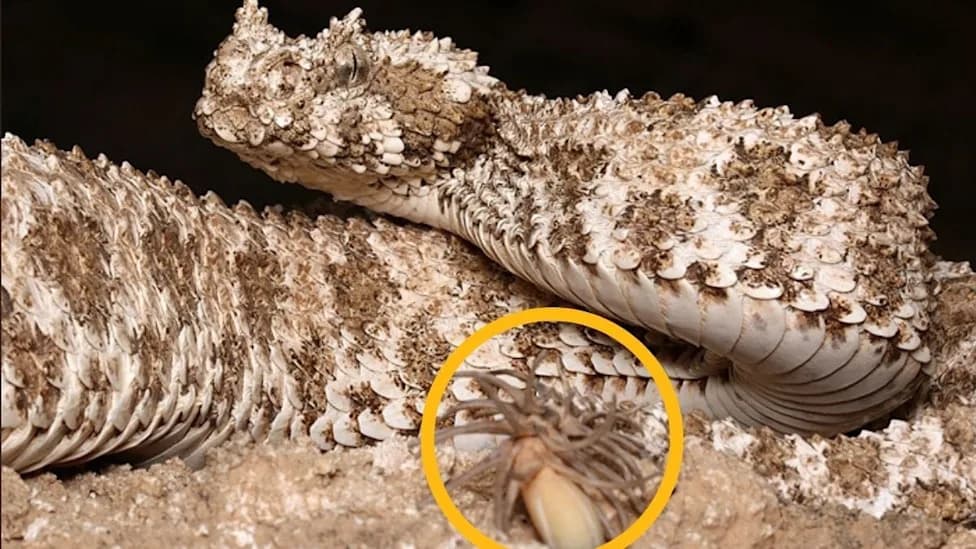
The spider‑tailed viper (Pseudocerastes urarachnoides) lures birds with a tail tip that convincingly mimics a crawling spider. MicroCT scans of the species’ 1968 holotype show the lure contains no special bones — it’s formed from elongated, modified scales and soft tissue. Shortened tail vertebrae increase flexibility to produce realistic, sinuous motions. The finding highlights limits of skeletal evidence and raises genetic questions about how the trait evolved.
X‑Rays Uncover the ‘Spider’ on a Rare Viper’s Tail — It’s All Scales, No Bone
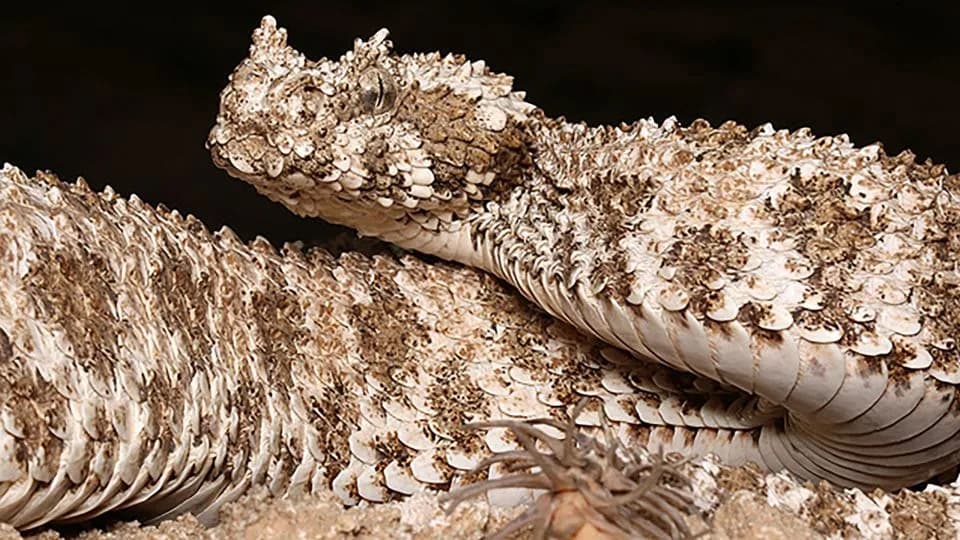
The spider-tailed horned viper wiggles its unusually shaped tail tip to lure prey. - Omid Mozaffari/Field Museum
High on the arid cliffs of Iran’s Zagros Mountains a remarkable deception plays out: a small, wriggling object perched on a rock looks like a plump spider to an approaching bird, but when the bird strikes the 'prey' it is instead seized by a waiting predator. The illusion is produced by the tail tip of a rare horned viper, the spider‑tailed viper Pseudocerastes urarachnoides.
First collected in 1968 and formally described as a new species in 2006, the snake’s bizarre caudal lure long puzzled researchers. Early collectors assumed the arachnid‑shaped tip was a tumor, parasite or other anomaly. Only after another specimen was found in 2003 did scientists recognize the structure as a consistent, species‑level trait.
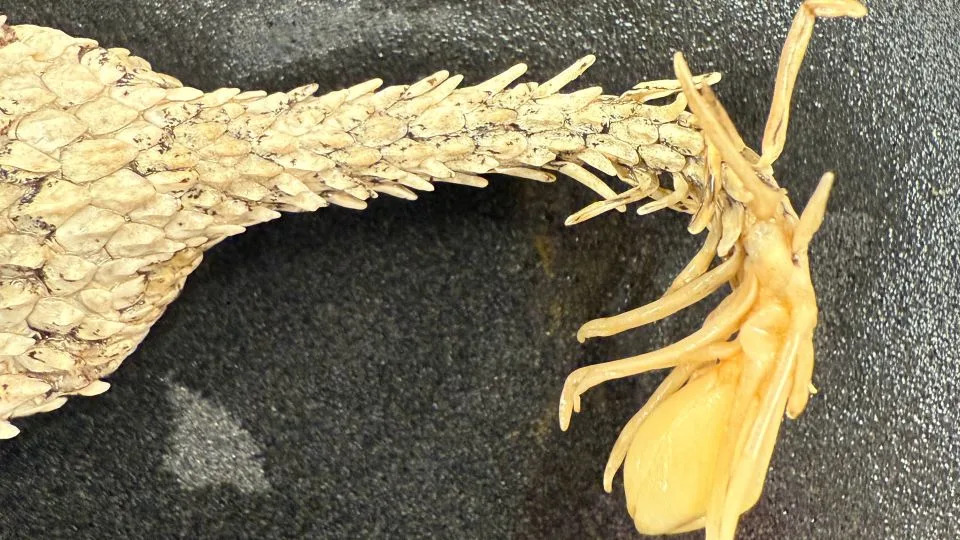
The viper's twitching tail tip mimics a crawling spider. - Sara Ruane/Field Museum
Researchers led by Sara Ruane of the Field Museum and Dr. Georgios Georgalis used X‑ray computed tomography (XCT/MicroCT) to scan the 1968 holotype after the museum installed a new scanning lab. The results, published in The Anatomical Record, delivered an unexpected finding: the spiderlike tip contains no special bones or modified vertebrae.
Soft Tissue Deception
MicroCT renderings reveal that the vertebrae at the tail tip are essentially typical for vipers, though somewhat shortened to increase flexibility. The visible spiderlike form comes from elongated, highly modified scales and soft tissues — a keratinized, darkened appendage that the snake twitches with precise, sinuous motions to mimic a crawling spider.
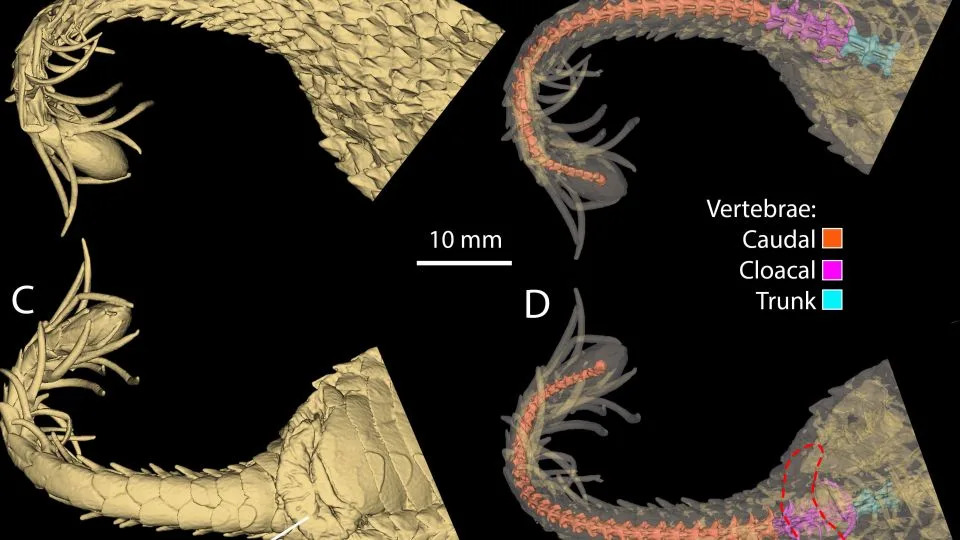
There are no bony structures within the spider-like tip, based on scans. - Sara Ruane et al/Field Museum
“If we had these remains only as fossils today, we would not be able to reconstruct or imagine its spider‑like tail morphology,” Dr. Georgalis wrote, underscoring the limits of skeletal evidence in paleontology.
Behavior, Habitat and Evolutionary Questions
Videos of the species show the snake fishing from narrow rock crevices along cliff faces, luring and ambushing birds that come within reach — sometimes pulling the prey and the snake off the rock. Many snakes perform tail‑twitching displays, especially juveniles with brightly colored tips that attract frogs, but the spider‑tailed viper represents an extreme elaboration of that ancestral behavior.
Reptile morphologist Kurt Schwenk notes that shortened tail vertebrae likely enhance flexibility, allowing the tight bends needed for the realistic spiderlike movements. Future research could investigate the genetic and developmental changes that produced the modified scales and highly keratinized tail tip.
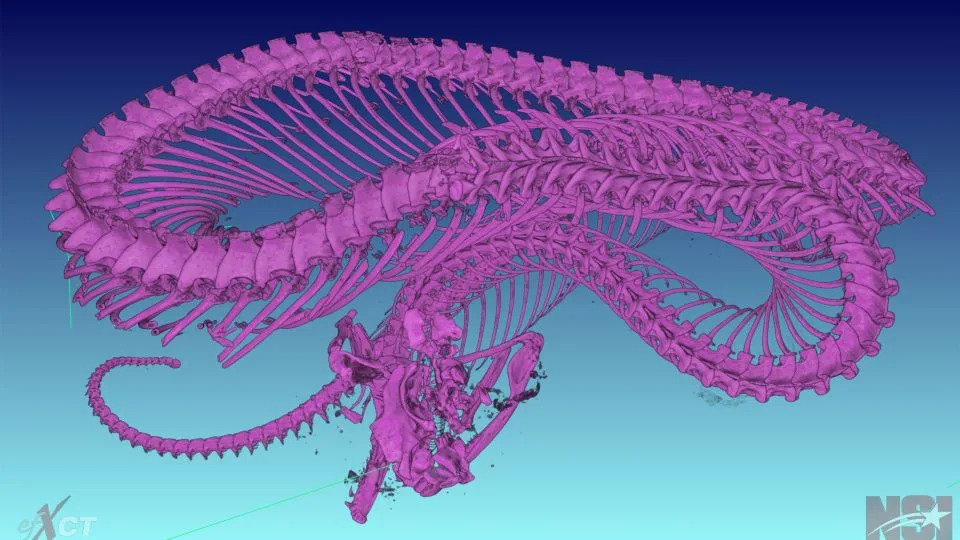
The researchers used MicroCT scanning to see all of the vertebrae within the viper. - Sara Ruane and Stephanie Smith/Field Museum
Scientific And Practical Takeaways
The study is a reminder that soft tissues — scales, skin and keratinized structures — can produce striking morphology absent from the skeleton. For paleontologists, this finding emphasizes caution when reconstructing the appearance and behavior of extinct animals from bones alone.
Publication: The Anatomical Record. Specimen: 1968 holotype housed at the Field Museum, Chicago. Techniques: XCT / MicroCT scanning.
Help us improve.