New modeling shows some mangrove stands may be losing carbon sequestration capacity, but the study focuses narrowly on carbon and sites constrained by development or poor hydrology. Experts say the solution is practical: restore tidal connections and give mangroves room to migrate, including managed retreat or infrastructure realignment where needed. Seatrees’ Marereni project in Kenya illustrates how restoration paired with blockchain-registered biodiversity credits can support conservation.
How People Can Help Mangroves Hold Back Climate and Storm Damage
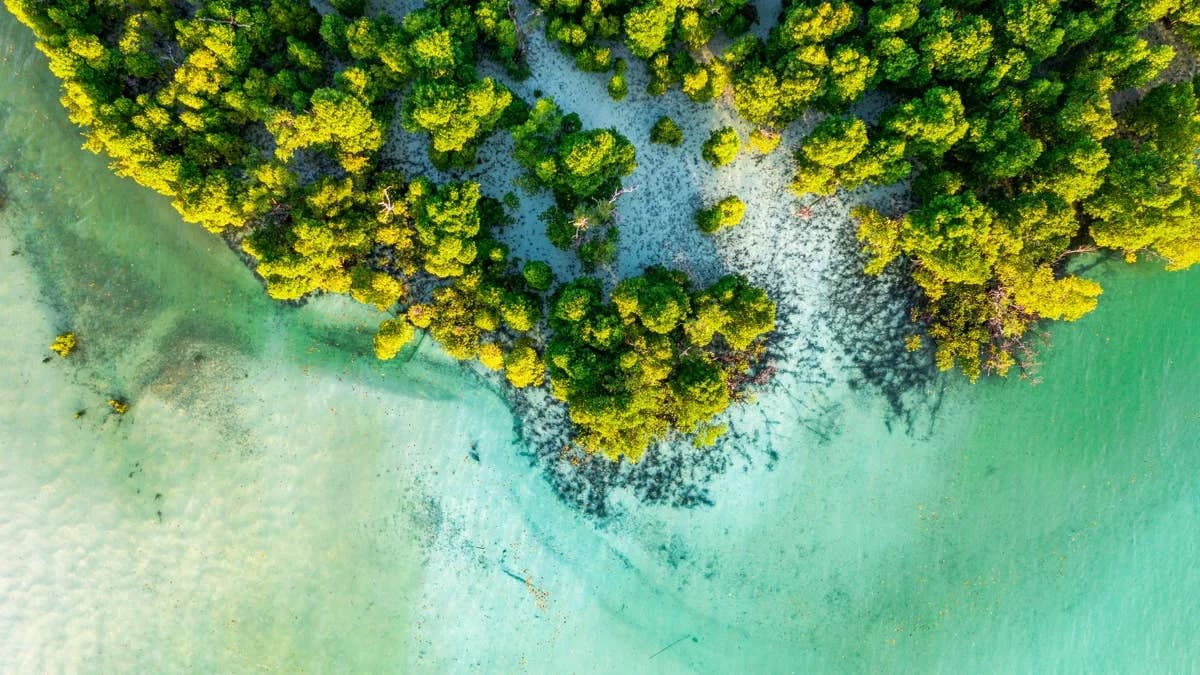
Mangrove forests act as powerful natural defenses—like kelp beds and barrier reefs—protecting shorelines by their physical presence and by trapping and building sediment so the land can keep pace with rising seas.
A recent computer-modeling study published in the journal Earth’s Future, titled "The Importance of Scale in the Future of Mangrove Blue Carbon Under Sea-Level Rise," finds that some mangrove stands are beginning to sequester less carbon. Media coverage framed the results as “Mangrove Forests Fight Climate Change—But Climate Change Is Fighting Back.”
That headline can invite fatalism, but the study addresses only one ecosystem service—carbon storage—and focuses on mangroves on low-lying land that are constrained by beachfront development or limited tidal connectivity. Those site conditions, not an intrinsic failure of mangroves, largely explain the modeled carbon declines.
"The major point that the study pointed out was not necessarily that mangroves were doing a bad job," says Michael Stewart, founder of the conservation nonprofit Seatrees. "It was that coastal infrastructure—roads and buildings built right up to the mangroves—prevents forests from migrating inland as sea levels rise."
Stewart and other experts emphasize practical fixes: restore blocked tidal channels and hydrological connections so the tide can flow naturally, and, where necessary, realign or retreat infrastructure to give mangroves room to adapt. These actions require engineering, policy changes and political will, but they have precedents in managed-retreat projects such as Ventura’s C-Street/Surfers Point.
Mangroves are ancient—present for roughly 50 million years—and, when allowed to function, provide many benefits beyond carbon storage: reducing storm impacts for coastal communities, supplying habitat for terrestrial and marine life, serving as nurseries for commercially important species, and underpinning local fisheries and livelihoods.
A practical example is Seatrees’ Marereni project in Kenya. The initiative combines on-the-ground restoration with an innovative finance mechanism: Seatrees says it is issuing marine-based biodiversity credits tied specifically to mangrove restoration, registered on the blockchain and supported by an interactive project dashboard for transparency.
Rather than viewing modeling results as a reason to abandon mangrove conservation, they should guide targeted interventions—restore hydrology, protect migration corridors, and consider managed retreat where development blocks natural adaptation. With space and connected tides, mangroves can continue to shield coastlines and support communities.
Takeaway: The modeling study highlights site-specific risks to mangrove carbon storage but also points to clear, actionable remedies. Protecting hydrological connections and making room for mangroves are practical steps that preserve their wide-ranging benefits.
Help us improve.