Paleontologists in South Korea analyzed a 106-million-year-old slab preserving two sets of footprints that suggest a large pterosaur chased a smaller vertebrate across the ground. The larger trackmaker has been named Jinjuichnus procerus, an ichnotaxon attributed to neoazhdarchian pterosaurs; its handprints show unusually elongated finger impressions. Researchers estimate the pterosaur moved at about 2.9 km/h (1.8 mph). While direct predation cannot be proven, the proximity and pattern of the tracks make an interaction more likely than a chance co-occurrence.
Ancient Footprints Reveal Giant Flying Reptile Chasing Prey on Land — New Trackmaker Jinjuichnus procerus
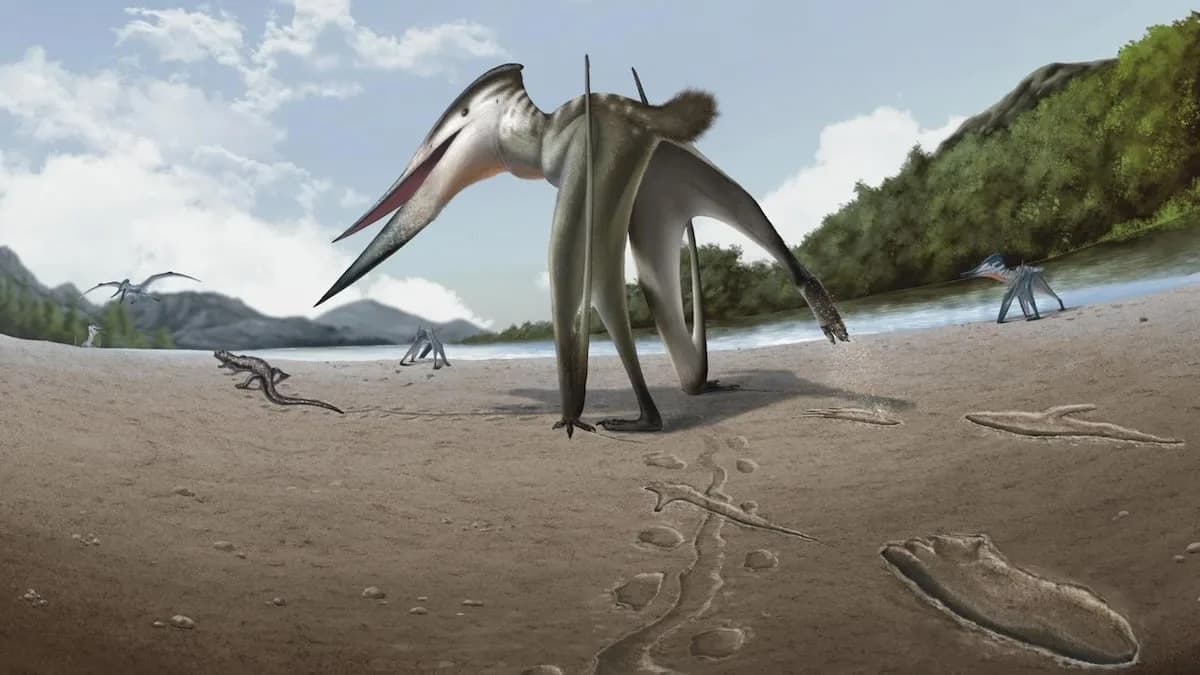
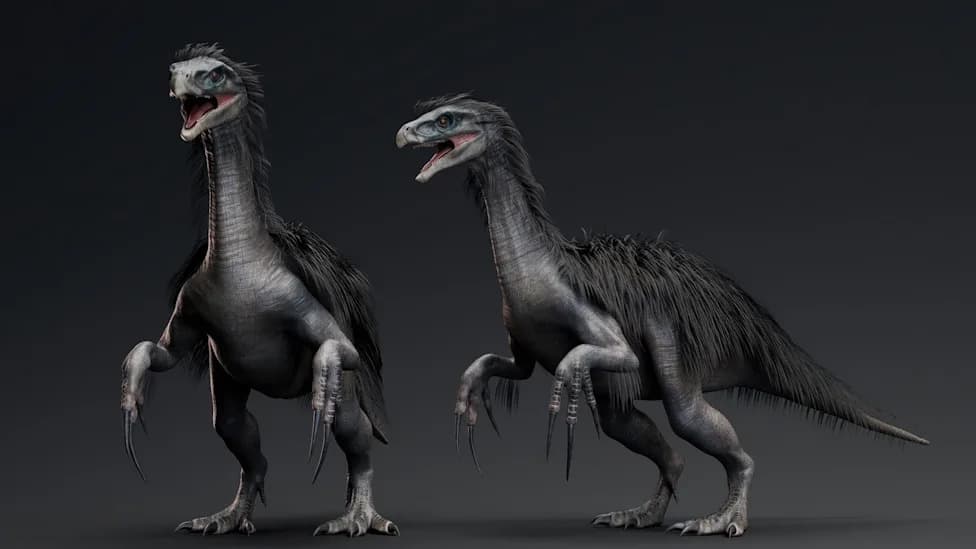
An artist's impression of the pterosaur J. procerus, chasing a small animal – with their footprints in the foreground. (Jun Seung Yi/CC BY 4.0)
Paleontologists in South Korea have reconstructed a dramatic moment from the Early Cretaceous preserved in stone: a large flying reptile running across the ground in apparent pursuit of a much smaller animal. The scene is recorded as two sets of fossilized footprints in a slab of rock that has been preserved for roughly 106 million years.
What the Tracks Reveal
The sequence begins with the smaller animal moving at a leisurely pace before abruptly changing direction and accelerating into a run. A second trackway—clearly distinct and interpreted as belonging to a large pterosaur—appears to approach obliquely and closely follow the smaller creature’s path. Both trackways exit the preserved slab, so the final outcome is unknown, but the pattern and proximity of the impressions make a fatal encounter a plausible interpretation.
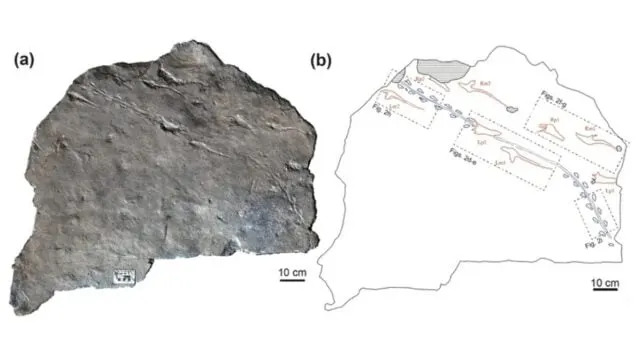
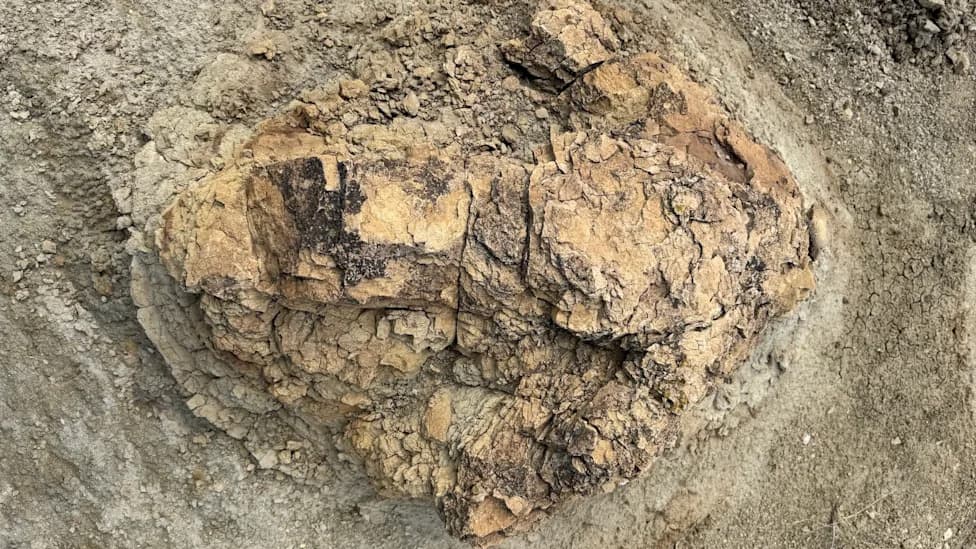
(a) The slab of rock with the footprints embedded in it; (b) a diagram highlighting the two sets of trackways, with the small animal in blue and the pterosaur in red. (Jung et al.,Sci. Rep., 2026)
“While trackway association alone does not constitute direct evidence of predation, the convergence of these lines of evidence, particularly in light of the size and ecological inference of the trackmaker, could suggest an interaction scenario,” the researchers write.
A New Ichnotaxon: Jinjuichnus procerus
Comparisons with other footprint and bone fossils showed the larger trackmaker does not match any previously described species. The authors therefore assign the prints to a new ichnotaxon, Jinjuichnus procerus. The genus name references Jinju, the discovery region in South Korea, combined with the Greek root -ichnus (track). The species name procerus means “elongated,” alluding to the unusually long finger impressions visible in the handprints.
Who Was the Smaller Trackmaker?
The smaller footprints cannot be identified definitively but resemble those of a small salamander, a lizard, or a small crocodilian. The abrupt change in speed and direction of these prints is consistent with an animal detecting and attempting to escape a nearby threat.

Subscribe to ScienceAlert's free fact-checked newsletter
Why Would a Pterosaur Hunt on Land?
Many pterosaurs regularly landed and walked on all fours. Some groups are reconstructed with a powerful, almost gorilla-like forelimb gait, which would allow terrestrial foraging. The researchers describe a possible “terrestrial stalking” strategy—similar in ecological role to modern storks—where pterosaurs forage for lizards, mammals, fish, other pterosaurs, and even small or juvenile dinosaurs.
Speed and Attribution
From stride lengths and footprint geometry, the team estimated the pterosaur trackmaker’s ground speed at about 2.9 km/h (1.8 mph). Claw marks and the morphology of the hand- and footprints match features expected for neoazhdarchian pterosaurs, supporting the attribution of Jinjuichnus procerus to that group.
Interpretation and Caution
The authors acknowledge alternative explanations: the two animals might simply have passed the same spot at different times. However, they argue that several lines of evidence make a direct interaction the more parsimonious interpretation, including the temporal proximity implied by the overlapping impressions, the abrupt behavioral change of the smaller trackmaker, consistent travel direction, and the inferred speed and ecology of the pterosaur.
“Considering the probable temporal proximity of the two trackways, the abrupt change in speed and direction of the small vertebrate trackway, the apparent shared direction of progression, the inferred high speed of the pterosaur trackmaker, and the paleoecology of neoazhdarchians, an interaction between the two trackmakers appears more parsimonious than coincidental co-occurrence,” the researchers conclude.
If the interpretation is correct, the slab offers a striking example of how trace fossils—footprints, not bones—can capture behavior and predator–prey dynamics that are otherwise absent from the fossil record. The study was published in the journal Scientific Reports.
Help us improve.