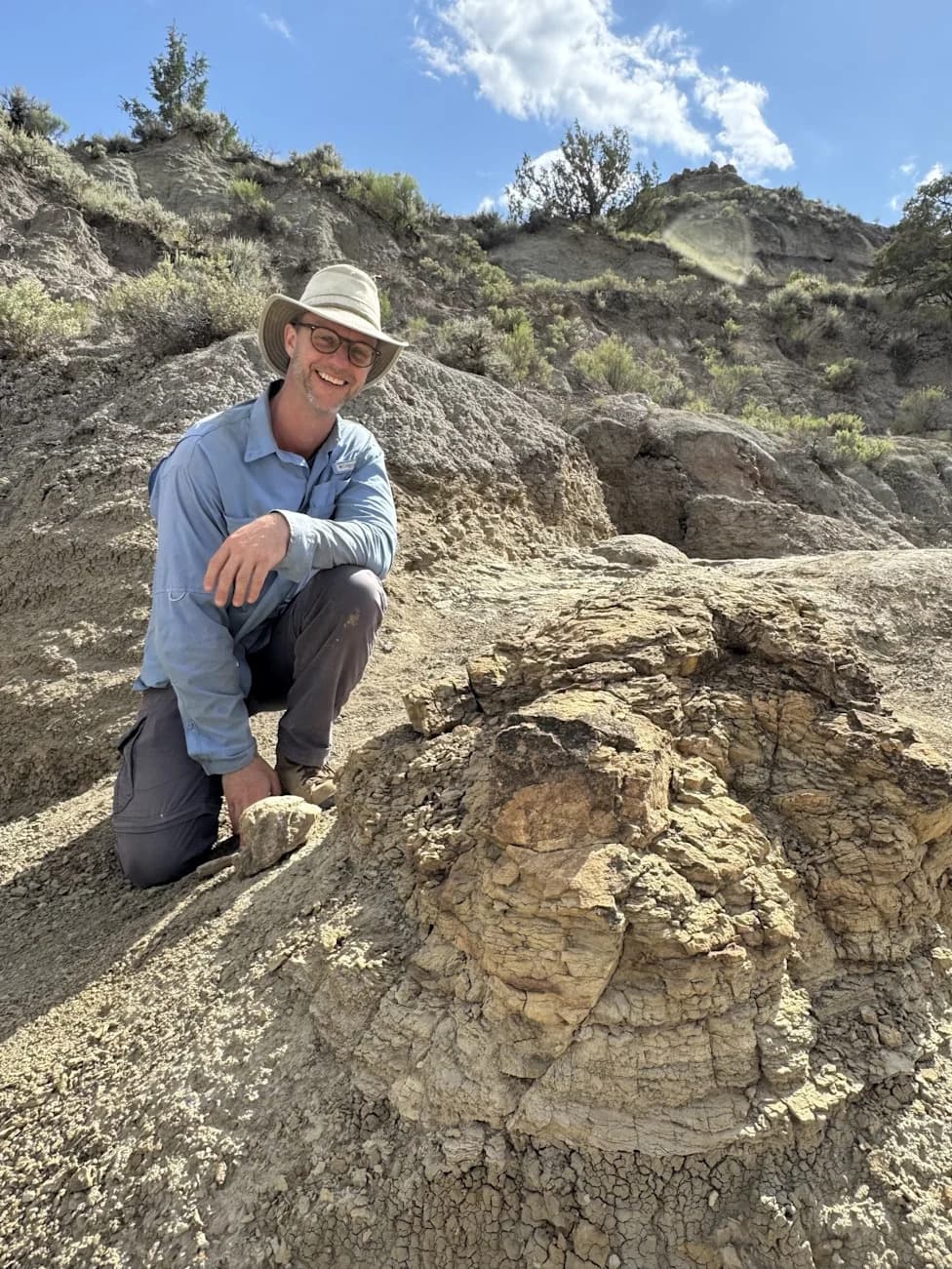
High school teacher and volunteer researcher Kent Hups discovered at least five enormous, three-toed footprints in the Hell Creek Formation in July 2025. Measurements and toe anatomy indicate the prints form the first confirmed Tyrannosaurus rex trackway, a finding described in the Journal of Vertebrate Paleontology on September 8. The four-print stride measures about 13 feet (4 m), suggesting a walking speed near 3.5–4.5 mph (5.6–7 km/h). The Denver Museum of Nature & Science plans to collect three prints for further tissue and skin analysis.
First Confirmed T. Rex Trackway Discovered in Hell Creek — Teacher Uncovers Five Giant Prints

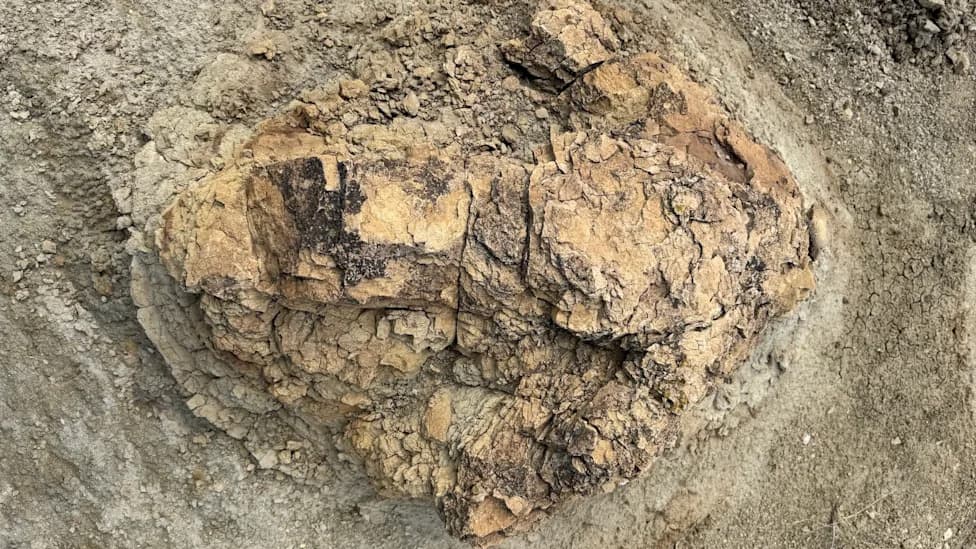
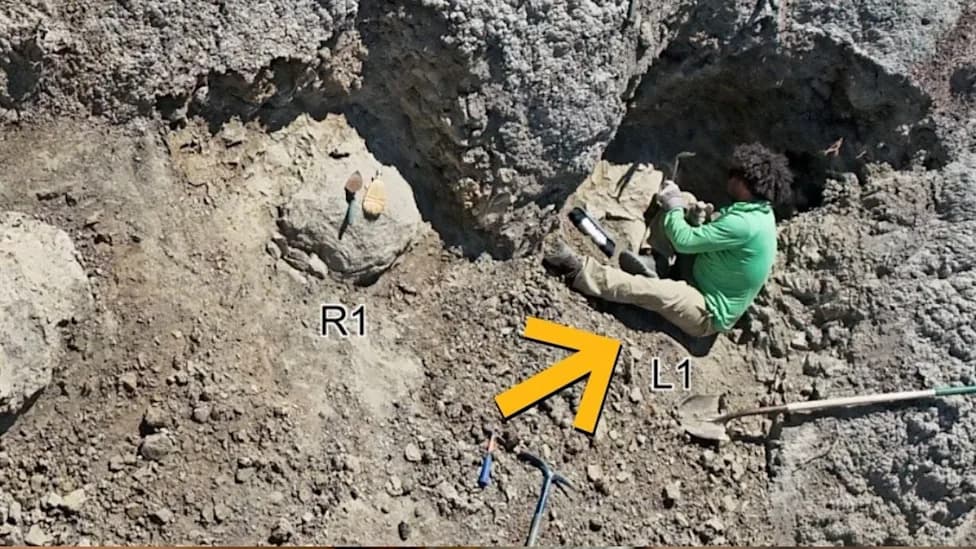
In the Hell Creek Formation in North Dakota, a bird's-eye view shows a researcher uncovering Tyrannosaurus rex tracks from 66.5 million years ago. - Kent Hups/Denver Museum of Nature & Science
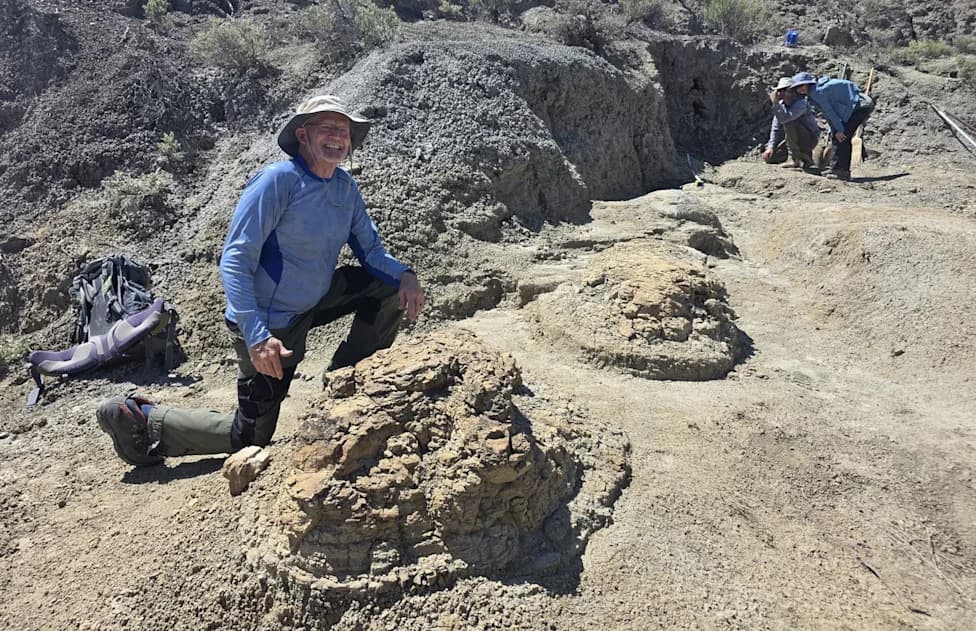
In July 2025, high school science teacher and volunteer researcher Kent Hups discovered unusually large, three-toed impressions in the Hell Creek Formation — a fossil-rich band of sedimentary rock spanning parts of Montana, Wyoming, North Dakota and South Dakota. What began as two exposed prints soon became a sequence of at least five footprints that researchers now identify as the first confirmed trackway attributable to Tyrannosaurus rex.
From an Unexpected Find to a Scientific Milestone
Hups, a volunteer research associate at the Denver Museum of Nature & Science, measured each footprint at roughly 3 feet (0.9 m) long and about 2 to 2.5 feet (0.6 to 0.8 m) wide. The long, three-pronged shape with a relatively elongated central digit matched the known foot anatomy of large theropods, and the size narrowed the likely maker to two candidates from the formation: the duck-billed Edmontosaurus or the apex predator Tyrannosaurus rex. The combination of toe anatomy and scale led researchers to attribute the prints to T. rex.
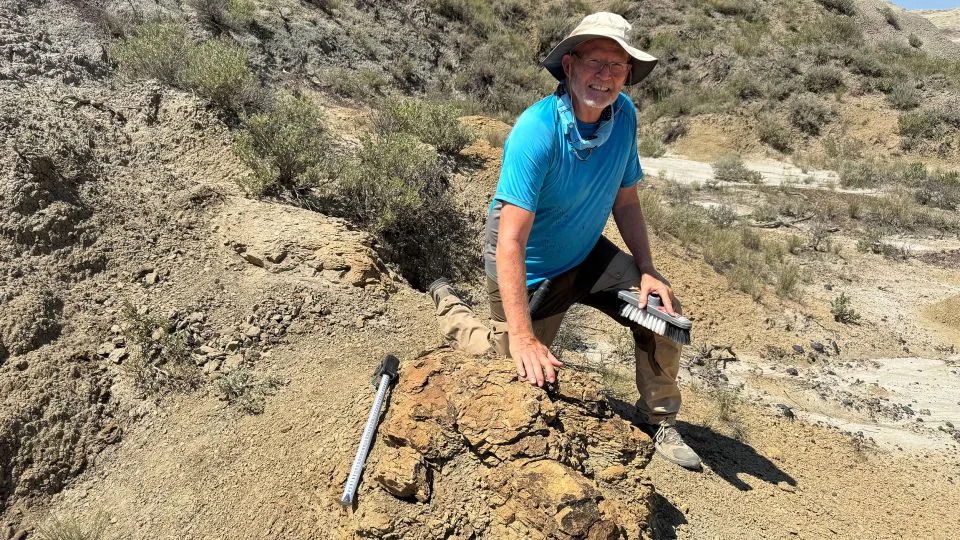
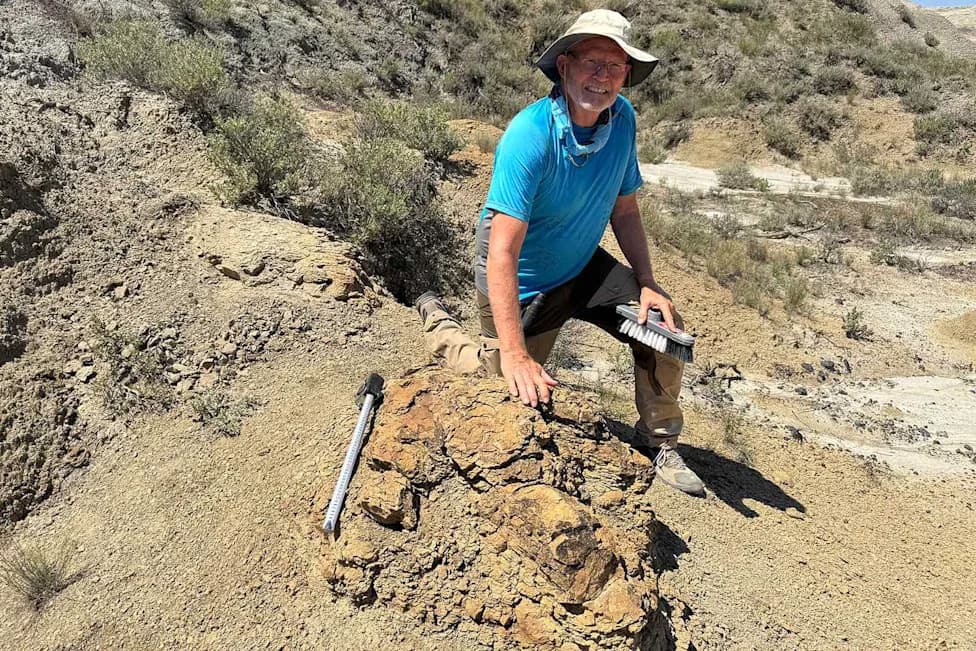
Kent Hups, a high school science teacher from Northglenn, Colorado, first found and helped identify the T. rex footprint. - Tyler Lyson/Denver Museum of Nature & Science
Kent Hups: 'My first reaction was total disbelief. I sat and looked at it for a period of time before I was convinced it was a track at all.'
Tyler Lyson, senior curator of vertebrate paleontology at the Denver Museum of Nature & Science and coauthor of the study, led additional excavation after marking where the next prints should lie. The team uncovered a third, then a fourth, and later a fifth print, forming a convincing trackway sequence documented in a paper published September 8 in the Journal of Vertebrate Paleontology.
What the Trackway Reveals
Unlike isolated bones, a trackway captures a few seconds of an animal's life. The four consecutive footprints measured by the team span a stride of about 13 feet (4 meters), which yields an estimated walking speed of roughly 3.5 to 4.5 miles per hour (5.6 to 7 km/h). Researchers caution this reflects walking on soft, wet ground and is not the animal's maximum speed, but it does provide new, direct data on T. rex locomotion and gait.
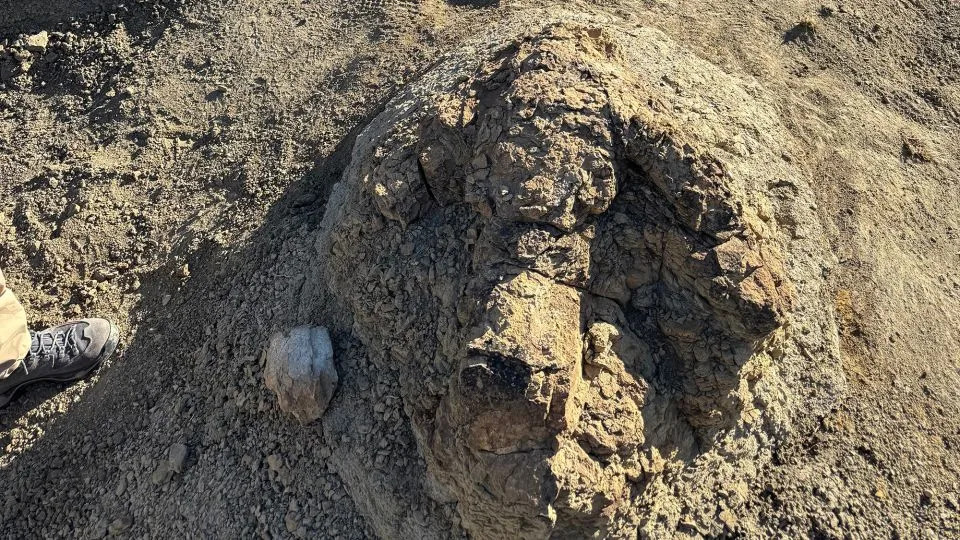
The footprints had a distinct shape, with three slender toes. The prints were about 3 feet in length. - Tyler Lyson/Denver Museum of Nature & Science
Previous reported tyrannosaur footprints are rare: one isolated footprint described in New Mexico in 1994 and another reported from the Hell Creek Formation in Montana in 2008. Trackways from similarly large carnivores exist elsewhere, but sequences attributable to T. rex are exceptionally scarce, making this discovery particularly significant.
Next Steps
The Denver Museum of Nature & Science plans to collect three of the North Dakota prints for detailed study of possible tissue or skin impressions and for further analysis of footprint morphology. The published measurements also invite independent verification and modelling by other paleontologists, and the find may prompt more targeted searches for additional trackways in the region.
Tyler Lyson: 'So, there's no doubt in my mind that it's a trackway that belongs to a T. rex.'
This discovery highlights how a chance field observation can yield fresh insight into ancient behavior and shows the value of careful fieldwork, even in formations long studied by scientists. The trackway offers a rare glimpse into a moment of life 66.5 million years ago and serves as an important complement to the many T. rex skeletons known from Hell Creek.
Credit: Tyler Lyson/Denver Museum of Nature & Science. Reporting by Taylor Nicioli.
Help us improve.