Researchers at Yamaguchi University combined torsion testing of donated cat spines with live 1-meter drops to explain how cats right themselves during a fall. They found the thoracic (upper) spine is significantly more flexible than the lumbar (lower) spine and contains a neutral zone that initiates rotation. High-speed video confirmed the thoracic region turns before the lumbar region, and front-heavy mass distribution (about 26.4% anterior vs. 49.3% posterior) helps the maneuver. The study refines century-old ideas about the aerial righting reflex and calls for further comparative research.
How Cats Twist Midair to Land on Their Feet: New Study Reveals Spine Mechanics
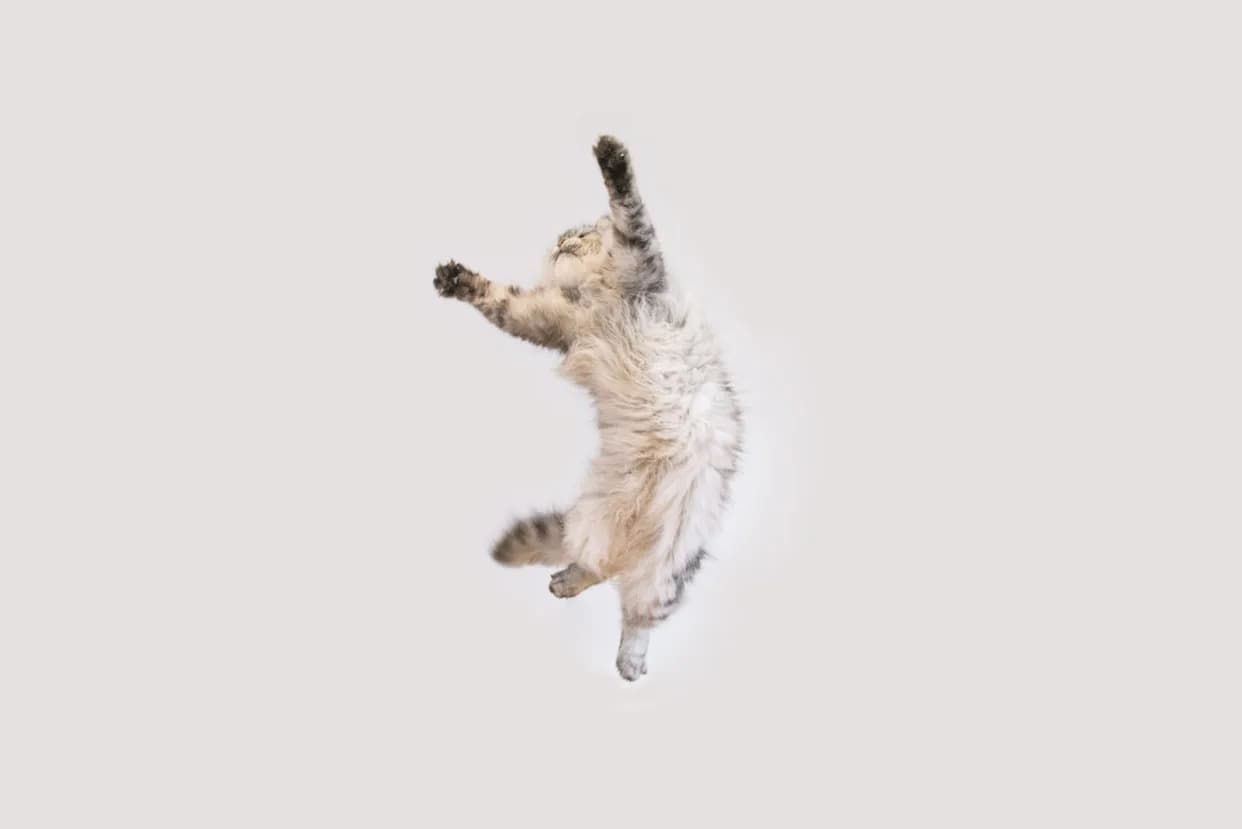
Experts Just Learned How Cats Land on Their FeetKeith_Rose - Getty Images
Cat lovers have long marveled at felines' uncanny ability to right themselves in midair and land on all four paws. A new biomechanics study from Yamaguchi University explains how spinal mechanics and body-mass distribution work together to make that feat possible.
Early work on the aerial righting reflex dates back to French physiologist Etienne-Jules Marey in 1894, but the recent study published in The Anatomical Record adds precise mechanical detail. The researchers combined torsion testing of donated cat cadaver spines with controlled live-drop trials to compare the thoracic (upper) and lumbar (lower) regions of the spine.
Cadaver Tests Show Thoracic Region Is More Flexible
Using a torsion-testing device, the team rotated isolated thoracic and lumbar spinal segments until signs of structural failure appeared. The thoracic spine demonstrated a larger range of motion, a distinct neutral zone that twists under minimal torque, and lower stiffness than the lumbar spine. Maximum torque before failure was lower in the thoracic segments, indicating they are more flexible but also mechanically more fragile than the lumbar region.
Live Drops Confirm Rotation Sequence
To observe the maneuver in living animals, the researchers dropped two domestic cats from a height of 3.3 feet (1 meter) onto a soft cushion while filming at high speed. Frame-by-frame analysis showed the thoracic region began rotating before the lumbar region during successful righting, confirming the sequence inferred from cadaver tests.
The authors note that the thoracic spine had a larger range of motion, a larger neutral zone, and lower stiffness than the lumbar spine, suggesting greater flexibility of the anterior spinal column.
Mass Distribution Helps the Trick
Body-mass distribution appears to assist the maneuver: the head, neck, and forelimbs account for approximately 26.4% of a cat's mass, while the hind limbs, rear trunk, and tail account for about 49.3%. Because the front half is lighter and the thoracic spine is more compliant, the anterior can rotate more readily than the heavier, stiffer posterior, enabling the sequential twisting motion that reorients the cat's body in midair.
Unlike squirrels, which can use a substantial tail for aerial control, a typical cat's tail is too light to be the primary righting mechanism. Whether very bushy tails confer any measurable advantage remains an open question.
The paper concludes that further comparative work is needed to explore interspecific differences in spinal mechanics and to better understand how living animals coordinate vision, muscle control, and passive mechanical properties during aerial righting.
Note: The study used cadaver specimens for mechanical testing and a small number of live-animal trials for behavioral confirmation. The paper does not report reward protocols for the participating cats.
Help us improve.