The Environmental Protection Agency, now under the Trump administration, told a federal appeals court it will defend a Biden-era rule requiring replacement of most lead service lines within 10 years. The rule lowers the action trigger to 10 parts per billion, mandates customer notification and immediate action when elevated lead is found, and provides a three-year planning window before replacement begins. The American Water Works Association is challenging the rule on authority and feasibility grounds; the EPA says most systems can comply and that replacement is necessary to prevent widespread health harms.
EPA Under Trump Will Defend Biden-Era 10-Year Lead Pipe Replacement Rule
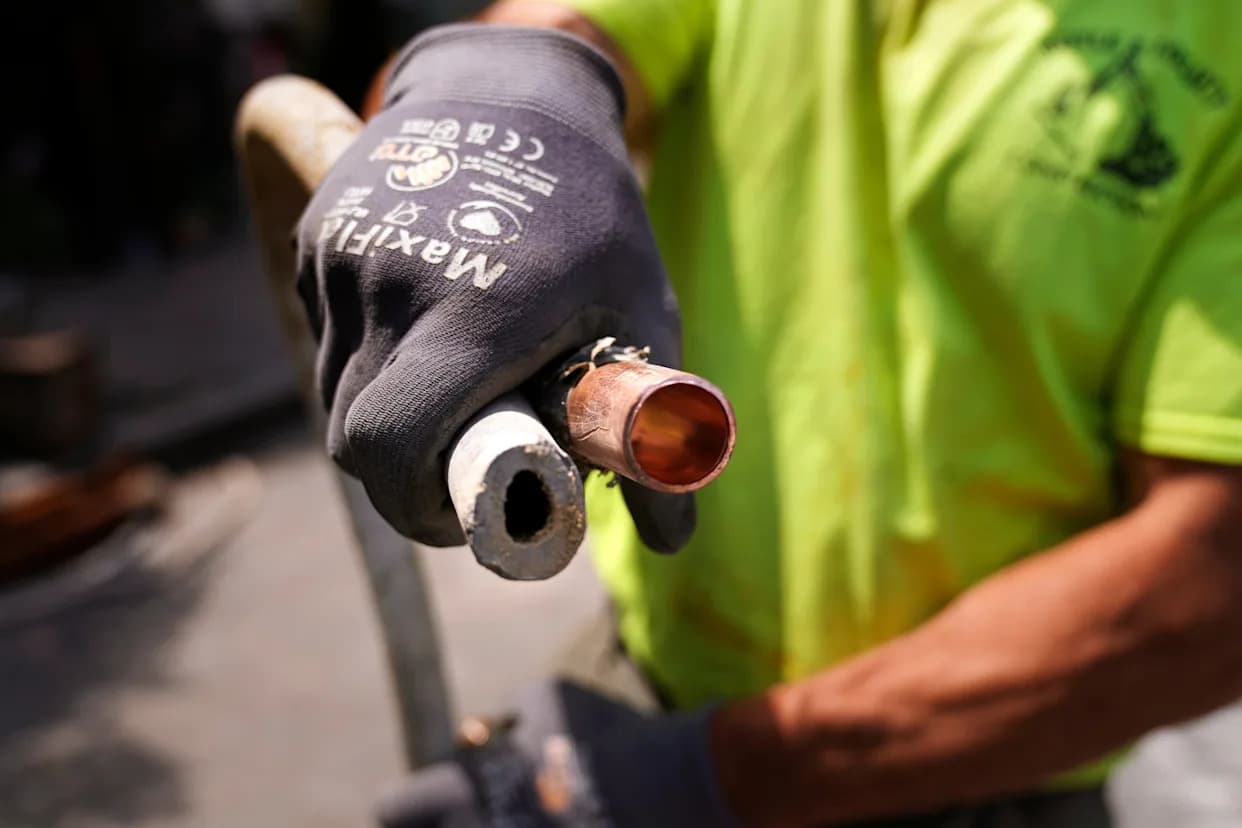
FILE - Richie Nero, of Boyle & Fogarty Construction, shows the the cross section of an original lead, residential water service line, at left, and the replacement copper line, at right, outside a home where service was getting upgraded June 29, 2023, in Providence, R.I. (AP Photo/Charles Krupa, File)(ASSOCIATED PRESS)
WASHINGTON — The Environmental Protection Agency, now operating under the Trump administration, told a federal appeals court it will defend a Biden-era rule that requires most cities and towns to replace lead service lines within 10 years. The EPA said replacement is the only feasible way to meet the Safe Drinking Water Act’s mandate to prevent anticipated adverse health effects.
Agency Will Defend the Rule
In a filing to the U.S. Court of Appeals in Washington, the EPA said it will contest a legal challenge brought by the American Water Works Association (AWWA), a trade group representing water utilities. The agency characterized the rule as the most significant tightening of drinking-water lead standards in roughly three decades and reiterated that a decade-long timeline is realistic for most systems.
Why Replacement Is Required
The EPA’s filing said prior approaches that relied mainly on chemical treatment and monitoring "failed to prevent system-wide lead contamination and widespread adverse health effects." Replacing lead service lines directly addresses the primary source of lead in drinking water, the agency argued, and supports the Safe Drinking Water Act’s requirement to prevent harm "to the extent feasible."
Key Provisions and Implementation
The 2024 rule lowered the action trigger for lead in drinking water from 15 parts per billion to 10 parts per billion, requires utilities to notify customers and take immediate action when elevated levels are found, and mandates work to replace lead service lines. Utilities are given a three-year planning window before the 10-year replacement countdown begins, and systems with very large inventories of lead lines may receive additional time.
Legal Challenge and Agency Response
The AWWA argues the EPA lacks authority to require replacement of the portion of service lines located on private property and also says the 10-year deadline is infeasible given workforce and other infrastructure demands. The EPA countered that utilities exercise sufficient control over service lines to be required to replace them and said its review of dozens of systems shows most can complete replacements within the allowed timeframes.
Health Stakes and Estimates
Federal estimates cited when the rule was finalized projected substantial public-health benefits: preventing low birth weight in up to 900,000 infants and averting as many as 1,500 premature deaths from heart disease each year. The Biden administration initially estimated about 9 million lead service lines in the U.S.; the EPA’s updated analysis using a revised methodology now projects roughly 4 million. The agency says the change corrects anomalous state-level results and reflects improved data handling.
Broader Context and Reactions
Environmental groups welcomed the EPA’s decision to defend the rule. Erik Olson of the Natural Resources Defense Council called opposition to the measure limited to water utility trade interests. Some advocates, however, expressed concern after the EPA signaled it would develop "practical implementation flexibilities and regulatory clarity," worrying this could create loopholes.
Separately, the EPA under the Trump administration has proposed partial rollbacks of other Biden-era drinking-water protections, including a plan to revise limits and deadlines for certain PFAS compounds. Both PFAS contamination and lead service lines are costly threats to safe drinking water, and federal funds exist to help communities address them.
Where Lead Is Most Common
Lead service lines remain most common in older, industrial neighborhoods of major U.S. cities such as Chicago, Cleveland, Detroit and Milwaukee. The rule also revises sampling and measurement approaches, which could substantially increase the number of communities identified as violating lead standards.
The EPA did not immediately return requests for additional comment. The AWWA referred to its filings in court when asked for reaction.
Help us improve.