Two senior defence chiefs from Germany and the UK have urged European publics to accept difficult trade-offs—such as higher taxes or cuts to services—to fund increased military spending and strengthen deterrence against a more assertive Russia. In a joint op-ed they warned that Moscow’s military buildup and willingness to wage war, as seen in Ukraine, require collective action and a "whole-of-society" response. They highlighted NATO’s 5% GDP defence target for 2035 and outlined concrete steps under way, including UK munitions factories, German troop repositioning, and a planned UK carrier strike group deployment.
European Military Chiefs Urge Public To Back Painful Defence Trade-Offs To Deter Russia
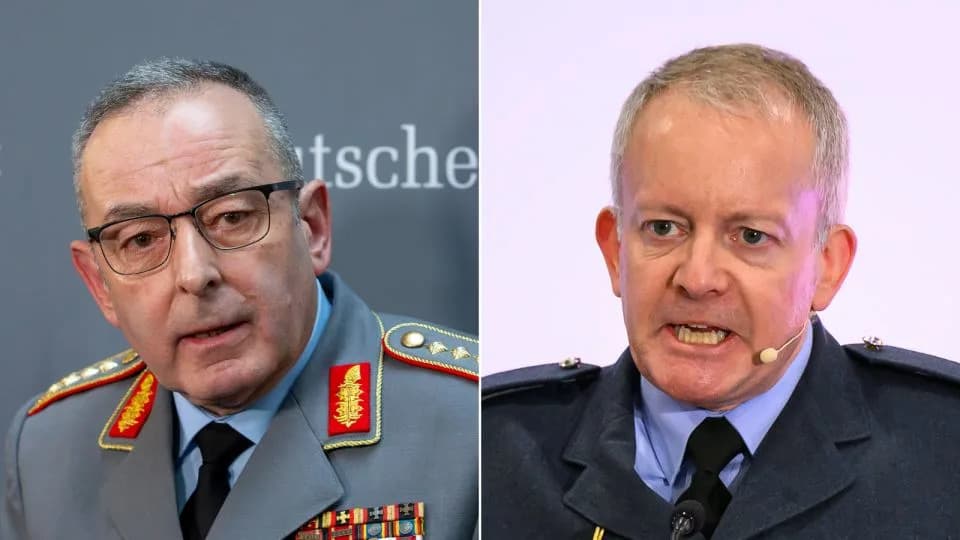
(From left) Germany’s chief of defense, Gen. Carsten Breuer, and the UK’s chief of defense staff, Air Marshal Sir Richard Knighton - SIPA/Getty Images
Senior military leaders from two of the United States’ closest European allies have made an unusually public appeal for broad popular support for significant increases in defence spending to deter an increasingly westward-looking Russia.
In a joint opinion piece published in The Guardian and Die Welt, Germany’s chief of defence, Gen. Carsten Breuer, and the United Kingdom’s chief of the defence staff, Air Marshal Sir Richard Knighton, warned that European governments "must now confront uncomfortable truths" about security and face "hard choices" on public spending.
Why They Warned
"Moscow’s military buildup, combined with its willingness to wage war on our continent, as painfully evidenced in Ukraine, represents an increased risk that demands our collective attention," the commanders wrote. They added that Russia’s intentions extend beyond the current battlefield and that Europe must strengthen deterrence to prevent further aggression.
What They Are Asking Of The Public
Breuer and Knighton urged citizens to accept higher defence budgets even if that requires trimming other public programmes—reversing part of the post–Cold War "peace dividend." They framed rearmament not as warmongering but as a responsible measure to protect populations and preserve peace.
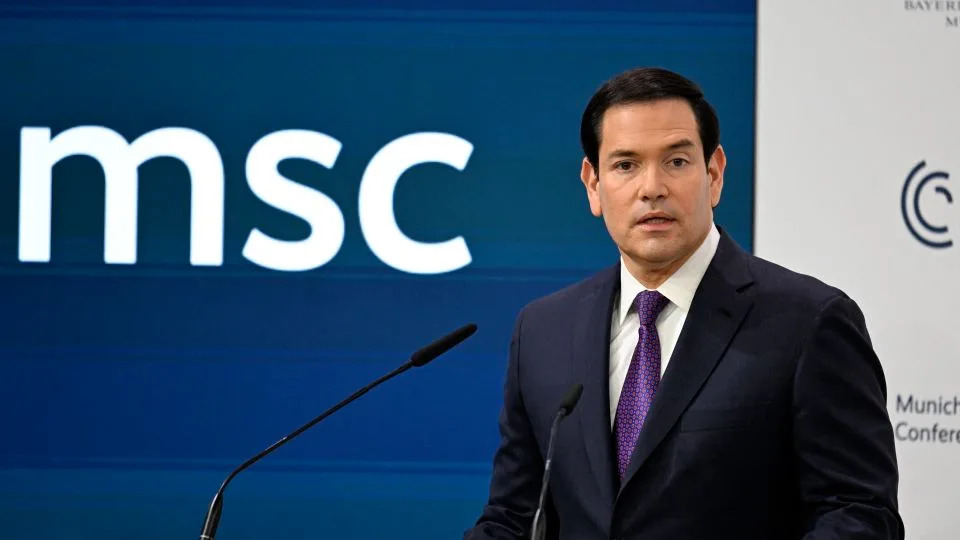
US Secretary of State Marco Rubio speaks during the 62nd Munich Security Conference (MSC) in Munich, Germany, on February 14, 2026. - Thomar Kienzle/AFP/Getty Images
Concrete Steps Underway
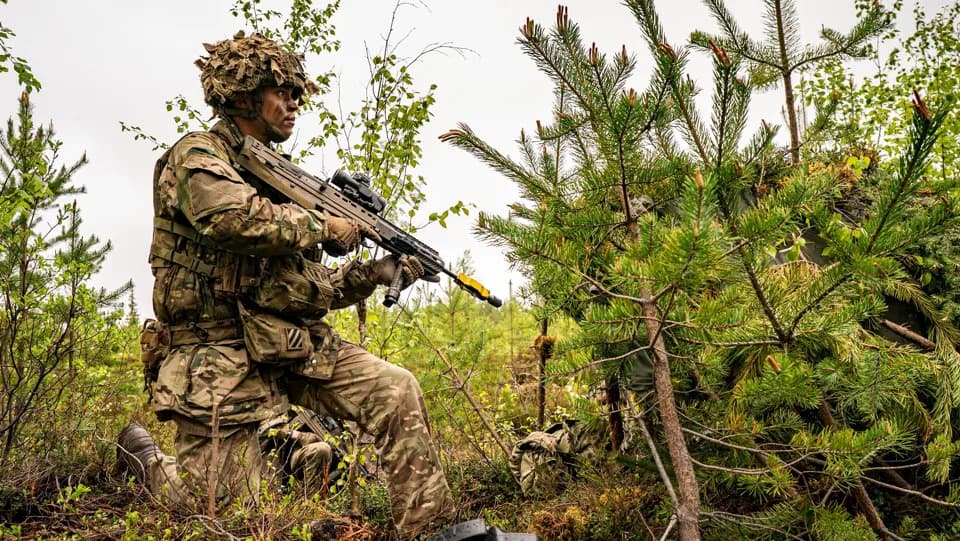
Alongside the appeal for public backing, the chiefs outlined measures their countries are already taking: the United Kingdom is building six new munitions factories, Germany is repositioning forces closer to its eastern border to improve readiness, and the UK plans to deploy a carrier strike group led by HMS Prince of Wales—complete with F-35 jets—to the North Atlantic and Arctic to deter aggression and safeguard undersea infrastructure. The deployment is intended to operate alongside US, European and Canadian forces.
Political And Public Hurdles
The article notes NATO leaders have set a collective benchmark of spending 5% of gross domestic product on defence by 2035. But public appetite for the trade-offs required appears limited: a January YouGov poll found roughly 25% of Britons would support higher taxes or cuts to public services to boost defence, while a Politico poll reported about 24% of Germans would accept higher defence spending if other programmes suffered.
"Defence cannot be the preserve of uniformed personnel alone. It is a task for each and every one of us," Breuer and Knighton wrote, calling for a "whole-of-society" approach to national security.
Their intervention followed discussions at the Munich Security Conference, where international participants emphasized that Europe must assume a larger share of its own defence responsibilities. The joint op-ed aims to spark public debate ahead of difficult policy choices for governments across the continent.
Source: Joint op-ed in The Guardian and Die Welt; polls by YouGov and Politico.
Help us improve.