Law enforcement in southern Africa has uncovered a network of industrial methamphetamine laboratories linked to Mexico's Sinaloa cartel, allegedly built to supply the lucrative Australian and New Zealand markets. The Swartruggens facility — raided in May 2025 — was capable of producing up to five tonnes a month and is under investigation for ties to consignments routed through Durban. Authorities report the P2P production method, large handmade reaction tanks, and precursor chemicals imported from China and India; international agencies including the DEA are assisting the probes.
Sinaloa's Southern Africa Operation: Industrial Meth Labs Target Australia and New Zealand

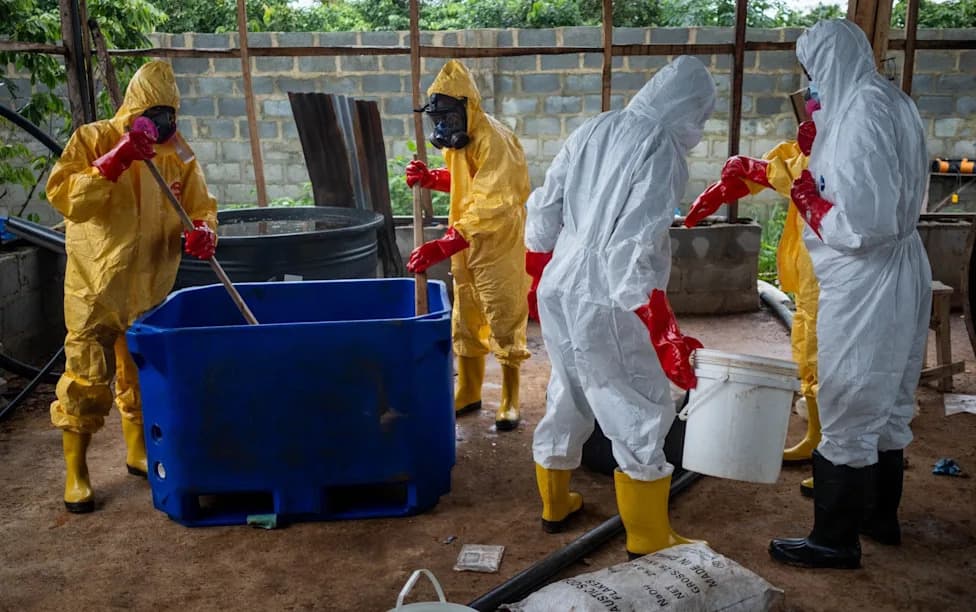
Nigerian investigators enter the biggest methamphetamine laboratory ever found in the country at Iroto in Ogun State, where three Mexicans were held (TOYIN ADEDOKUN)
Mexican 'tourists' who told immigration officials in Johannesburg they were visiting South Africa's famed 'Big Five' — elephants, rhinos, lions, leopards and buffaloes — are now suspected of being chemists dispatched by Mexico's Sinaloa cartel to build industrial methamphetamine laboratories on remote farms. Authorities say the Swartruggens site northwest of Johannesburg is one of at least seven such facilities discovered across southern Africa in recent years, and investigators believe the network was established to supply the highly profitable meth markets in Australia and New Zealand.
Investigation And Key Findings
When police raided the Swartruggens operation in May 2025, they assessed the facility as capable of producing up to five tonnes of crystal meth per month — a volume with an estimated wholesale value of roughly $1 billion in Australia. Brigadier Devon Naicker of the South African Narcotics Enforcement Bureau (SANEB) said investigators are examining whether a specific Australian seizure matched consignments that moved through the port of Durban and matched the lab's packaging methods.
How The Network Operates
Investigators report that the cartel is using the P2P method (based on phenyl-2-propanone), a production route previously uncommon in South Africa. The process depends on a steady supply of restricted precursor chemicals and reagents, most often sourced from China and India and moved via containers, storage units and multiple truck consignments. Producing the necessary precursors emits a distinct odor, which police say can be detected kilometers away under certain conditions.
Regional Spread And Arrests
The Swartruggens raid led to the arrest of 13 people, including five Mexican nationals identified as chemists who police believe arrived on three-month tourist visas in March 2025. Other arrests at the site included Mozambican, Zimbabwean and South African nationals, among them members of the Afrikaner family that owned the game reserve. Similar operations and arrests have occurred in Klipvoor, Musina and earlier sites such as Marble Hall and Krugersdorp.
Authorities in Nigeria and Mozambique have reported comparable discoveries: in Nigeria several large labs have been dismantled this year with Mexicans among those arrested, while in Mozambique two Mexican nationals were detained at Maputo airport and substantial quantities of chemicals were later found at a suspected accomplice's home.
Signatures Of Industrial Production
Police and investigators point to distinctive markers of cartel-run, industrial-scale labs: handmade large-capacity reaction tanks, custom-built kettles assembled by boilermakers, well-organized chemical logistics, and the presence of skilled Mexican operatives who set up production, train local staff and sometimes leave trained personnel to run day-to-day operations.
International Cooperation And Local Impact
Law enforcement agencies including the US Drug Enforcement Administration (DEA) and the US Department of Homeland Security have assisted South African authorities in several seizures and investigations. In one recent action at Musina, police seized five tonnes of solvents, catalysts and reagents commonly used in meth production.
Risks: Officials warn the expansion of cartel activity in Africa raises corruption risks, fuels local consumption (as intermediaries are sometimes paid in drugs rather than cash), and introduces more potent, potentially deadlier meth to international markets.
Local treatment centers in Mozambique and other parts of southern Africa report an uptick in methamphetamine cases, underscoring the immediate social and health costs of these trafficking and production networks.
Help us improve.