A University of Stuttgart team reported a new "super‑moiré" magnetic state in twisted double‑bilayer CrI3 in Nature Nanotechnology. Scanning nitrogen‑vacancy magnetometry at cryogenic temperatures revealed dot‑like spin textures that span multiple moiré cells, growing to ~300 nm near a 1.1° twist and vanishing around 2°. The effect is attributed to competing exchange, magnetic anisotropy and interfacial Dzyaloshinskii–Moriya interaction, and suggests twist angle can tune antiferromagnetic, skyrmion‑like states relevant to ultra‑dense magnetic storage. Practical application will require more stable materials and higher operating temperatures.
Twist Unlocks 'Super‑Moiré' Magnetism in 2D CrI3 — A Step Toward Ultra‑Dense Data Storage
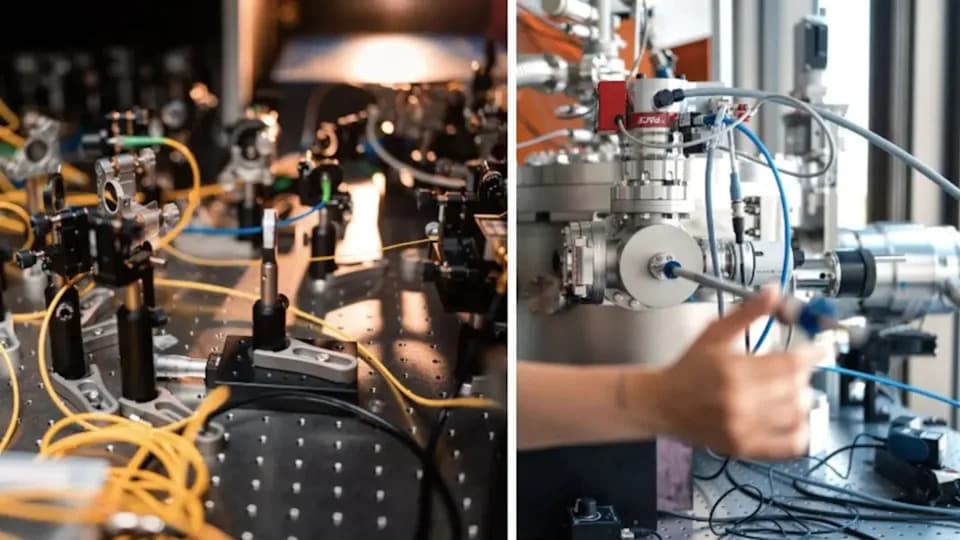
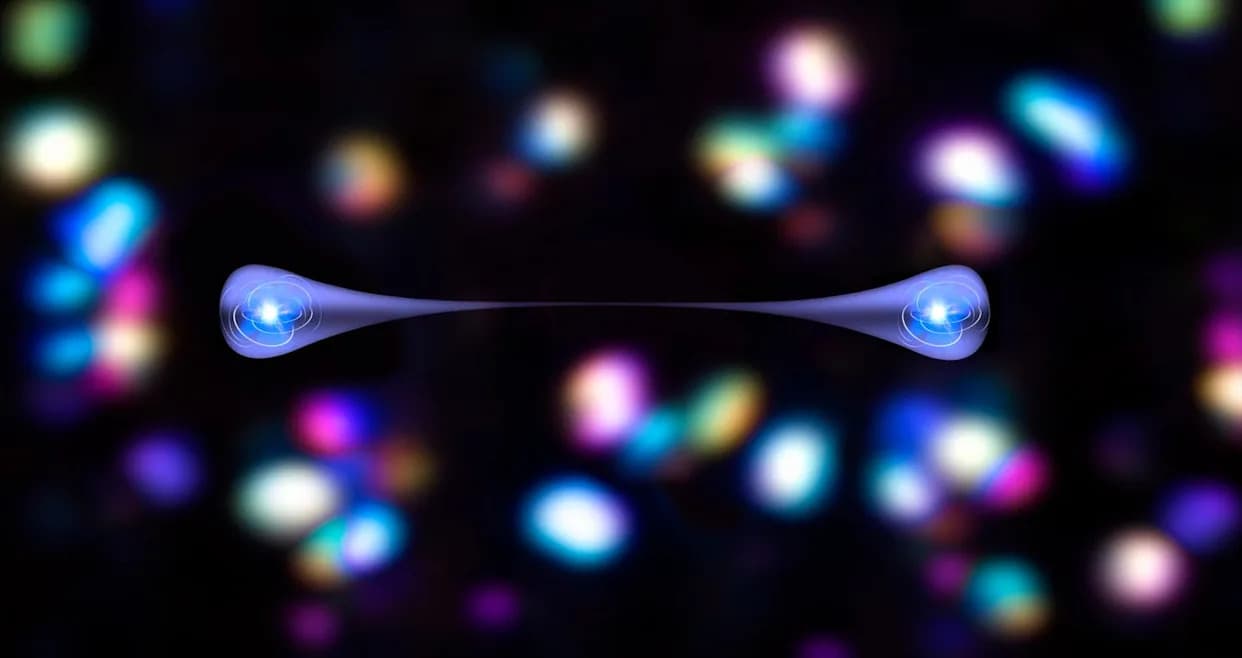
Credit: University of Stuttgart / Ludmilla Parsyak
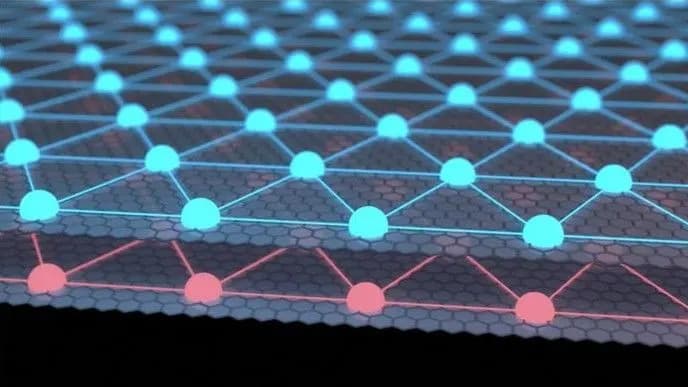
A research team led by the University of Stuttgart has discovered an unexpected, long-range magnetic state in twisted double-bilayer chromium triiodide (CrI3). Published in Nature Nanotechnology on February 2, the work uses nanoscale magnetic imaging at cryogenic temperatures to reveal ordered spin textures that extend well beyond the geometric moiré pattern formed by slightly rotated atomically thin layers.
What the Team Observed
Using scanning nitrogen‑vacancy (NV) magnetometry, the researchers directly imaged dot-like magnetic textures that span multiple moiré unit cells. These textures grew in characteristic size as the twist angle was increased within a narrow range: they reached roughly 300 nanometres near a 1.1° twist and disappeared by about 2°. Individual features inside the textures measured approximately 60 nm.
Beyond a Geometric Moiré
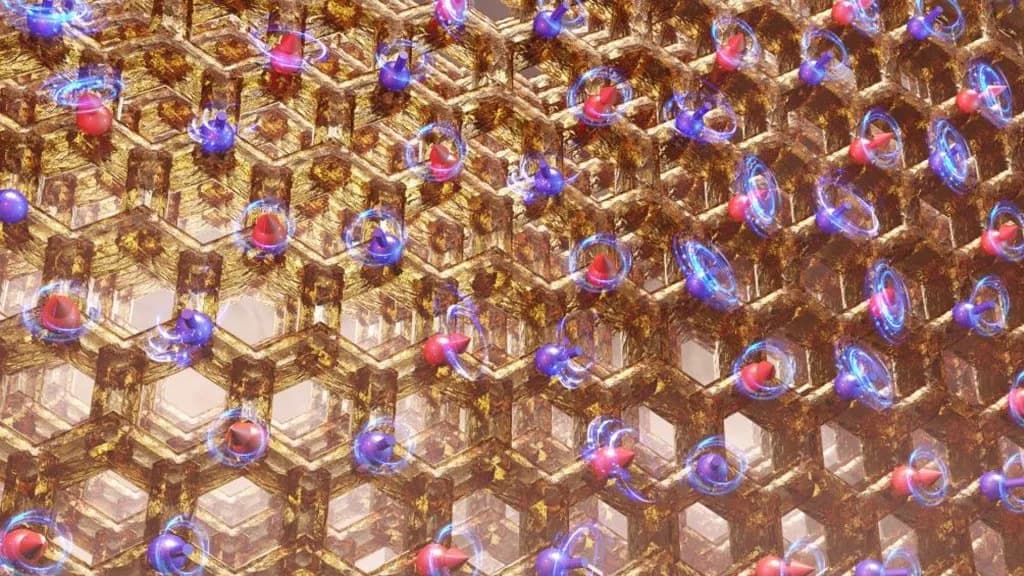
Crucially, the observed textures were not locked to a single stacking fault or local energy minimum of the geometric moiré lattice. Instead, the patterns form a higher-order “super‑moiré” magnetic state — a mesoscale reorganization of magnetism that decouples from the underlying geometric interference pattern and spans multiple moiré cells.

Google Preferred Source
Proposed Mechanism
The authors attribute the super‑moiré behavior to competition between several magnetic energy terms: symmetric exchange interactions, magnetic anisotropy, and interfacial Dzyaloshinskii–Moriya interaction (DMI), the latter arising from spin–orbit coupling at twisted interfaces. When the moiré period becomes sufficiently small, these competing energies can favor magnetic order that is not confined to the geometric moiré, producing textures at a larger length scale.
Why This Matters
The study highlights antiferromagnetic skyrmion‑like states as especially promising because antiferromagnetic textures are expected to suppress the skyrmion Hall effect, enabling straighter, more controllable motion for potential future spintronic devices. The work shows that the twist angle is an effective tuning knob for stabilizing such states in atomically thin materials without altering composition or layer count.
Professor Jörg Wrachtrup, Head of the Center for Applied Quantum Technologies at the University of Stuttgart, said: “As data volumes continue to grow, future magnetic storage media must be able to store information reliably at ever higher densities. Our results are therefore directly relevant for next‑generation data storage technologies.”
Limitations And Outlook
The experiments were performed at low temperatures and CrI3 is air‑sensitive, so the material in its current form is not ready for practical devices. However, the authors emphasize that the underlying mechanism — twist‑dependent competition among magnetic interactions — should be transferable to other layered magnetic materials, including those with higher ordering temperatures and greater environmental stability. If adapted, the super‑moiré concept could inform new routes to ultra‑dense, controllable magnetic information units.
Bottom line: Twist engineering in 2D magnetic stacks can produce emergent mesoscale magnetic order — a tunable “super‑moiré” state — that may be leveraged in future high‑density magnetic storage and spintronic technologies once suitable, robust materials are identified.
Help us improve.