Summary: A new video showing Alex Pretti damaging an ICE vehicle surfaced 11 days before Border Patrol agents fatally shot him. Right-wing figures used the earlier clip to argue the killing was justified, while some on the left prematurely labeled the clip a deepfake despite verification. Cellphone footage of the fatal encounter shows Pretti pepper‑sprayed, disarmed and shot ten times, and the DHS initially issued a conflicting account. The piece warns that wrongly dismissing authentic recordings as AI undermines an important check on political falsehoods.
New Alex Pretti Video Deepens Fight Over 'Deepfakes' and Government Accountability
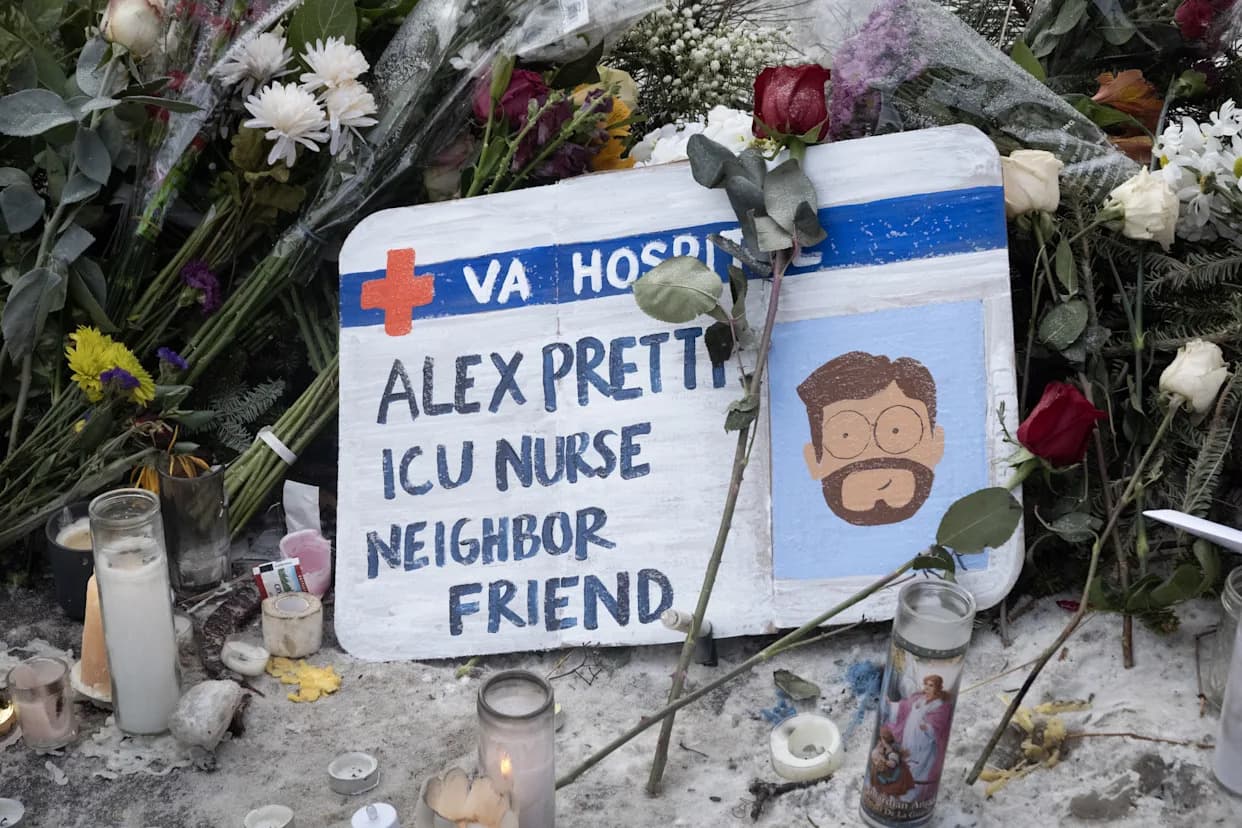
Flowers and candles make up a memorial to Alex Pretti on January 25, 2026 in Minneapolis, Minnesota. | Scott Olson/Getty Images
Last Wednesday, a new video surfaced showing Alex Pretti kicking out the taillight of an ICE vehicle — footage dated 11 days before Border Patrol agents fatally shot him. The clip has intensified an already fraught debate about the role of video evidence, political spin, and the emerging threat of synthetic media.
How The Footage Was Used
Right-leaning commentators quickly framed the earlier incident as evidence that the 37-year-old's killing was justified. On Megyn Kelly's program the footage was presented as proof that the anti-ICE demonstrator had been 'victimizing' Border Patrol, and former President Donald Trump described Pretti as an 'agitator and, perhaps, insurrectionist' whose 'stock has gone way down.'
Why Prior Conduct Does Not Justify Summary Execution
Whatever Pretti may have done previously does not determine whether his shooting was lawful. In the United States, damaging a government vehicle is not a capital offense. The moral and legal problem with Border Patrol shooting Pretti in the back is not that he had sometimes clashed with officers, but that he was a human being who was killed by federal agents.
Video Evidence Versus 'Deepfake' Claims
Some on the left reacted to the newly surfaced clip by alleging it was a deepfake. Those claims spread rapidly across X, Bluesky, and TikTok even after news organizations independently verified the recording's authenticity. Few prominent liberals amplified the conspiracy, yet the rush to call the footage synthetic was notable and, in many cases, unfounded.
Labeling verified footage as AI-generated without strong evidence can erode trust in recorded images — one of the last checks on disinformation and official falsehoods.
The Broader Stakes
From his entry into national politics, Donald Trump has frequently challenged objective fact. All politicians bend the truth to some degree, but critics note that the scale and audacity of his falsehoods have been exceptional. In his first term, for example, fact-checkers cataloged tens of thousands of false or misleading statements — a pattern that helped normalize disputing basic facts.
That dynamic was tested when Border Patrol agents shot Alex Pretti to death in Minneapolis. Cellphone recordings of the fatal encounter show the 37-year-old attempting to help another protester to his feet, then being pepper-sprayed, struck, disarmed and ultimately shot ten times by federal officers. Despite this footage, the Department of Homeland Security initially released a conflicting account, saying Pretti had 'approached officers with a 9mm semi-automatic handgun' and intended 'to inflict maximum damage on individuals and to kill law enforcement.' The widely circulated videos contradicted that narrative.
Official Response And Accountability Measures
Public outrage over the discrepancy between the recordings and official statements prompted high-level responses: a Border Patrol commander was demoted, the DHS secretary acknowledged that initial remarks about the shooting may have been incorrect, and the FBI took control of the investigation. Those moves may or may not restore full accountability, but they did temporarily reassert the power of verifiable evidence.
Why Careful Verification Matters
Artificial intelligence can produce photorealistic fabrications, and reporters were right to seek independent confirmation of the Pretti video rather than accept it at face value. But falsely crying 'deepfake' is also dangerous: it weakens the credibility of authentic visual evidence and accelerates a political environment in which recordings of state violence have diminished power.
In heated political conflicts, people gravitate toward comforting narratives and clear heroes and villains. But those impulses must not override intellectual honesty. The authoritarian right can spread flattering falsehoods without worrying about preserving a reality-based discourse. Defenders of democratic norms do not have that luxury. If critics resist reflexive propaganda tactics and demand rigorous proof before dismissing footage as synthetic, they preserve one of the last practical constraints on executive mendacity — and keep the facts on their side.
Help us improve.