The White House’s initial portrayal of Alex Pretti as a “would‑be assassin” collapsed after multiple witness videos showed he held only a phone while agents forced him to the ground and that an officer removed a weapon moments before another agent shot him in the back. Public outrage spread across political lines and platforms, pressuring President Trump to partially retreat and reorganise immigration leadership in Minneapolis. Commentators compared the administration’s denials to Orwellian tactics, while experts say the proliferation of video evidence is making it harder to sustain alternate realities. Still, critics warn the reversal may be temporary as misinformation patterns persist.
Video Undercuts White House Narrative as Minneapolis Shootings Spark Backlash
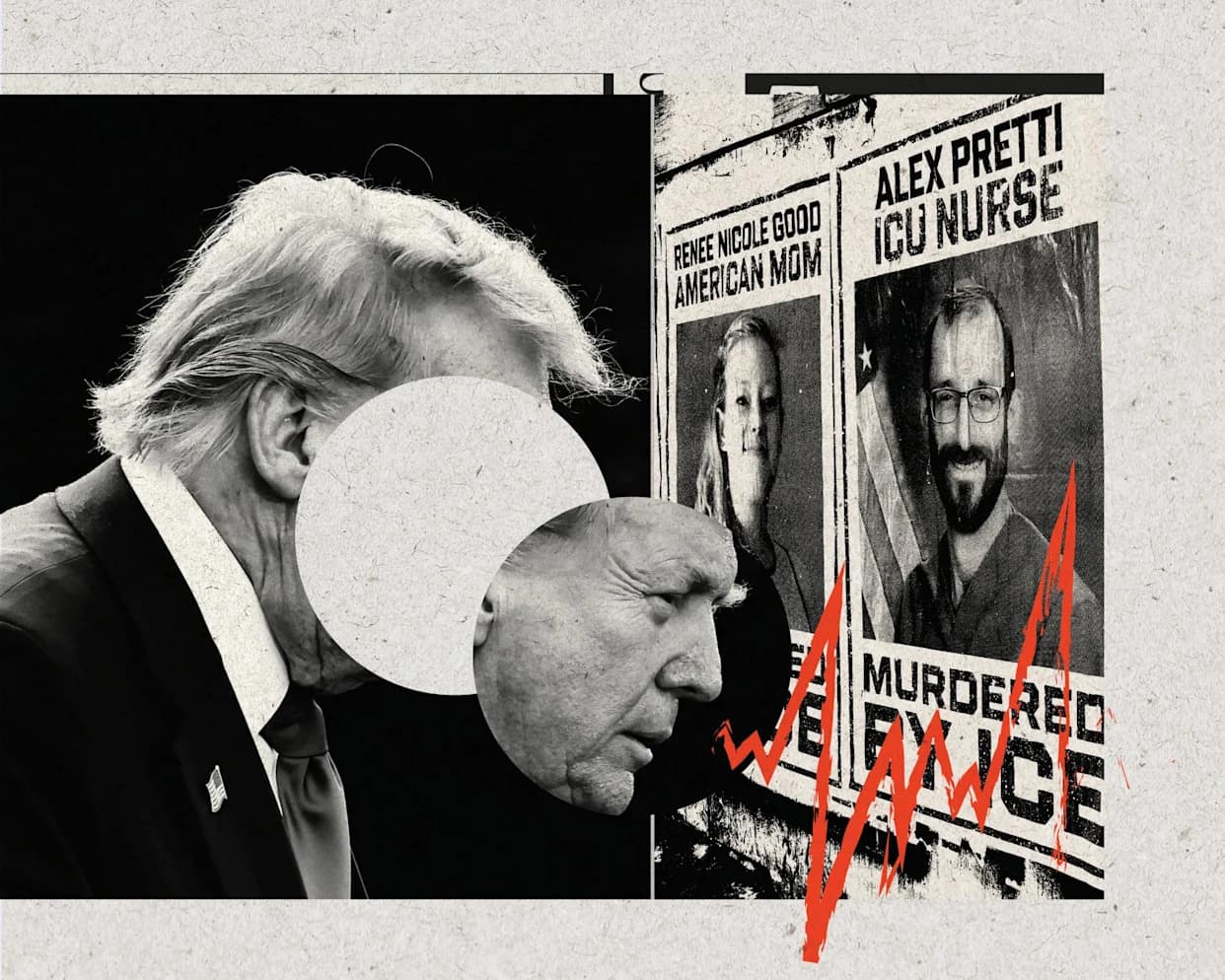
The anger at ICE broke through to online spaces that normally avoid politics.Composite: Rita Liu/The Guardian/Getty Images(Composite: Rita Liu/The Guardian/Getty Images)
Kellyanne Conway’s January 2017 defence — “Our press secretary, Sean Spicer, gave alternative facts” — quickly became shorthand for an administration willing to present contested versions of events as truth. This playbook was tested again after federal agents shot and killed 37‑year‑old intensive‑care nurse Alex Pretti in Minneapolis.
Within hours multiple witness videos surfaced showing Pretti holding only a phone when border patrol agents forced him to the pavement. The footage also indicates that an agent located Pretti’s gun near his waistband and removed it seconds before another agent shot the restrained man in the back.
White House officials initially sought to frame Pretti as a “would‑be assassin” and “domestic terrorist.” Confronted with widespread public outrage — from Democrats, independent observers and some Republicans — President Trump partially backed away, distancing himself from the administration’s hardest‑line rhetoric and reshuffling immigration leadership in Minneapolis. Allies such as Stephen Miller and political figures including Kristi Noem were cited as proponents of the original messaging.
Why Video Made a Difference
Unlike earlier incidents, the Pretti footage was pervasive, detailed and widely shared across platforms. Governor Tim Walz summed up the moment: “Thank God, thank God we have video.” The availability of multiple angles and bystander clips made it difficult for officials to sustain the initial account.
“They were telling Americans to ignore the evidence of their own eyes. That turned out to be the bridge too far for them,” said conservative broadcaster Charlie Sykes.
The episode followed the recent shooting of Renee Good, who was shot by an Immigration and Customs Enforcement (ICE) officer while in her vehicle. Officials’ initial attempts to rebut video evidence in that case had already strained public trust; the Pretti footage proved even harder to contest.
Social Media and the Limits of Narrative Control
Anger toward ICE and the administration spread into corners of the internet that often avoid politics. Posts condemning the White House narrative gained traction on mainstream and niche platforms alike, from Reddit communities to specialty websites. Rick Wilson of the Lincoln Project observed that many MAGA influencers abandoned efforts to defend the administration’s initial story early on, allowing the video‑based narrative to dominate.
Commentators drew comparisons to George Orwell’s Nineteen Eighty‑Four — the idea of a regime insisting people deny their own senses. Laura Beers, author of Orwell’s Ghosts, warned that the message “don’t believe your own eyes” is among the most worrying features of authoritarian information control. But she also noted an important difference today: readily available, sharable video makes it harder to force a counter‑reality on a broad public.
Governor Walz has encouraged residents to record encounters with ICE to build a catalogue of abuses and evidence for potential prosecutions. Tragically, Pretti himself was holding his phone when he was confronted and assaulted.
What remains unclear is whether the White House’s partial retreat represents a lasting check on its information strategy or simply a temporary setback. Within days the president resumed attacks on Minneapolis officials and reiterated broader baseless claims about paid protesters and a stolen 2020 election. Observers warn the administration’s pattern of misinformation is unlikely to disappear entirely.
Bottom line: Ubiquitous video evidence forced a rare public retreat from an official narrative, illustrating the power of smartphone footage and social platforms to expose contested deaths — but whether this moment produces long‑term accountability remains uncertain.
Help us improve.