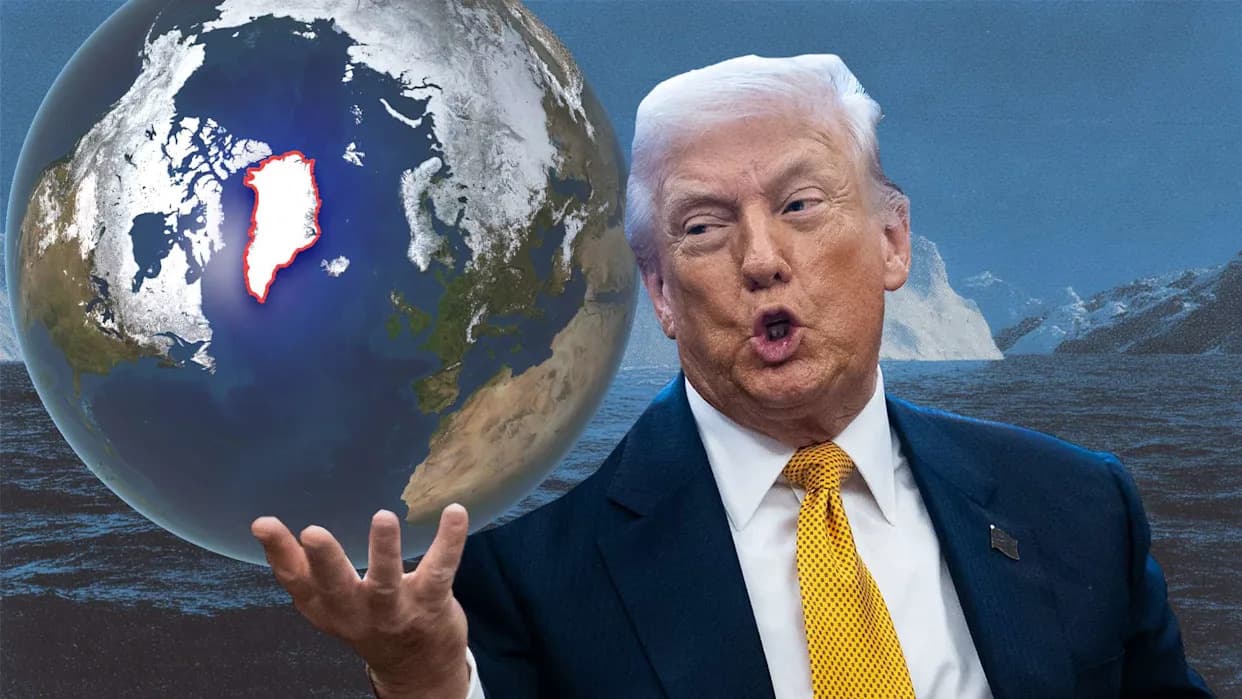
President Trump’s statement about “acquiring” Greenland raises constitutional, diplomatic and legal hurdles. A peaceful transfer would require a negotiated treaty, Senate ratification by a two-thirds majority (typically 67 votes), congressional funding, and the consent of Denmark and Greenland — likely including a vote by Greenlanders under international law. Historical examples such as the Louisiana Purchase, Alaska and the U.S. Virgin Islands show these processes can be lengthy and politically contentious.
What It Would Take For The U.S. To ‘Acquire’ Greenland: Constitution, History, And Hurdles

People gather to march in protest against President Donald Trump and his announced intent to acquire Greenland on January 17 in Nuuk, Greenland. - Sean Gallup/Getty Images
President Donald Trump has publicly said he wants to “acquire” Greenland. That idea captured headlines, but the Constitution, historical precedent, and international law show that a peaceful transfer of sovereignty would be complex, politically fraught and legally demanding.
Constitutional Requirements
The U.S. Constitution gives the president the power to make treaties "by and with the Advice and Consent of the Senate," which requires the approval of two-thirds of Senators present. In practice, when all 100 senators vote, that means 67 votes — a high bipartisan threshold. Separately, Congress controls the disposition and governance of federal lands and territories and must provide any funding for a purchase.
How A Purchase Would Likely Work
A peaceful acquisition would almost certainly require:
- Negotiation of a treaty with Denmark (and likely with Greenlandic authorities and institutions),
- Senate ratification by a two-thirds majority,
- Appropriate legislation and funding by Congress, and
- Consent under international law — including the views and likely a referendum of Greenlanders under U.N. principles on self-determination.
Historical Precedents And Lessons
U.S. history offers examples showing how messy such deals can be:
- Louisiana Purchase (1803): President Jefferson worried the Constitution did not explicitly authorize land purchases, but he submitted the deal and the Senate approved it; Congress authorized funding.
- Alaska (1867): Secretary of State William Seward negotiated the purchase from Russia; despite criticism at the time, the Senate ratified the treaty.
- U.S. Virgin Islands (Late 19th–Early 20th Century): The U.S. tried and failed in 1867 to buy the islands; a later 1916 purchase for strategic reasons succeeded only after political shifts and Danish approval.
- Hawaii (1893–1898): A U.S.-backed coup and contested annexation highlighted how acquisitions can involve extra-legal actions and subsequent political debate; formal annexation required later executive and congressional steps.
- Philippines and Cuba (1898 onward): The Spanish-American War and its aftermath show how military action, occupation, and political compromises (like the Platt Amendment) produced long-term U.S. influence without simple transfers of sovereignty.
Military Action Is Not A Simple Option
Although President Trump did not explicitly rule out military options, using force to seize a semi-autonomous territory would be unprecedented in modern U.S. practice and would carry serious legal, diplomatic and military consequences — both domestically and internationally.
International Law And Greenlandic Consent
Greenland is an autonomous territory within the Kingdom of Denmark. Any transfer of sovereignty would require Danish agreement and would almost certainly require the consent of Greenlanders themselves under U.N. principles on self-determination. Existing agreements already allow the U.S. to expand its military presence in Greenland under certain conditions, but ownership is a far different and more complicated matter.
Political Reality
At present there is no announced purchase price, no clear plan, and no evident willingness from Denmark or Greenland to sell. Key U.S. senators from both parties have expressed skepticism or introduced measures to block any attempt that would damage NATO ties or transatlantic relations.
Bottom Line
Legally and politically, acquiring Greenland by purchase would require complex diplomacy, broad bipartisan support in Congress, Danish and Greenlandic consent, and compliance with international law. Historical examples show such transfers can take years — even decades — and often depend on shifting strategic and political circumstances.
Quick takeaway: A peaceful transfer would mean negotiation, Senate ratification (67 votes in a full Senate), congressional funding, and likely a Greenlandic referendum — not a unilateral move by the president.
Help us improve.