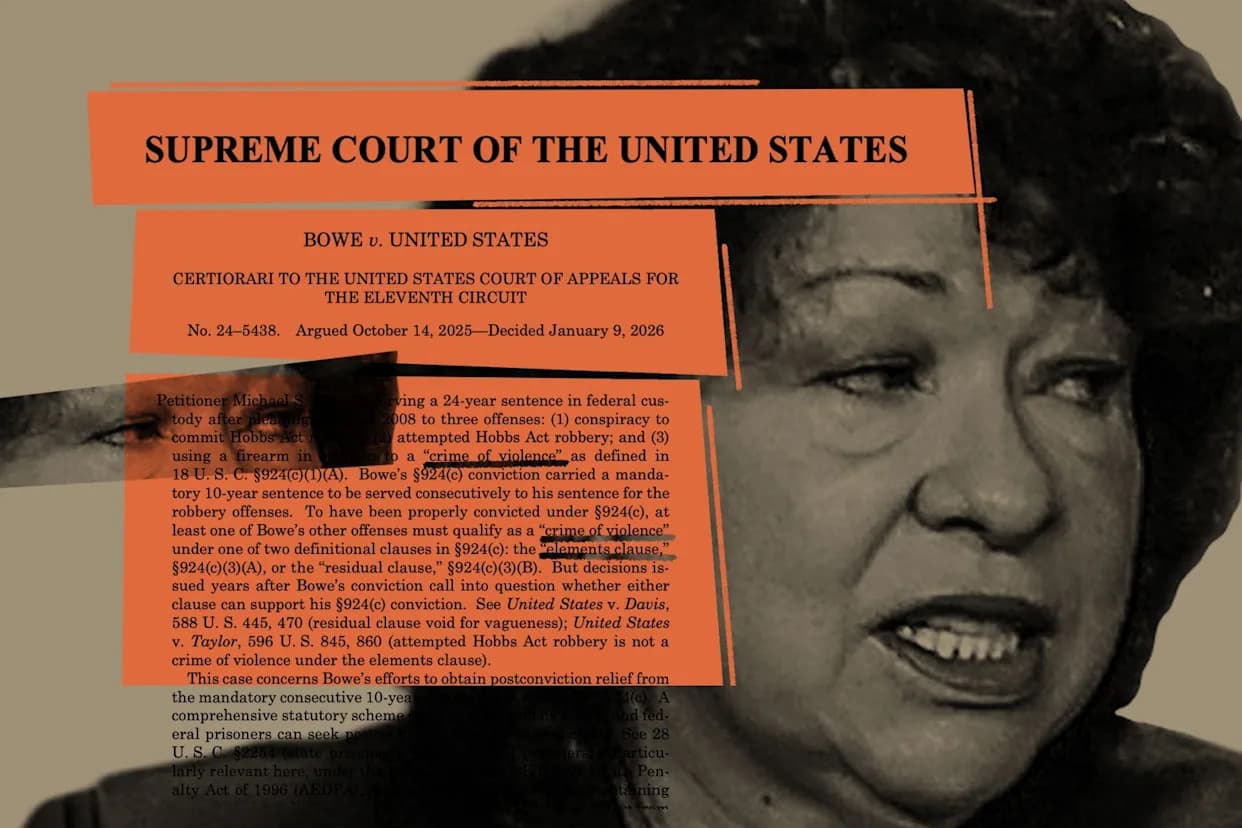
Justice Ketanji Brown Jackson issued a solo dissent condemning the Supreme Court's expanding practice of barring indigent prisoners from filing noncriminal petitions without paying fees. Tracing the trend to Martin v. District of Columbia Court of Appeals (1992), she argued the rule has become routine rather than exceptional. Using Danny Howell's case — six petitions over 14 years — Jackson warned that routine 'Martinization' can deny incarcerated people meaningful access to habeas relief and other challenges.
Justice Jackson Slams Supreme Court's 'Intolerable' Ban On Free Filings For Indigent Prisoners

Justice Ketanji Brown Jackson issued a forceful solo dissent on Tuesday, criticizing the Supreme Court's growing practice of barring indigent prisoners from filing noncriminal petitions unless they pay court fees. She argued that what began as an exceptional measure has become a routine barrier to access to justice.
A Short History: From Martin To Routine Bars
Jackson traced the trend back to the court's expansion of prospective filing bars beginning in 1989 and, most notably, to the 1992 decision in Martin v. District of Columbia Court of Appeals. In Jackson's view, that precedent 'significantly expanded the reach of its filing bar,' allowing courts to deny free filings to indigent litigants in noncriminal matters whom they deemed to have abused the judicial process.
From Extraordinary Remedy To Routine Practice
Jackson warned that the court has steadily broadened Martin, converting an extraordinary remedy into a common restriction. She emphasized the practical costs that prevent meaningful access: a Supreme Court petition typically costs about $300 to file, in addition to the substantially higher expense of printing 40 bound copies.
The Howell Case: An Example
The dissent arose from a brief, unsigned order in the case of Danny Howell, an indigent Indiana inmate serving a 70-year sentence for child molestation and related offenses. The court directed the Clerk not to accept further noncriminal petitions from Howell unless he pays the filing fee, concluding he 'has repeatedly abused this Court's process' and citing Martin as support.

Judge Ketanji Brown Jackson during her confirmation hearing on March 23, 2022 on Capitol Hill.(Anna Moneymaker / Getty Images)
Jackson called Howell's record — six petitions over 14 years, with the last filing eight years ago — 'a prime example' that the court now 'reflexively Martinize[s] petitioners after only a few petitions.' She said Howell's pattern hardly amounts to an inundation of frivolous filings.
Why This Matters To Prisoners
Jackson stressed the unique stakes for incarcerated people: even a prisoner with a meritorious habeas claim or a legitimate challenge to the conditions of confinement can be blocked from seeking review unless able to pay. She described the blanket denial of free filings as 'a questionable restriction as to any litigant who cannot afford to pay a filing fee' and 'an intolerable one as to incarcerated individuals.'
'But if Welch had been Martinized, he would have been unable to seek relief in this Court,' Jackson noted, referring to Welch v. United States (2016), where a petition from an indigent appellant produced a ruling with broad significance for criminal defendants.
Broader Implications And A Call To Keep The Courthouse Open
Jackson's dissent is notable not only for its content but for its solitary nature: no other justice joined her in this opinion. She framed the issue as a fundamental access-to-court problem with systemic consequences, urging colleagues to 'err on the side of keeping our courthouse doors open.' Even when standing alone, Jackson's dissent seeks to highlight the human and institutional costs of routinely denying free filings to indigent litigants.
Implication: If the practice continues to expand, incarcerated and indigent litigants risk losing meaningful avenues for habeas relief and other federal review — potentially shutting the courthouse door on meritorious claims.
Help us improve.