President Trump has renewed efforts to increase U.S. influence over Greenland and threatened 10% tariffs on several European countries starting Feb. 1, rising to 25% by June 1 if no deal is reached. He framed control of Greenland as a strategic necessity to deter China and Russia, though a 1951 U.S.-Denmark agreement already allows an expanded American military presence. Analysts say the episode fits a familiar Trump-era pattern of economic coercion, limited military actions, and unpredictable diplomacy; religious leaders and commentators warn such tactics can erode moral and diplomatic norms.
Trump Pursues Greenland — Threatens Tariffs on European Allies If No Deal
Donroe
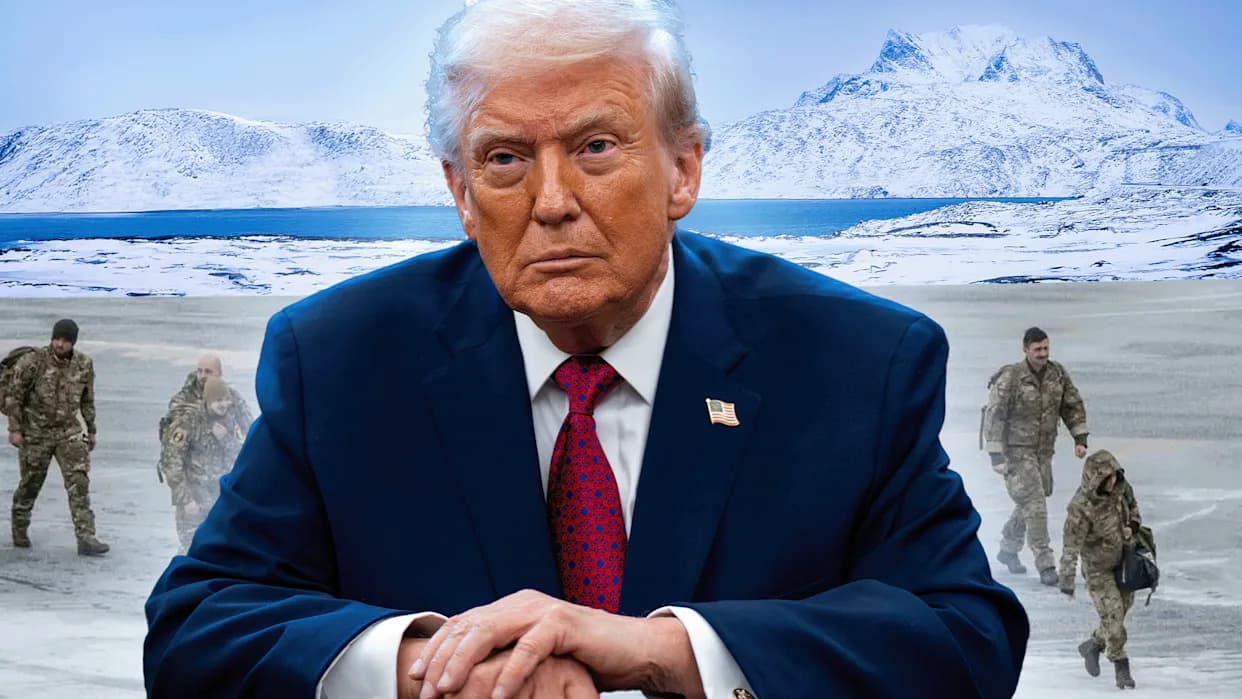
President Donald Trump has renewed pressure to secure influence over Greenland while threatening fresh tariffs on several European countries if they oppose U.S. moves. On Saturday he announced plans for a 10% tariff beginning February 1 on Denmark, Norway, Sweden, France, Germany, Britain, the Netherlands, and Finland, warning the duty could rise to 25% by June 1 if no agreement is reached.
Trump justified the push by arguing the United States must limit Chinese and Russian influence in the Arctic. The New York Times noted, however, that the U.S. already has the right to expand its military presence in Greenland under a 1951 defense agreement with Denmark.
Trump said on social media that he had "a very good telephone call with Mark Rutte" and that he had arranged a meeting of interested parties in Davos, Switzerland. (Mark Rutte is the Prime Minister of the Netherlands.)
How Analysts See It
Commentators have framed the Greenland episode as part of a broader Trump-era foreign-policy pattern. Charles Kupchan of The Atlantic calls Trump "more demolition man than architect," suggesting the president often relies on forceful gestures that are difficult to translate into sustained policy. Eliot Cohen, also in The Atlantic, summarized the pattern: tariffs and economic coercion, brief bombing campaigns, and commando-style raids are the tools most readily deployed — while prolonged ground wars are typically avoided.
"Tariffs and coercive economic measures may avoid bloodshed but still exert pressure on allies and rivals alike," analysts say. "Bluster can produce results, but it can also fracture diplomatic relationships."
Domestic and Cultural Side Notes
Domestically, a federal judge allowed a real-estate investment firm to complete a $451 million purchase of thousands of apartments from a bankrupt landlord — a decision reported as an early legal setback for New York's municipal leadership after promises to protect tenants.
The author also criticized proposals for mandatory national service as likely to become politicized and produce ill-fitting assignments for young people, arguing that youth deserve autonomy rather than being treated as instruments of state policy.
Religious leaders have expressed concern about the growing reliance on force or the threat of force in diplomacy. U.S. Catholic archbishops warned that unilateral coercive tactics risk undermining the moral foundation of American foreign policy and that diplomacy should prioritize dialogue and consensus.
On a lighter cultural note, The New York Times observed that Americans adopting Scandinavian sauna practices often treat them as performance or optimization rituals rather than slow, social experiences; the article's author defended the traditional, convivial approach to sauna culture.
What This Means
The Greenland controversy underscores a recurring tension in contemporary U.S. foreign policy: the appeal of rapid, visible actions that project strength versus the long-term costs to alliances and diplomatic norms. Whether Trump's tariff threat will produce a negotiated outcome, a diplomatic rupture, or a scaled-back policy move remains uncertain.
Originally published at Reason.com.
Help us improve.