The article compiles firsthand accounts from US citizens and lawful permanent residents who say ICE and CBP agents have increased racial profiling during a recent immigration enforcement campaign. Community organizers report targeted patrols in Black and brown neighborhoods, with Somali communities especially affected. Legal experts warn a 2025 Supreme Court decision and record detention targets complicate remedies, while local groups have expanded "know your rights" trainings and rapid-warning systems to protect residents.
‘It’s Like They’re Hunting’: US Citizens and Legal Residents Report Rising Racial Profiling by ICE
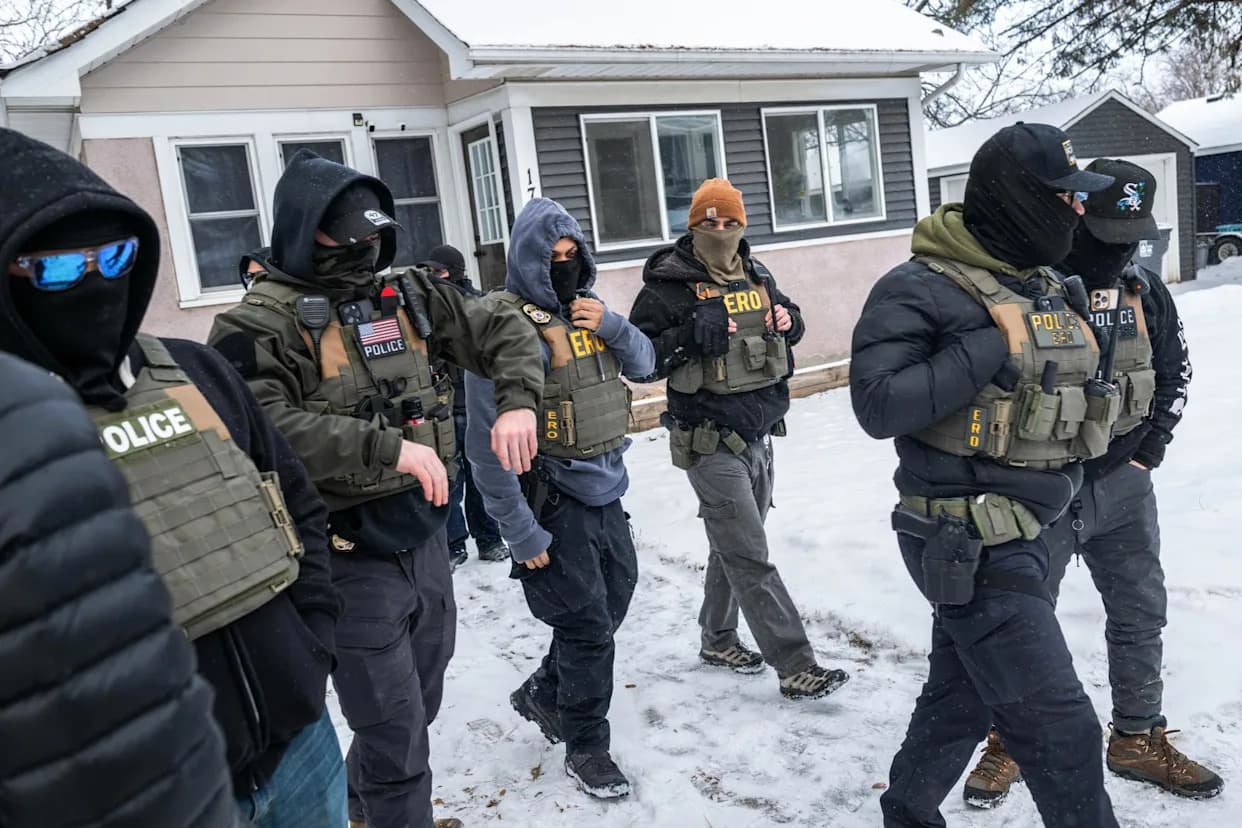
Federal law enforcement agents outside a private residence in St Paul, Minnesota, on 18 January 2026.Photograph: Victor J Blue/Bloomberg via Getty Images(Photograph: Victor J Blue/Bloomberg via Getty Images)
On a routine Tuesday morning in mid-January, Mohamed left his San Diego, California, home to exercise at Colina del Sol park. Four agents from US Immigration and Customs Enforcement (ICE), wearing jackets labeled ICE and balaclavas that concealed their faces, surrounded the middle-aged father and demanded to see his green card before questioning him about why he was in the park. Mohamed, who uses a pseudonym for fear of retaliation, said he was "terrified." He is a lawful permanent resident from Somalia and, although the encounter ended quickly, it left him shaken. "I have high blood pressure," he said through a translator. "I used to exercise every day; now I don't even do that anymore because I'm scared."
Firsthand Accounts
The Guardian spoke with several US citizens and lawful permanent residents who say ICE and US Customs and Border Protection (CBP) agents have increasingly racially profiled people in recent weeks amid an immigration enforcement push under the Trump administration. Those affected described long-lasting fear and behavior changes — from sleeping with passports to avoiding daytime travel — and said they feel they have limited ways to hold agents accountable.
Where and Who Is Being Targeted
Community organizers reported that agents have focused on Black and brown neighborhoods in states including Minnesota, New York, Washington, California and Illinois. Reports say agents have patrolled Home Depot parking lots, mosques, daycares, street vending areas and construction sites. In several cities, organizers and volunteers have distributed whistles, posted volunteers near places of worship and set up information tables to warn and assist community members.
Somali Communities in the Spotlight
Federal enforcement has reportedly concentrated heavily on Somali communities. The administration deployed about 2,000 ICE officers and 800 CBP agents to the Minneapolis area, which has the largest Somali population in the US. Arrests have extended to Maine, where Somali communities that settled there in the early 2000s have also been targeted. Officials additionally announced plans to end the temporary protected status (TPS) designation for Somalis in March, a change that would strip many people of work authorization and protection from deportation.
Legal Context and Detention Levels
Thomas A. Saenz, president and general counsel at the Mexican American Legal Defense and Educational Fund, said the Federal Tort Claims Act is the primary legal route to sue the federal government for harms caused by federal employees. He warned, however, that a recent Supreme Court decision could complicate racial-profiling claims: in September 2025, justices allowed immigration agents in southern California to question anyone they suspected might be present unlawfully and said perceived race or ethnicity can be considered along with other factors.
Detention numbers have climbed to record highs: according to ICE data published by the agency, as of 8 January 2026 ICE held 68,990 people in detention. "Anytime you impose a target for a number of arrests and detention, you're going to encourage the use of unconstitutional shorthands like racial profiling," Saenz said.
Agency Response
The Department of Homeland Security pushed back on allegations of racial profiling. Tricia McLaughlin, a DHS spokesperson, told the Guardian that such claims are "disgusting, reckless and categorically FALSE," saying that immigration status — not skin color, race or ethnicity — guides enforcement. She also emphasized that law enforcement acts on "reasonable suspicion" under the Fourth Amendment and said the Supreme Court has vindicated that approach.
Personal Impacts
Other firsthand accounts show how profiling has affected citizens and residents. In Nebraska, Fernando — a US citizen using only his first name for fear of retaliation — said ICE agents pulled him over, claimed he matched the description of a Hispanic man they sought, interrogated him for an hour, and then threw him to the ground before leaving. The incident left him anxious, and he now avoids daytime travel.
In Tampa, Sara, a US-born woman of Persian descent, said a white SUV shadowed her more than a dozen times over a month in March 2025. She began carrying passports everywhere and even sleeping with them; the episode harmed her mental and physical health. In Maryland, a guardian named Kate began escorting an 11-year-old Guatemalan boy to school because she feared he could be targeted due to his appearance.
Community Response and Preparedness
Nonprofits and local groups across the country have intensified outreach and preparedness efforts. Brighton Park Neighborhood Council in Chicago said it has hosted more than 50 "know your rights" sessions since the beginning of the administration and provided resources outside day-labor sites. In Minneapolis' Cedar-Riverside neighborhood, volunteers blow whistles and station themselves near mosques and Somali-owned businesses to warn residents when agents are nearby. "It's like you're looking for game," said Suleiman Adan of CAIR Minnesota. "It's like you're hunting; who can I prey on today?"
"Right now, it's like 'to hell with the Constitution.' Freedom for whom is really the question." — Suleiman Adan, CAIR Minnesota
Community groups say they continue to document incidents and provide legal and emotional support to affected families, even as many people report difficulty getting a response when they try to file complaints with federal agencies.
Help us improve.