The University of Glasgow team has developed biodegradable printed circuit boards by transferring electroplated zinc tracks onto substrates such as paper, bioplastics and even chocolate. These zinc-based circuits perform comparably to conventional PCBs and have been tested in simple devices like LED counters and temperature sensors. Published in Communications Materials, the work aims to advance circular electronics and help address the ~62 million tonnes of e‑waste discarded in 2024.
Biodegradable Circuit Boards — Even Made From Chocolate — Could Slash E‑Waste
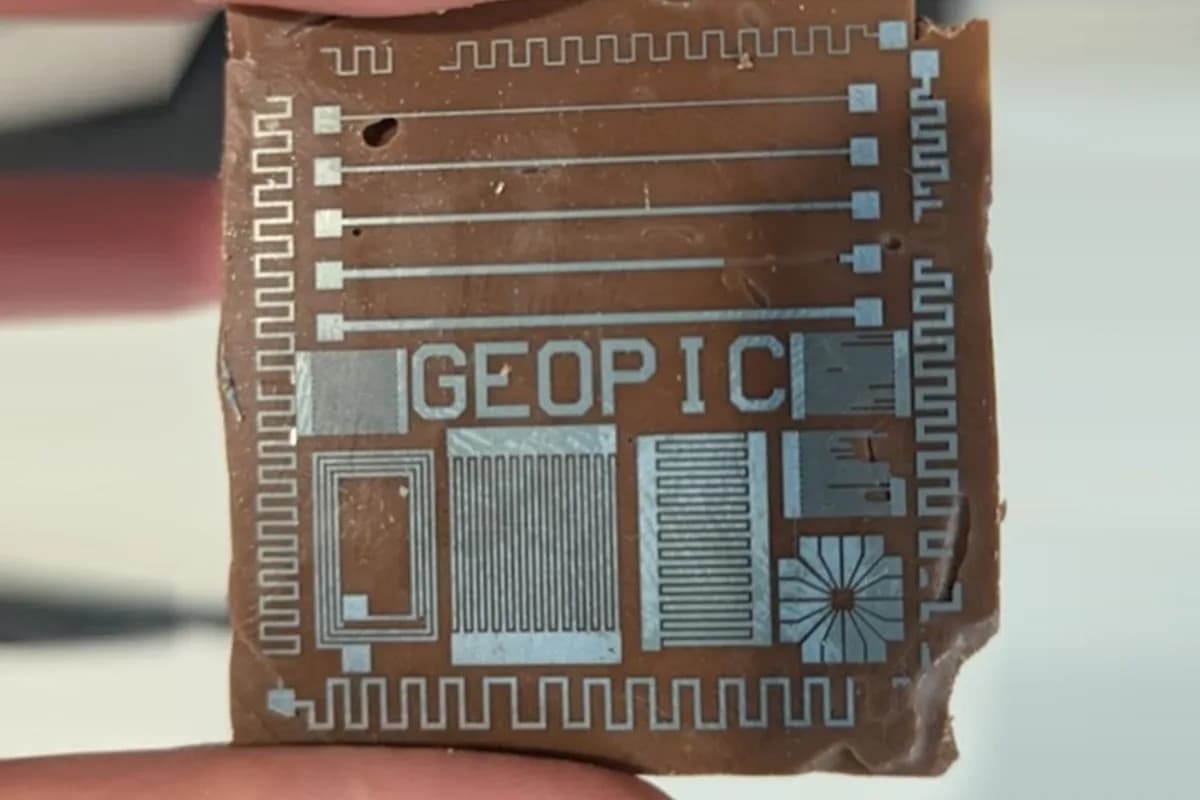
A new way of creating electronic circuit boards can address the tens of millions of tonnes of e-waste generated annually (University of Glasgow)
Engineers at the University of Glasgow have developed a new class of biodegradable printed circuit boards that could help reduce electronic waste. The team demonstrated a method for printing conductive tracks made of zinc onto degradable substrates such as paper, bioplastics — and, for playful demonstrations, chocolate — all of which can break down in ordinary garden compost.
The innovation replaces conventional copper tracks with electroplated zinc and uses a transfer printing process that is compatible with a wide range of substrate materials. According to the researchers, these zinc-based circuits perform comparably to traditional printed circuit boards and have been successfully tested in simple devices such as LED counters and temperature sensors.
How It Works
The process involves electroplating zinc tracks and transferring them onto biodegradable substrates, producing functional conductive paths with a low material and waste footprint. Because zinc is more amenable to safe biodegradation than copper used in conventional PCBs, the approach supports a route toward devices that can be safely composted or more easily recycled.
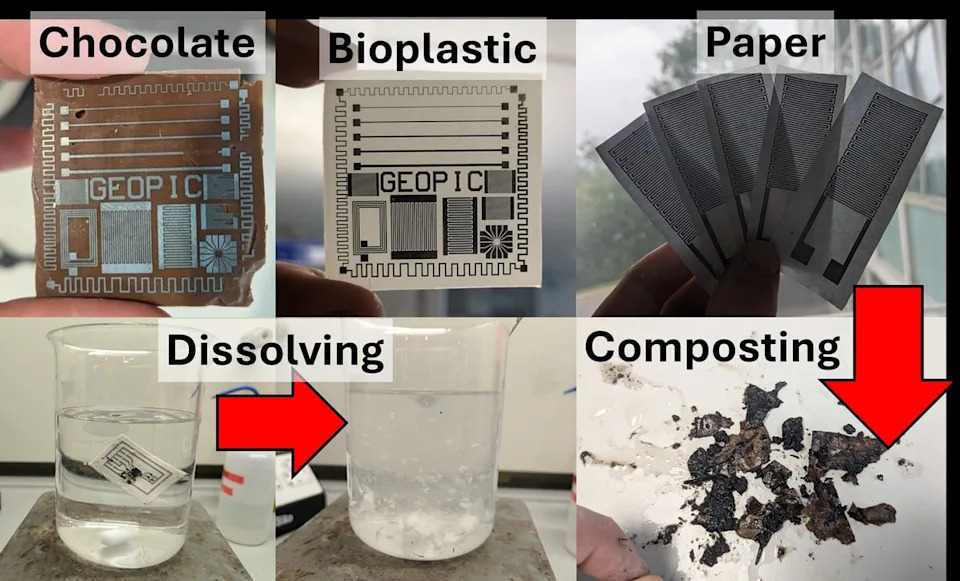
Zinc-based electronic circuit boards can be printed on paper, bioplastics and chocolate (University of Glasgow)
Applications And Impact
Lead researchers Professor Jeff Kettle and Dr Jonathon Harwell from the James Watt School of Engineering say the method’s broad substrate compatibility opens possibilities beyond disposable electronics. The team is exploring uses in mouldable electronics and biosensing, where low-cost, flexible, and environmentally friendlier circuits could be particularly valuable.
"We are now exploring ways to adapt this technique to other fields such as mouldable electronics or biosensing," said Professor Jeff Kettle. "The technique offers a cheap, versatile way to make high-quality circuits with a lower environmental footprint."
The research, published in Communications Materials in a paper titled "Additively manufacturing printed circuit boards with low waste footprint by transferring electroplated zinc tracks," positions the work as a step toward circular electronics — designing devices for reuse, recycling or safe degradation from the start. The United Nations Environment Programme estimated that roughly 62 million tonnes of electronic waste were discarded in 2024, underscoring the scale of the problem this approach aims to address.
Limitations And Next Steps
While promising, the zinc-transfer approach still needs scale-up, long-term reliability testing, and assessment under real-world environmental conditions before widespread adoption. The Glasgow team is continuing work to adapt the technique for different device types and to evaluate lifecycle impacts compared with traditional PCBs.
Help us improve.