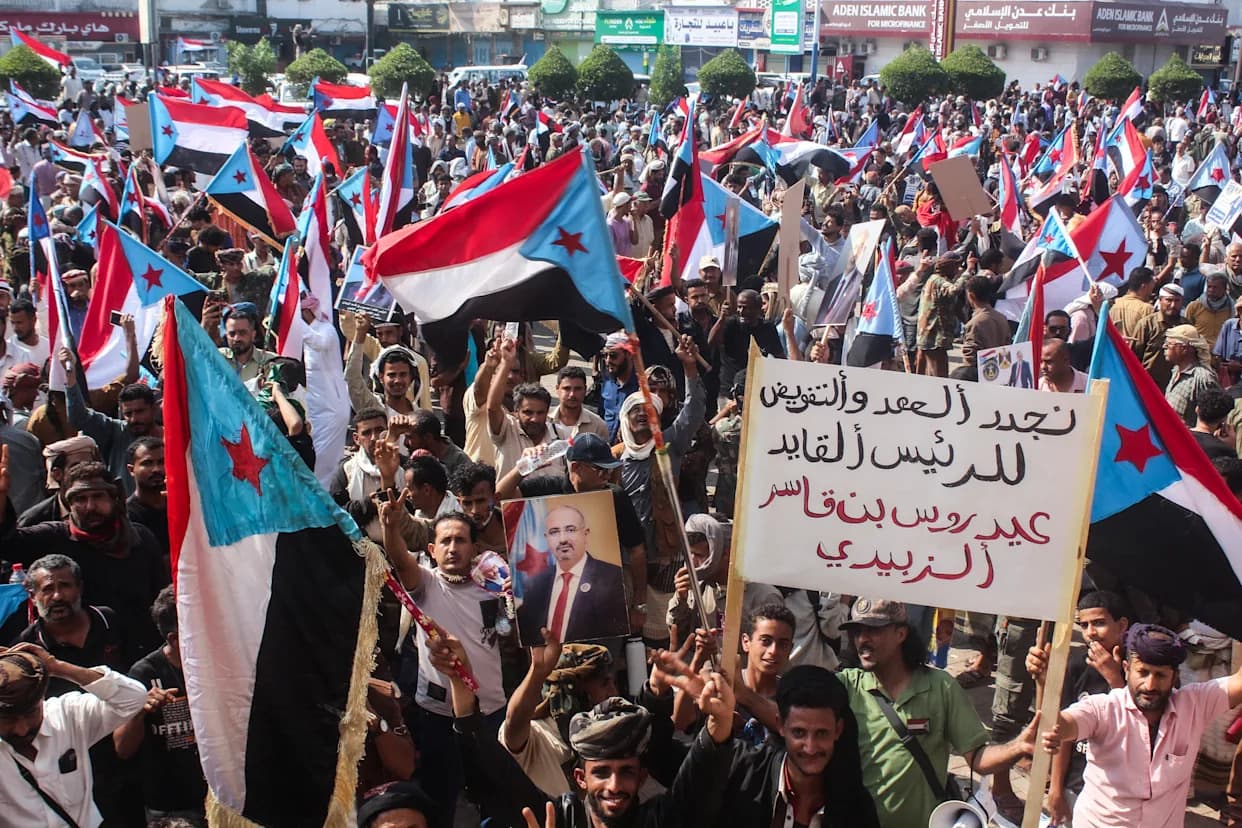
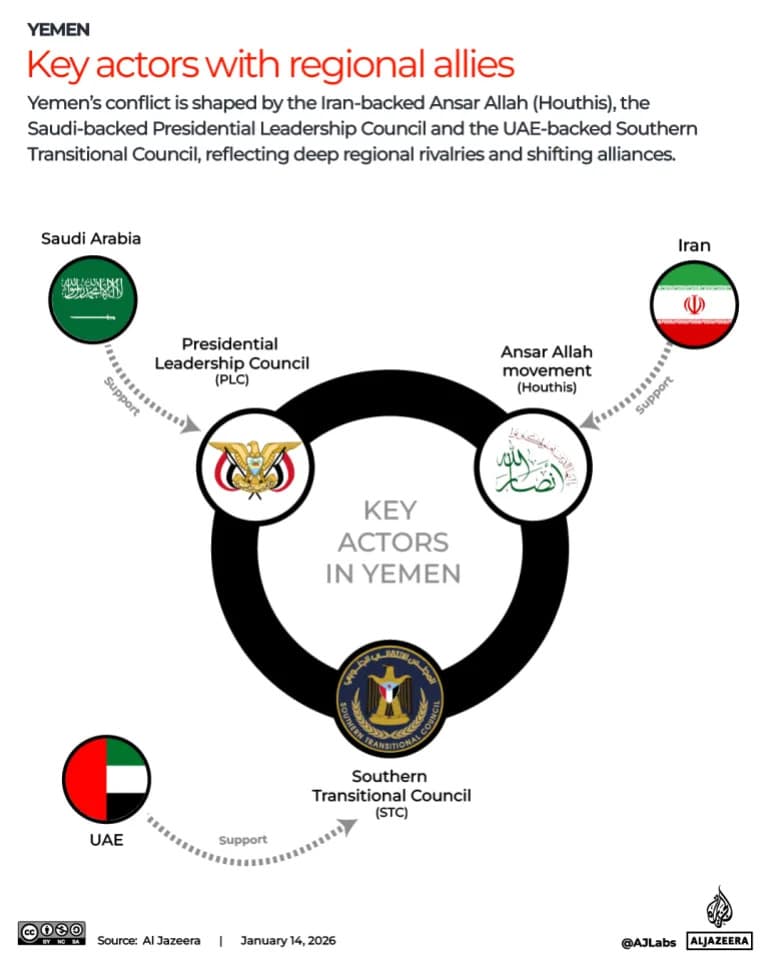
The Southern Transitional Council drew tens of thousands to Aden’s Khor Maksar district to demand an independent southern Yemen and to back leader Aidarous al-Zubaidi despite the council’s recent announcement that it had dissolved. STC advances in Hadhramaut and al-Mahra last month intensified tensions between Riyadh and Abu Dhabi and sparked Saudi-backed counteroperations. The Presidential Leadership Council appointed a new prime minister amid the upheaval. U.N. officials warn more than 18 million Yemenis face acute food insecurity next month, with nearly half of children under five acutely malnourished.
Tens of Thousands Rally in Aden Demanding Independent South Yemen as Tensions Escalate
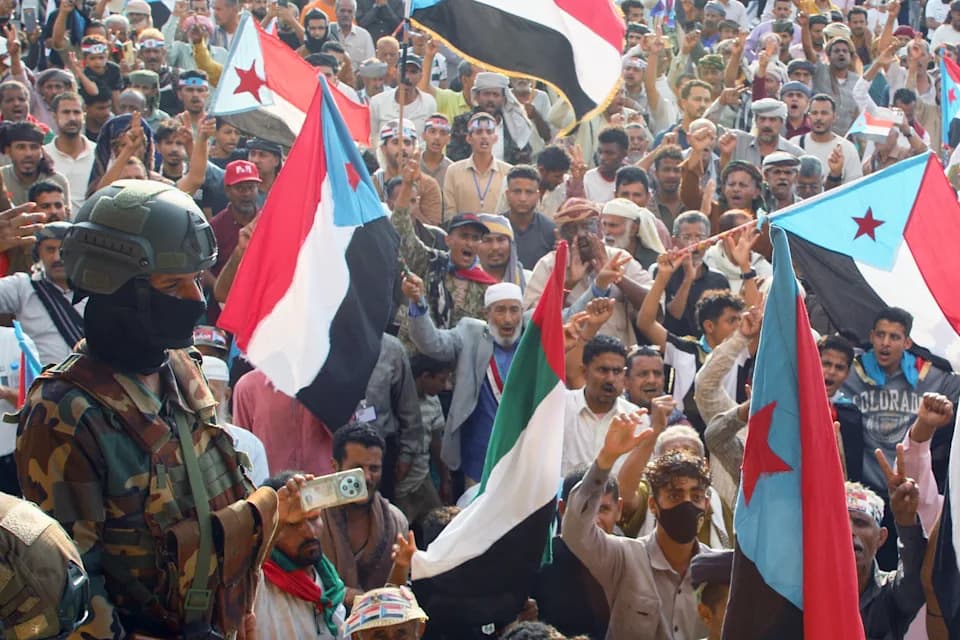
Supporters of the Southern Transitional Council (STC), a coalition of separatist groups seeking to restore the state of South Yemen, hold South Yemen flags during a rally, in Aden, Yemen, Friday, Jan. 2, 2026. (AP Photo)(ASSOCIATED PRESS)
ADEN, Yemen — Tens of thousands of demonstrators gathered Friday in Aden’s Khor Maksar district to demand the restoration of an independent southern Yemen and to show support for the Emirati-backed Southern Transitional Council (STC), even after the movement announced it had dissolved just over a week earlier.
What Happened
Supporters assembled near Aden’s international airport, chanting slogans in favor of STC leader Aidarous al-Zubaidi and denouncing perceived northern domination. STC-aligned AIC satellite footage showed large crowds waving the former South Yemen flag (used from 1967 to 1990) and carrying posters of al-Zubaidi, whom STC media say traveled to the United Arab Emirates earlier this month.
Roots of the Separatist Drive
The STC, founded in 2017, brings together groups seeking to re-establish southern Yemen as an independent state. Its constituency draws on long-standing grievances among southerners who feel marginalized in a unified Yemen. The council has received financial and military backing from the UAE and in 2022 joined a Saudi-led coalition against the Iran-aligned Houthi movement.
Recent Military Moves and Political Fallout
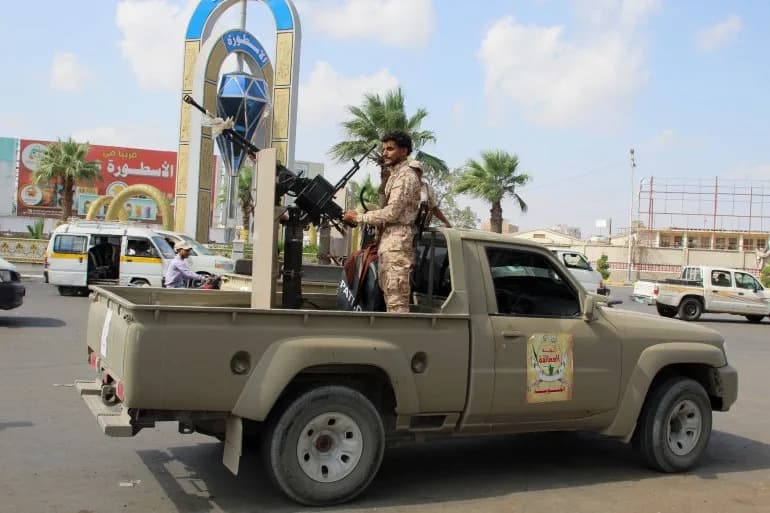
In December the STC launched advances into parts of Hadhramaut and al-Mahra governorates, displacing Saudi-aligned National Shield Forces and exposing tensions between Riyadh and Abu Dhabi. Saudi-backed forces later reasserted control over key sites — including the presidential palace in Aden, parts of Hadhramaut and military camps in al-Mahra — following airstrikes. The STC subsequently announced it would dissolve, a decision contested by some members.
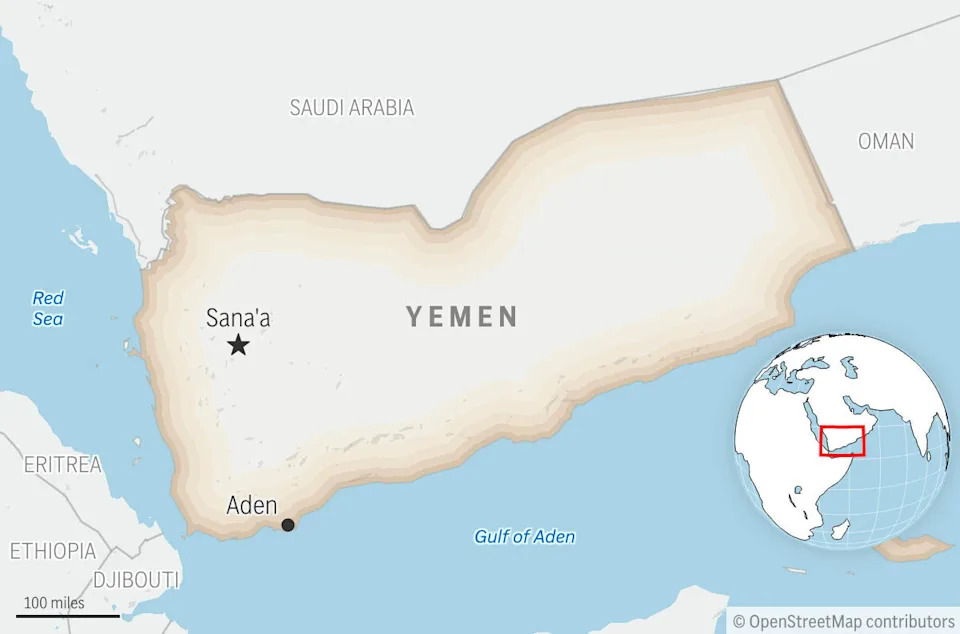
This is a locator map for Yemen with its capital, Sanaa. (AP Photo)(ASSOCIATED PRESS)
In a separate development, the Saudi-backed Presidential Leadership Council accepted Prime Minister Salem bin Breik’s resignation and appointed Foreign Minister Shae’a al-Zandani to form a new cabinet. PLC Vice President Abdullah al-Alimi said the change aims to "normalize the situation and strengthen the institutional structure of the state." Riyadh has signaled plans to convene a conference with influential southern figures, with a date yet to be set.
Humanitarian Crisis Deepens
U.N. aid coordinator Ramesh Rajasingham warned the U.N. Security Council that Yemen’s humanitarian crisis is worsening: more than 18 million people — roughly half the population — are expected to face acute food insecurity next month, with tens of thousands at catastrophic risk. He highlighted funding shortfalls and access challenges, particularly in Houthi-controlled areas, and said women and girls are among the hardest hit. Nearly half of Yemeni children under five are acutely malnourished, officials warn.
Why It Matters
The southern separatist movement is one element of Yemen’s multifaceted conflict, which began in 2014 when Houthi forces seized the capital, Sanaa. The crisis involves local grievances, tribal dynamics and regional rivalries that complicate prospects for a stable, unified government and hinder aid delivery to millions in need.
Voices from the protests: “Our state is coming, no matter the challenges,” said demonstrator Marwan al-Dahli. Protesters argue that southern control of local resources, including oil and gas, would improve living conditions.
Reporting contributions came from Cairo and the United Nations.
Help us improve.