Michaela Benthaus, a 33-year-old aerospace engineer from Munich, became the first wheelchair user to cross the Kármán Line aboard Blue Origin’s New Shepard during a roughly 10-minute suborbital flight. Her achievement followed a 2018 spinal cord injury and years of rehabilitation, training and technical problem-solving. Engineers adapted emergency and in-capsule procedures to ensure her safety, and Benthaus hopes the mission will broaden expectations and encourage inclusion across aerospace and other high-barrier fields.
First Wheelchair User Reaches Space: Michaela Benthaus’s Breakthrough Flight on Blue Origin
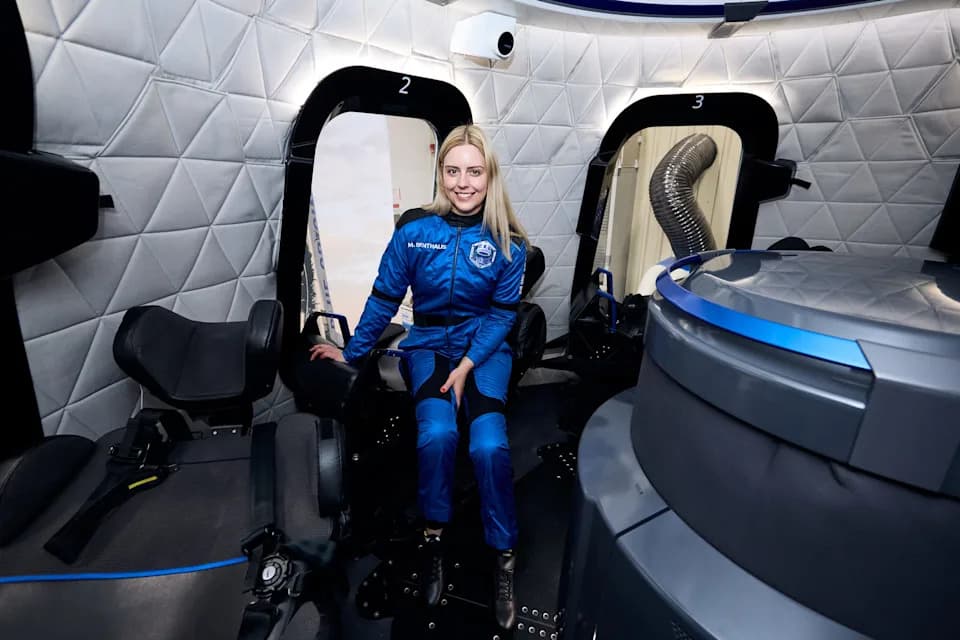
Michaela “Michi” Benthaus trains inside the Blue Origin New Shepard capsule ahead of her historic flight, which made her the first wheelchair user to travel into space.
Sixty-two miles above Earth, the dense cloud layer that had followed Michaela Benthaus fell away to reveal the blackness of space. The 33-year-old aerospace engineer from Munich had just become the first wheelchair user to cross the Kármán Line aboard a Blue Origin New Shepard capsule launched from Texas.
The suborbital flight lasted roughly 10 minutes, but for Benthaus the minutes felt both swift and profound. “I wanted to look at my crewmates, at what they are doing, how they are feeling. I wanted to see everything. I wanted to see the super black sky,” she told reporters in a recent video call with The Record and NorthJersey.com. “I wanted to see the atmosphere, which parts of the Earth I can see. It was just overwhelming, honestly.”
From Injury to Innovation
Benthaus’s journey to space followed a spinal cord injury sustained in a 2018 mountain-biking accident in the Czech Republic. She spent eight months in hospital care—immobilized and in pain for the first two months—before learning to use a wheelchair. While she initially hoped surgery might restore mobility, she ultimately adapted to a new life and refocused on her training and career in aerospace engineering.
“I struggled a lot with coming home because suddenly I was the only one with a disability,” she said. “I realized pretty quickly how many barriers we have and how much harder it is to move around.” Re-engaging with her studies and professional goals gave her renewed purpose and a daily rhythm that helped fuel her comeback.
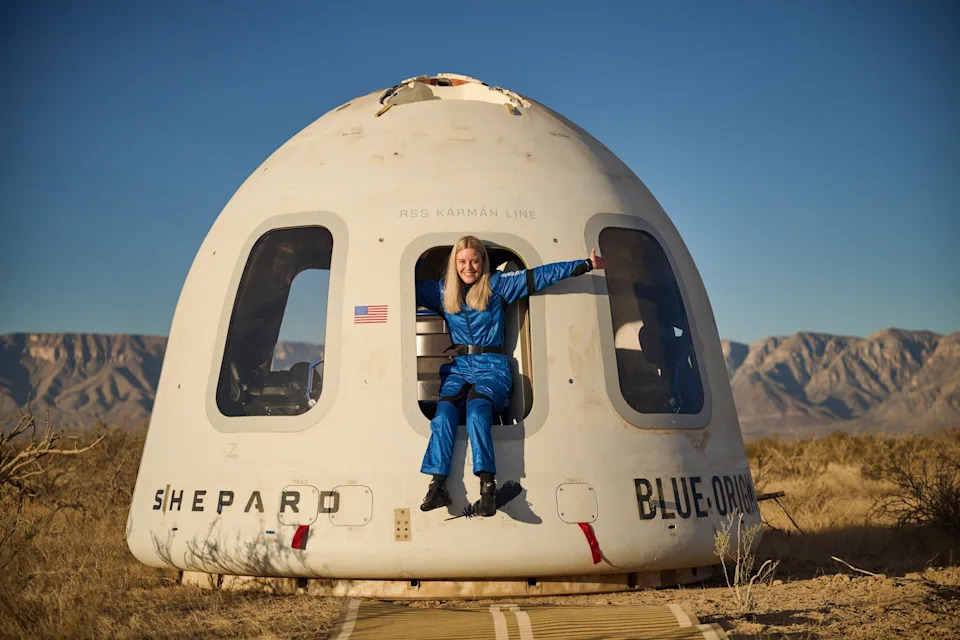
Benthaus deboarded the Blue Origin capsule after it successfully landed on Dec. 20.
Deliberate Preparation and Technical Problem-Solving
Benthaus pursued practical, hands-on preparation: parabolic flights that simulate microgravity, an analog space mission in Poland to study isolation, and extensive training with engineers. She asked practical, mission‑critical questions: Which accessibility barriers could be removed? Which safety challenges—especially emergency evacuation—would require new procedures?
She connected with former SpaceX executive Hans Koenigsmann on LinkedIn, a connection that helped introduce her to Blue Origin. Around the same time she secured a position at the European Space Agency—achieving two longtime goals that framed her path to the flight.
“The most critical thing is always emergency procedures, because if you’re sitting on a fueled rocket, if there’s an emergency, you want to get away fast. I cannot just run out of the capsule,” Benthaus explained.
Engineers and trainers developed step-by-step evacuation scenarios and practiced in-capsule mobility during weightlessness until procedures were safe and repeatable. Benthaus—trained as an engineer—said she relished the methodical problem-solving in the process.
The Flight And Its Wider Meaning
When launch day arrived at Blue Origin’s West Texas facility—after an earlier scrub that became an unplanned rehearsal—Benthaus described feeling calm. The rocket’s ascent built gradually; minutes later, weightlessness returned and the view of Earth shifted from familiar to extraordinary.
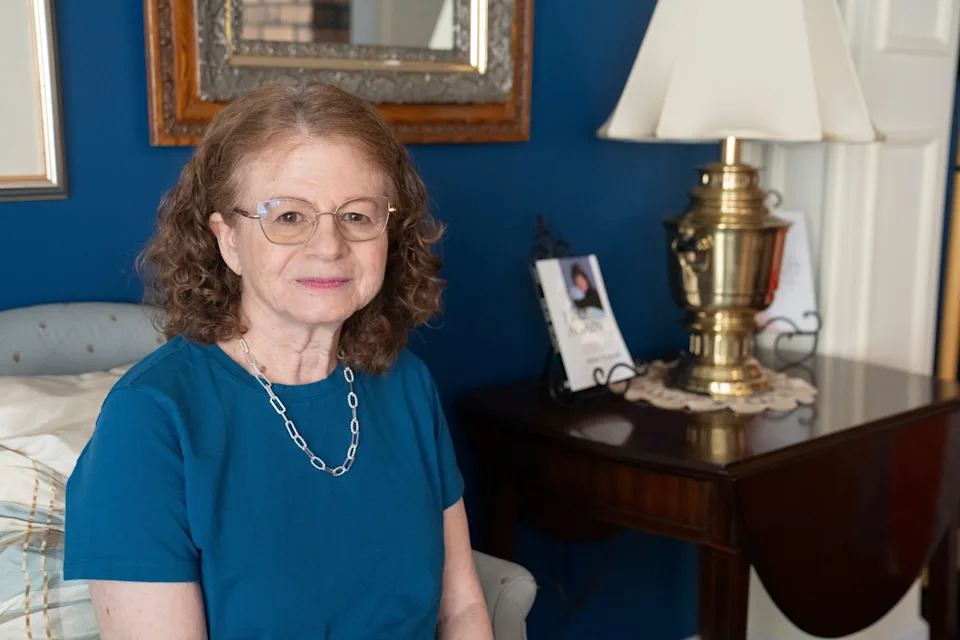
Disability advocate Arelene Romoff, former president of the Hearing Loss Association of New Jersey, said seeing barriers challenged can help others imagine more for themselves.
Beyond personal achievement, Benthaus sees the mission as a challenge to assumptions about who belongs in high‑risk, high‑barrier professions. People with disabilities often develop adaptive thinking and resilience when navigating environments that were not designed with them in mind. That mindset, she says, can be an asset in aerospace and elsewhere.
“If we want to be an inclusive society,” she said, “we should be inclusive in every part of life. Space is one part of life.” Advocates in New Jersey and beyond note that visible milestones like this one can expand what children and adults with disabilities imagine possible.
What’s Next
Benthaus is writing a book about her experiences, scheduled for release in October, and is using the attention from her flight to support spinal cord injury research and public efforts to improve accessibility. Her message to those who watched her journey is simple: aspirations that others dismissed as unrealistic can be achieved with perseverance, ingenuity and inclusive engineering.
“Every time I told people before that I wanted to go to space, nobody took it seriously and now everybody is like, ‘oh, wow, you actually did it,’” she said.
Help us improve.