Islamist groups in Bangladesh, led by Jamaat-e-Islami, are mobilising ahead of the February 12 parliamentary vote after years of bans and repression. The party has formed strategic alliances, fielded only male candidates and taken symbolic outreach steps that analysts call tactical. The resurgence follows the 2024 uprising and the release of jailed Islamist leaders, and has heightened tensions with Sufi communities and religious minorities. Observers will watch whether these movements can convert mobilization into political power.
Bangladesh's Islamist Forces Surge Ahead Of Feb. 12 Vote — Jamaat-e-Islami Leads The Push
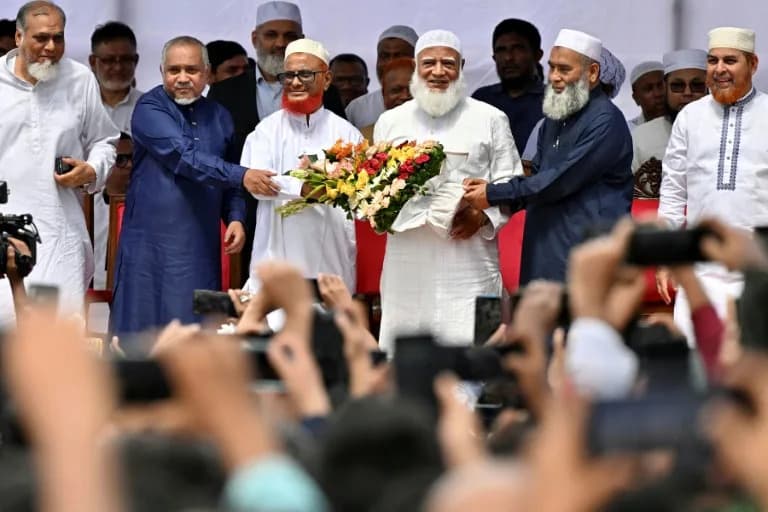
Bangladesh's Jamaat-e-Islami party leader Ameer Shafiqur Rahman (centre R) presents a floral wreath to leader A.T.M. Azharul Islam (centre L) after his release from prison in Dhaka on May 28, 2025 (Munir UZ ZAMAN)(Munir UZ ZAMAN/AFP/AFP)
After years of bans and crackdowns, Islamist groups in Bangladesh are mobilising ahead of parliamentary elections scheduled for February 12, positioning themselves to regain influence in a changed political landscape.
The South Asian nation — home to roughly 170 million people, most of them Sunni Muslims — is preparing for its first national vote since the mass uprising that toppled the government of Sheikh Hasina in 2024. At the centre of the mobilisation is Jamaat-e-Islami, the country’s largest and best-organised Islamist party.
Jamaat's Return And Strategic Alliances
Ideologically close to the Muslim Brotherhood, Jamaat-e-Islami is seeking re-entry into formal politics after years of legal bans and heavy repression. It has patched over divisions with several Islamist factions for the ballot, fielding only male candidates and forming an alliance with the student-led National Citizen Party (NCP) — a move that prompted some prospective female candidates to withdraw.
Tightened Ties And Symbolic Outreach
The party has even nominated a Hindu candidate, a step analysts say could be tactical rather than a sign of deep reform. Political analyst Altaf Parvez warned that such gestures may be intended to broaden appeal:
"These efforts are to deceive the public. The reform is not coming from within."
Troubled Recent History
Under Sheikh Hasina’s 15-year rule, the government took a hard line on Islamist movements: senior Islamist figures were convicted of war crimes tied to support for Pakistan during Bangladesh’s 1971 independence war, and several were executed. Hasina also presided over sustained operations against militant groups, arresting hundreds and killing scores.
Extremist attacks have scarred the country since 2013. The 2016 assault on a Dhaka café killed 22 people, including 17 foreigners. Mufti Abdul Hannan, leader of a Bangladesh branch of Harkat-ul-Jihad, was executed in 2017 for a plot to assassinate Britain’s High Commissioner.
Resurgence And Social Tensions
Since Hasina fled to India and the subsequent release of key Islamist figures, these groups have grown more assertive in public life. They have pushed to restrict cultural activities they deem "anti-Islamic," including music and theatre festivals, women's football matches and traditional kite-flying. More extreme actors have attacked Sufi shrines; in one reported incident, a Sufi leader’s exhumed body was desecrated.
Many activists draw on Deobandi teachings — a conservative Sunni tradition — while others adhere to Wahhabi and Salafi currents. Hefazat-e-Islam, a coalition representing thousands of madrasas and religious organisations, operates as a major grassroots pressure group. Its leaders travelled to Afghanistan last year and received visits from Afghan Taliban officials in December, underscoring growing regional ties.
Sufi Influence And Religious Diversity
Bangladesh hosts the world’s fourth-largest Muslim population and a wide spectrum of religious practice. Sufism remains influential — more than a quarter of Muslims are estimated to follow Sufi traditions by the Pew Research Center — and Sufi popularity presents a political and cultural challenge to rigid Islamist groups that denounce mystical practices as heretical.
The country also includes Ahmadiyya and Shia communities, and around 10% of the population are non-Muslims, mostly Hindus and a small number of Christians. These demographic realities shape how Islamist parties position themselves ahead of the vote.
What To Watch
Observers will be watching whether the Islamist surge translates into meaningful parliamentary seats, whether parties broaden their appeal beyond conservative constituencies, and how tensions with Sufi communities and religious minorities evolve in the coming weeks.
Help us improve.