
Tarique Rahman returned to Dhaka after nearly 17 years in exile and addressed tens of thousands of supporters, promising a plan for stability and safety. His arrival comes amid recent violence and ahead of the February 2026 national election, and analysts say it could calm tensions and energise the BNP. Key factors now include whether Rahman can present clear policies on extremism and governance and how he positions relations with India. His ability to translate momentum into a credible electoral strategy will shape Bangladesh’s near-term political trajectory.
Tarique Rahman’s Return Could Reshape Bangladesh Ahead Of The 2026 Election

Supporters of Bangladesh Nationalist Party (BNP) acting chairman Tarique Rahman shout slogans following his arrival at Hazrat Shahjalal International Airport in Dhaka after more than 17 years of self-imposed exile in London, on Thursday, December 25, 2025 [Mahmud Hossain Opu/AP Photo]
Dhaka — Tarique Rahman, acting chairman of the Bangladesh Nationalist Party (BNP), returned to Dhaka after nearly 17 years in exile and addressed tens of thousands of supporters at a large rally on the city’s outskirts. He framed his comeback around a promise of stability and a “plan for the people and for the country,” calling for peace and security across Bangladesh’s diverse communities.
Why His Return Matters
Rahman’s arrival comes amid heightened political tension following the assassination of youth leader Osman Hadi, episodes of violent unrest and a national election scheduled for February 2026. The BNP has long been viewed as a leading contender in opinion polls, and Rahman is widely seen as a central figure in the party’s bid to win power.
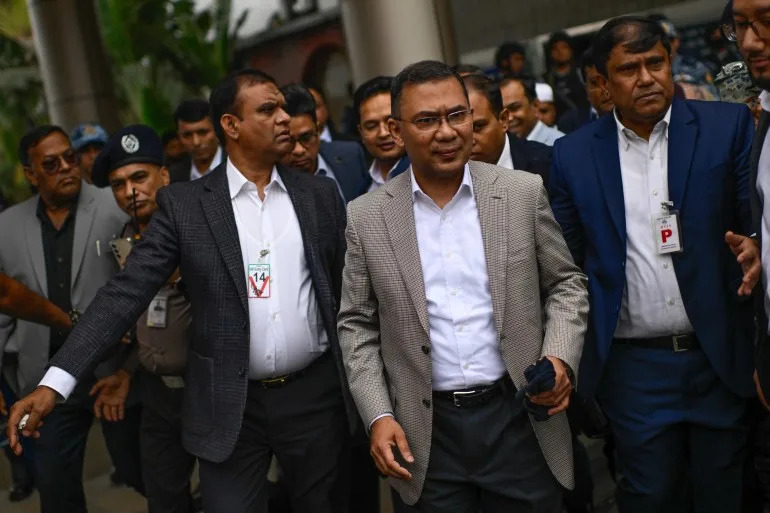
Bangladesh Nationalist Party (BNP) acting chairman, Tarique Rahman, centre, arrives at Hazrat Shahjalal International Airport in Dhaka, on Thursday, December 25, 2025 [Mahmud Hossain Opu/AP Photo]
Public Reaction and Political Momentum
Tens of thousands turned out to greet Rahman, a display analysts say underscores the BNP’s organisational strength and the potential to attract support beyond its traditional base. “His arrival has opened a new window of opportunity,” said Asif Mohammad Shahan, professor of development studies at the University of Dhaka, adding that Rahman’s return may reduce uncertainty and create a sense of stability.
“We want peace. We have people from the hills and the plains in this country — Muslims, Hindus, Buddhists and Christians. We want to build a safe Bangladesh, where every woman, man and child can leave home safely and return safely,” Rahman told supporters.
Legal Background and Party Repositioning
Rahman spent years abroad after being charged and later convicted in several cases while the Awami League was in power. In the past 12–18 months many of those convictions were stayed or dropped, clearing the way for his return. Observers note the BNP has also severed ties with Jamaat-e-Islami and sought to reposition itself toward the political centre — moves that could broaden its appeal.
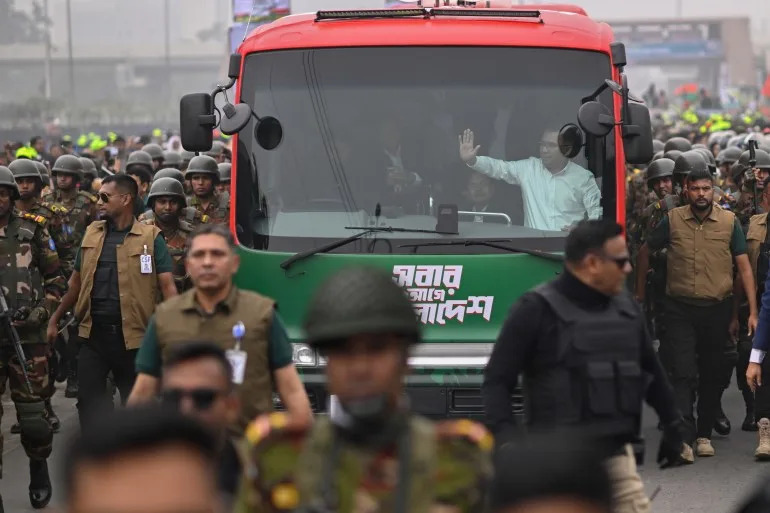
Tarique Rahman waves to supporters from a bus in Dhaka after returning from London on Thursday, December 25, 2025 [Mahmud Hossain Opu/AP Photo]
Risks and Expectations
Despite the warm reception, analysts caution that the rally alone does not guarantee electoral success. Experts say Rahman must articulate clear policies on governance, tackle extremism decisively and show he can run an effective, disciplined party. Mubashar Hasan of Western Sydney University and columnist Shafquat Rabbee both highlighted Rahman’s reputation as a policy-focused politician — a trait that could work in his favour if he follows through on concrete proposals.
Regional Implications
Rahman’s stance on India will be watched closely across South Asia. Historically, New Delhi has often favoured Sheikh Hasina’s Awami League over the BNP, and the BNP’s previous association with Jamaat-e-Islami complicated ties. Analysts say a more centrist, pragmatic BNP under Rahman is less likely to adopt an aggressively anti-Indian posture and could be seen by India as a negotiable political partner.
What Comes Next
With the February 2026 election approaching, the key questions are whether Rahman can translate public enthusiasm into broader electoral gains and whether he will reassure voters about law and order, democratic transition and governance. If he succeeds, some analysts predict a strong BNP performance; if he fails to deliver a clear, credible platform, political uncertainty could deepen.
Key names quoted: Asif Mohammad Shahan (University of Dhaka), Mubashar Hasan (HADRI, Western Sydney University), Shafquat Rabbee (geopolitical columnist).


