Newly released footage from National Geographic's Pole to Pole with Will Smith shows researchers and Waorani guides encountering a giant green anaconda during 2022 fieldwork in Ecuador. Genetic analysis of collected scales revealed two distinct green anaconda species: the known Eunectes murinus and the newly described northern Eunectes akayima, which diverged about 10 million years ago. Researchers also found male northern anacondas carry cadmium and lead levels more than 1,000% higher than females, prompting food-safety guidance for local communities.
Never-Before-Seen Footage Shows Giant Anaconda Discovery in Ecuador — Genetics Reveal New Species
Credit: National Geographic
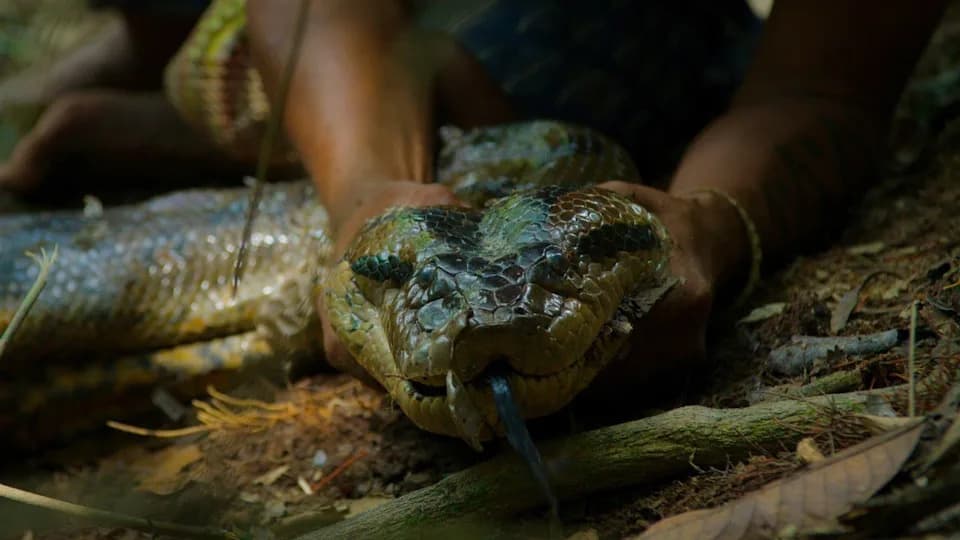
Filmmakers have released never-before-seen footage of the tense moment researchers encountered a giant anaconda during 2022 fieldwork in the Baihuaeri Waorani Territory of the Ecuadorian Amazon. The encounter appears in an episode of National Geographic's upcoming series Pole to Pole with Will Smith.
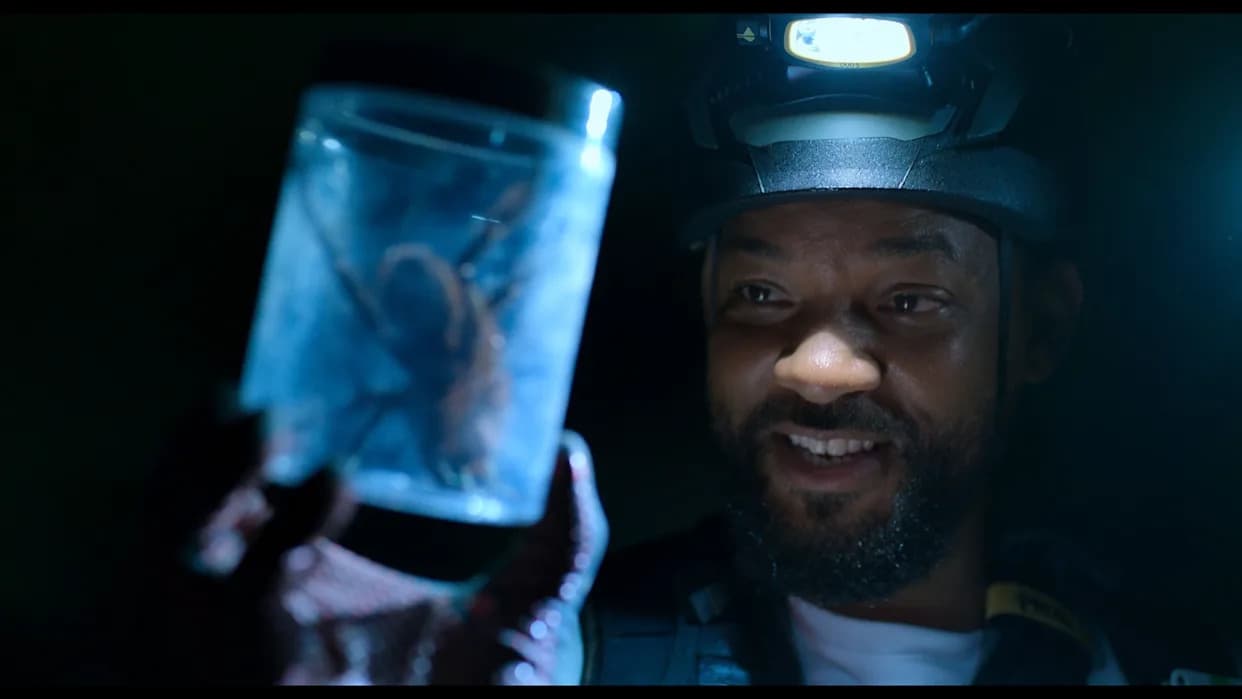
In the footage, venom researcher Bryan Fry and actor Will Smith travel by boat with Indigenous Waorani guides along a murky riverbank. The team locates an enormous green anaconda in a small clearing; the Waorani guides immobilize the animal so Fry and Smith can safely collect a small scale sample for genetic analysis.
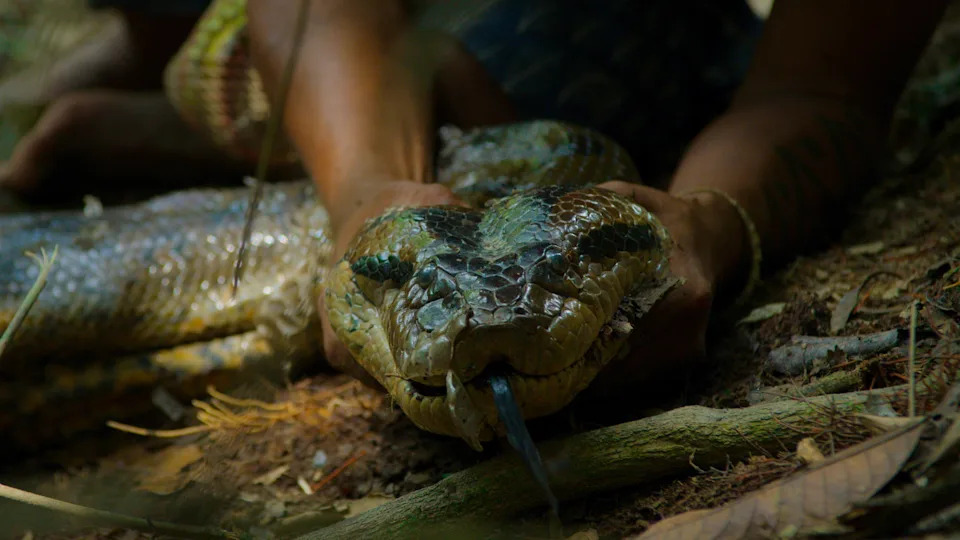
The Waorani capture an anaconda in Bameno, Ecuador. | Credit: National Geographic
Fry, a professor of toxicology at The University of Queensland, estimates the captured snake to be a female about 16–17 feet long (4.9–5.2 m). One guide warns that the animal could still bite while being restrained — a reminder that, although green anacondas are nonvenomous, they are powerful constrictors that subdue prey by coiling and suffocating it.
Genetics Reveal a Second Green Anaconda Species
Analysis of scale samples collected in 2022 showed that what was long treated as a single species of green anaconda actually comprises two distinct species: the southern green anaconda, Eunectes murinus, and a newly described northern green anaconda, Eunectes akayima.
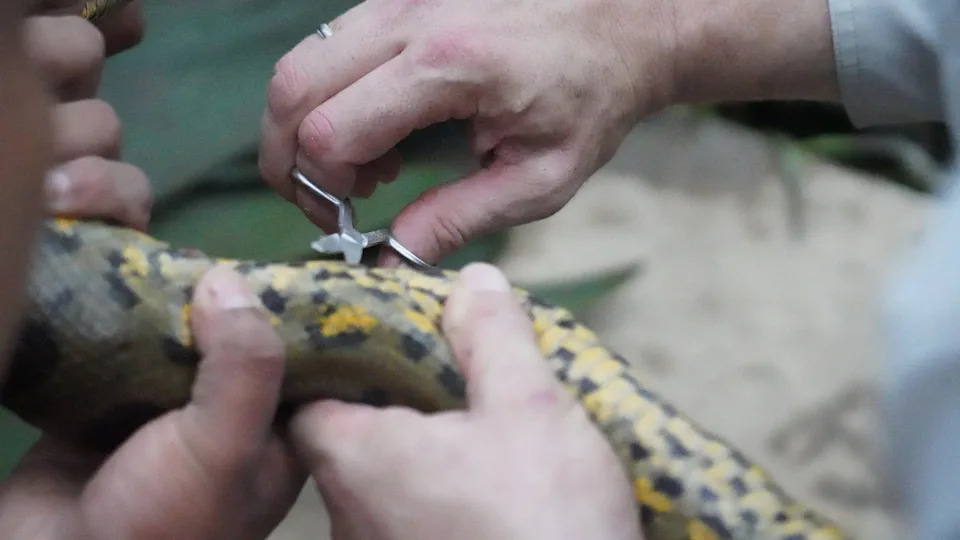
Professor Bryan Fry and Marcelo Tepeña Baihua take a sample from a male green anaconda, later revealed to be a new speciesEunectes akayima. | Credit: National Geographic/Tom Barbor-Might
Genetic data indicate the two lineages diverged roughly 10 million years ago and now differ by about 5.5% of their genomes — a substantial split compared with the ~2% difference typically cited between humans and apes.
Range, Size and Behavior
The northern green anaconda inhabits the Amazon's northern basin — including parts of Ecuador, Colombia, Venezuela, Trinidad, Guyana, Suriname and French Guiana — while the southern green anaconda occupies the southern basin across much of Brazil and into Peru and Bolivia. Both species prefer wetlands and rivers and spend much of their lives semi-submerged, relying on olive-green camouflage to ambush large prey such as capybaras, caimans and deer.
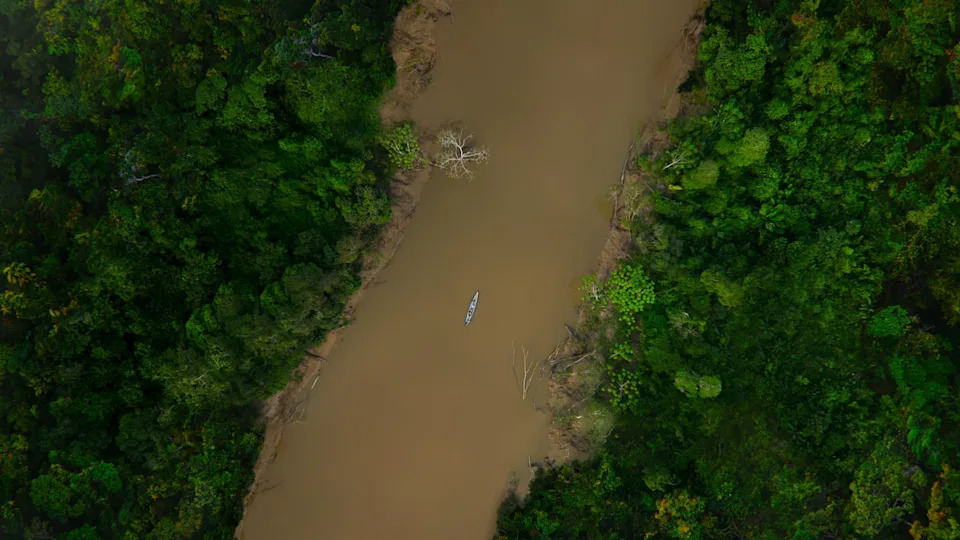
Led by Indigenous guides, Will Smith and Bryan Fry traveled by boat through the Ecuadorian Amazon. | Credit: National Geographic/Kyle Christy
Green anacondas are among the world’s heaviest snakes, with some individuals exceeding 550 lb (250 kg) and more than 12 in (30 cm) in girth. Females generally grow much larger than males, and that sexual size difference drives differences in prey choice and ecological role.
Conservation And Public-Health Implications
Fry's team found that male northern green anacondas eat more predatory fish and caimans, while females prey lower on the food chain. As a result, males bioaccumulate higher levels of environmental contaminants. In the study samples, concentrations of cadmium and lead — pollutants commonly associated with oil contamination — were more than 1,000% higher in males than in females. "That is not a subtle difference. That is a warning flare," Fry says.
Because the diets of male anacondas resemble those of some local humans who consume large predatory fish, contaminant levels in these snakes can serve as indicators of human exposure. In response, Fry is developing a wild-food guidance document for the Waorani, recommending that pregnant women and young children avoid consuming top predators such as arapaima and arowana.
The footage highlights both a dramatic wildlife encounter and the value of careful genetic research and indigenous collaboration in revealing biodiversity and environmental risks. Pole to Pole with Will Smith premieres Jan. 13 on National Geographic and Jan. 14 on Disney+ and Hulu.
Help us improve.